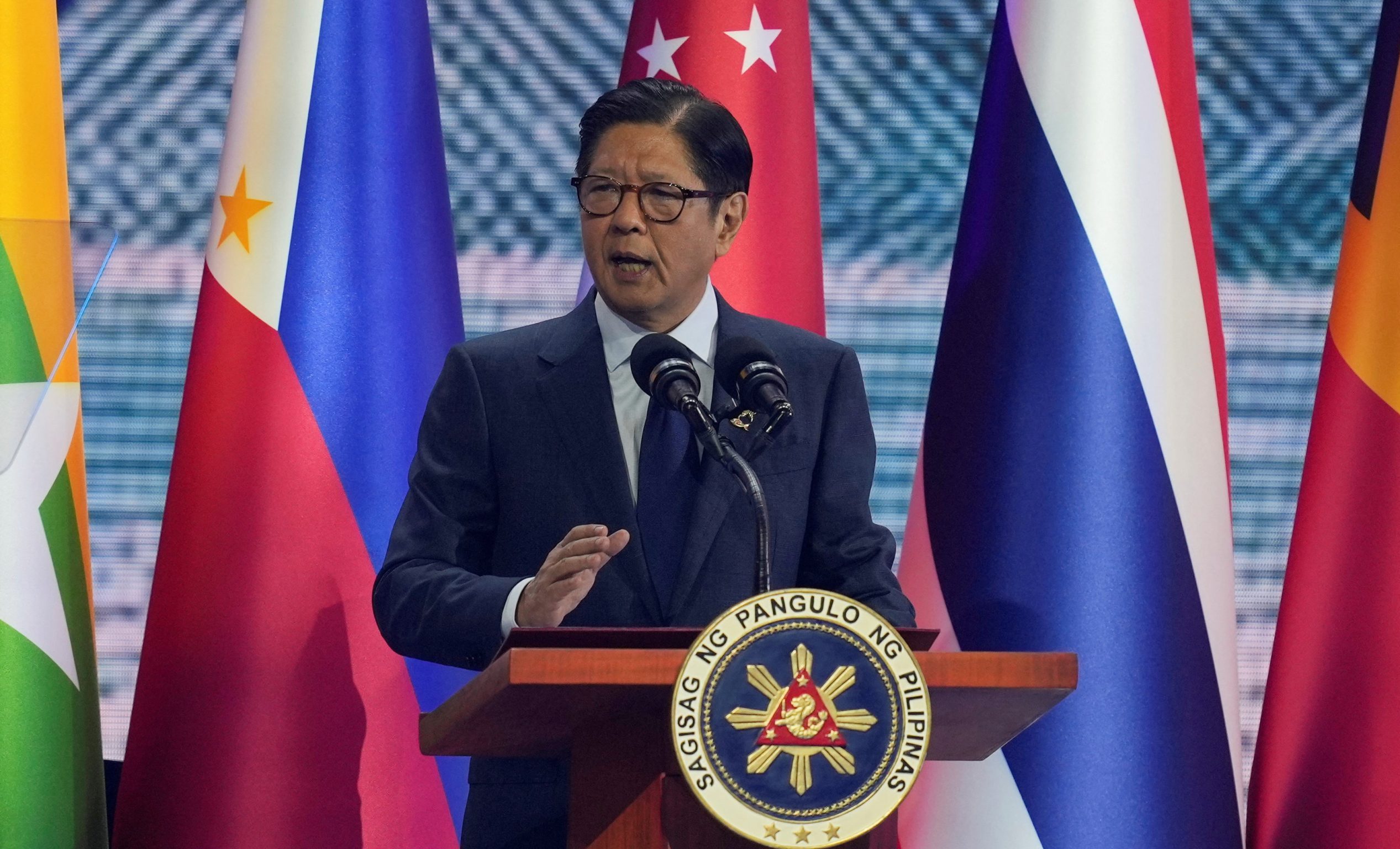
Philippine President Ferdinand Marcos Jr. expressed frustration over the slow progress in Myanmar as Association of Southeast Asian Nations (ASEAN) member states tasked foreign ministers with finding fresh approaches to break the deadlock.
ASEAN leaders voiced frustration over the stalled peace process in Myanmar during the 48th ASEAN Summit in Cebu, with Philippine President Ferdinand Marcos Jr. describing the country’s ongoing crisis as a “thorny problem” with no clear solutions.
“Myanmar is not merely a friend to ASEAN. Myanmar is part of the ASEAN family, and it is a tragedy when a family member is left out of the family for whatever reason,” Marcos said at a press conference on Friday.
The Philippines, serving as ASEAN chair for 2026, said member states agreed to task foreign ministers with exploring new approaches to restart normalization efforts.
Myanmar dominated discussions during the leaders’ closed-door retreat session, with several member states expressing disappointment over the lack of progress since the military seized power in 2021.
“We all agree that we would like to see more progress. We all agree that we all should try very hard to find ways to shift what has become a moribund process right now. It is not moving,” Marcos said.
Despite Min Aung Hlaing’s April 2021 commitment to ASEAN’s Five-Point Consensus, which calls for an immediate end to violence and inclusive dialogue, the regime leader has refused to implement it upon his return to Naypyidaw.
Marcos acknowledged a “nano-shift” in how ASEAN members are approaching the Myanmar issue, though no concrete changes have been agreed upon. The discussions were described as “very vibrant” and at times “emotional.”
The Philippine president highlighted the deteriorating conditions inside Myanmar, noting continued fighting and what he described as a “low-level civil war” still ongoing.
ASEAN leaders reaffirmed their commitment to the bloc’s core principles despite the lack of progress.
“We do not abandon ASEAN Centrality. We do not abandon the respect for human rights. We do not abandon the humanitarian disaster, the concern for humanitarian disaster,” Marcos said.
The Five-Point Consensus, adopted in 2021, calls for an immediate cessation of violence, dialogue among all parties, mediation by a special ASEAN envoy, humanitarian assistance, and envoy visits to meet all stakeholders.
Foreign ministers have been tasked with finding fresh ideas to break the deadlock, though Marcos cautioned that no final decisions have been reached.
“These things will not be decided now. But we will go away and try and find, maybe think about what can be done to improve the process,” Marcos added.
Min Aung Hlaing, who was inaugurated as Myanmar’s president by a pro-military parliament on April 10, did not attend the summit. The country was, once again, represented only by its regime’s Permanent Secretary of the Ministry of Foreign Affairs.
ASEAN member states have yet to reach consensus on recognizing the recent election in Myanmar, though Marcos stressed the country remains a member state of the regional bloc.
Manila urged Naypyidaw to allow its ASEAN 2026 Chair Special Envoy to Myanmar Ma. Theresa Lazaro to meet with detained leader Aung San Suu Kyi, pressing for greater transparency after authorities allowed her to serve the remainder of her 18-year prison sentence under house arrest.
“We view these developments as vital steps in a sequence of confidence-building measures necessary for long-term national stability in Myanmar,” the Philippines said in a statement on May 6.