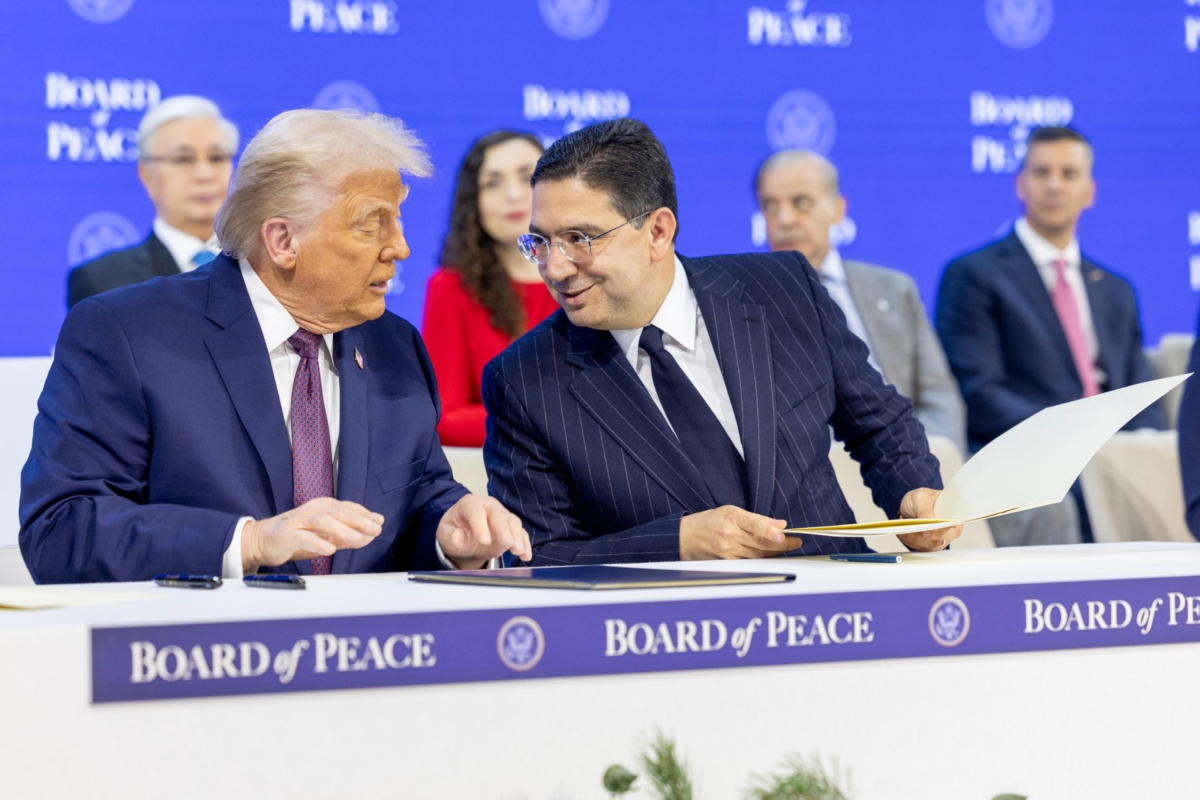
Beni Mellal – Morocco emerged as one of the key contributors at the inaugural meeting of Trump’s Board of Peace, held Thursday in Washington at the US Institute of Peace, pledging a range of security, military, and humanitarian commitments to the Gaza reconstruction effort.
Foreign Minister Nasser Bourita represented Morocco at the summit, speaking on direct instructions from King Mohammed VI, Chairman of the Al-Quds Committee – the body mandated to safeguard the holy city of Jerusalem and its heritage.
He opened by crediting Trump’s peace plan for achieving a ceasefire, saying it “ended a tragic war, saved lives, and crafted a pragmatic and forward-looking approach to rebuild Gaza.”
“His Majesty King Mohammed VI welcomes and supports your vision and leadership to foster peace and prosperity around the world, and particularly in the Middle East,” he added.
View this post on Instagram
Bourita announced five specific commitments. Morocco has already made what he described as “the first-ever financial contribution” to the Board of Peace. The country also pledged to deploy police officers to Gaza and train Gazan policemen.
It will send high-ranking military officers to the International Stabilization Force’s (ISF) joint military command and deploy a military field hospital. Finally, Morocco committed to leading a deradicalization program aimed at fighting hate speech and promoting tolerance and coexistence.
Morocco also confirmed its troop commitment, a move separately corroborated by US Major General Jasper Jeffers, the appointed ISF commander, who listed Morocco alongside Indonesia, Kazakhstan, Kosovo, and Albania among the countries pledging troops and police personnel for Gaza’s stabilization mission.
Bourita used his speech to outline conditions he said must be met for the effort to succeed. He called for the full implementation of Phase 2 conditions in Trump’s 20-point plan, stressed the importance of preserving stability in the West Bank, and insisted on Palestinian ownership of the process through “legitimate institutions.”
He concluded by calling for a broader peace process: “We hope that the stabilization of Gaza will help launch a global and genuine peace process based on the two-state solution.”
Morocco was also named by Trump among the countries contributing to a collective financial package exceeding $7 billion. The president listed Morocco alongside Kazakhstan, Azerbaijan, the UAE, Bahrain, Qatar, Saudi Arabia, Uzbekistan, and Kuwait as having contributed to what he called a “relief package.”
The broader meeting brought together representatives of over 40 countries, chaired by Trump alongside Vice President JD Vance and Secretary of State Marco Rubio. The US committed $10 billion to the Board of Peace.
The World Bank confirmed it would serve as the limited trustee managing donor funds. Indonesia pledged 8,000 troops as deputy commander of the ISF, while Qatar allocated $1 billion, and the UAE committed $1.2 billion.
Several Western allies, including France, the UK, Germany, and Canada, declined to join the board over concerns it could undermine the United Nations and grant Trump excessive personal authority under its charter.
The Board of Peace originated from Trump’s 20-point Gaza plan, which led to a ceasefire that took effect in October 2025. Its charter, signed in Davos last month, gives the board a mandate extending beyond Gaza to other global conflicts.
Trump chairs the board and holds veto power over its decisions, with his son-in-law Jared Kushner serving on the executive board alongside former UK Prime Minister Tony Blair.
Critics of Trump’s board have raised concerns about potential bias, particularly given the inclusion of Israeli Prime Minister Benjamin Netanyahu among its members.
They further argue that the absence of Palestinian representation prompts serious questions about legitimacy, as key decisions regarding the future of Palestinian territories are being shaped without direct Palestinian participation.
Despite the pledges, experts and observers warn that deployment of any international stabilization force remains unlikely without a Hamas disarmament agreement and an end to ongoing Israeli ceasefire violations, which have killed over 600 Palestinians since October.