Your support helps us to tell the story
From reproductive rights to climate change to Big Tech, The Independent is on the ground when the story is developing. Whether it’s investigating the financials of Elon Musk’s pro-Trump PAC or producing our latest documentary, ‘The A Word’, which shines a light on the American women fighting for reproductive rights, we know how important it is to parse out the facts from the messaging.
At such a critical moment in US history, we need reporters on the ground. Your donation allows us to keep sending journalists to speak to both sides of the story.
The Independent is trusted by Americans across the entire political spectrum. And unlike many other quality news outlets, we choose not to lock Americans out of our reporting and analysis with paywalls. We believe quality journalism should be available to everyone, paid for by those who can afford it.
Your support makes all the difference.Read more
Authorities in Spain have identified several suspected jihadists among the thousands of people who crossed from Morocco into the Spanish exclave of Ceuta last week, according to a report.
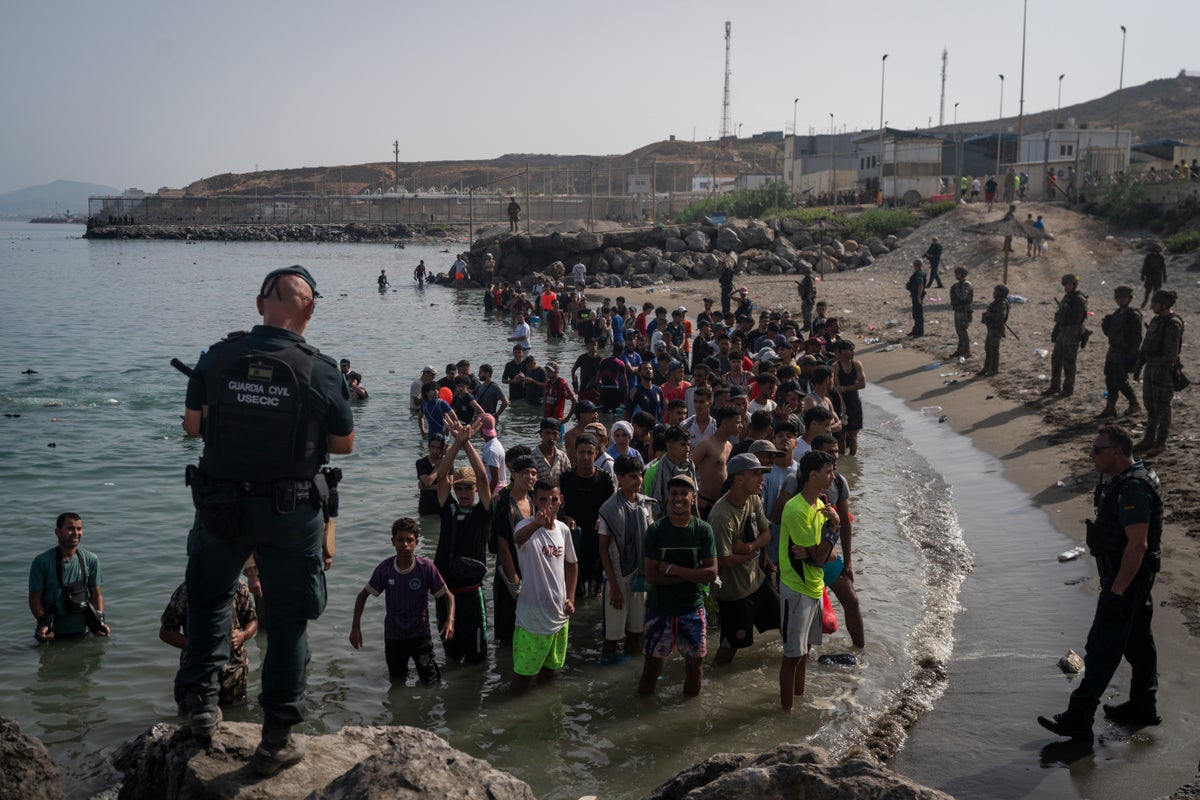
Some 60,000 migrants crossed illegally into the autonomous city in North Africa before mostly returning across the border in a political crisis that has inflamed tensions with the European Union and stoked anti-immigration rhetoric.
Sources within Spain’s Civil Guard told The Objective that intelligence agents have since identified several individuals who were previously monitored by intelligence services for their suspected links to Islamist extremism.
Video surveillance on the Ceuta border helped identify some of those under investigation during last Thursday’s crossing, according to the newspaper. Sources told the newspaper that some had been under investigation for several months, adding that “thousands” of other migrants may remain in Ceuta nearly a week on.
Spain estimates that about 69,500 migrants have returned to Morocco over the past four days, exceeding initial estimates of around 50,000 arrivals in Ceuta on Thursday (File – people cross the border on 31 July) (AFP/Getty)
Spanish online newspaper El Español separately reported on Tuesday that counterterrorism specialists from Spain’s Interior Ministry have identified individuals previously under investigation on suspicion of terrorism among those who crossed last week.
Agents were said to have found “at least a dozen” people previously arrested, convicted and deported to Morocco, the newspaper reported, adding that they could be among those who have not yet been repatriated.
It was unclear from either report who those under investigation were, or their alleged crimes. El Español reported that those identified had been investigated over “jihadist terrorism in Spain”. Authorities were said to be reviewing surveillance footage and images posted on social media.
The Independent contacted the Guardia Civil for comment.
Spain estimates that around 69,500 people have returned to Morocco over the past four days, exceeding their initial estimates of around 50,000 arrivals in Ceuta on Thursday. Local official Alberto Gaitan said the city was processing 862 migrant minors, who enjoy special legal protections from deportation.
Migrants wait in line to receive food and beverage from the Red Cross, following mass crossings of migrants on foot and by sea from Morocco into Spanish territory, in Ceuta, Spain, on 3 August 2026 (Reuters)
In the chaos, 72 people are believed to have died on the Spanish side of the border, while 11 people died on the Moroccan side.
Amid scrutiny over how the crisis was able to unfold, El Pais and Cadena SER radio, citing officials familiar with the matter, reported that Spanish intelligence services have concluded that Morocco did not plan the mass crossing, but did allow it to happen.
Moroccan border controls were gradually relaxed during July and were allegedly removed as crowds surged toward the Tarajal crossing during Morocco’s Throne Day holiday, the reports said.
The Objective reported that at the time of the crossing, there were also only a few Civil Guard officers policing the beach, and that the Interior Ministry took more than eight hours to react and send reinforcements.
Spanish military stands guard at the border on 30 July (Reuters)
Spain’s Interior Minister Fernando Grande-Marlaska told reporters on Saturday the foreign intelligence agency CNI, controlled by the Defence Ministry, did not warn him of an imminent surge – something El País reported had caused tensions between the two ministries.
Defence minister Margarita Robles declined to say whether the CNI had any prior intelligence of the mass crossing, adding its work was secret and praising the “exceptional” work of Spanish security services personnel.
Morocco’s Interior Ministry meanwhile blamed the surge on misinformation on social media, human trafficking networks and misinterpretation of a Spanish court ruling banning immediate returns of migrants intercepted at sea. That was in line with Madrid’s official view.
The EU’s migration chief said on Tuesday it was too early to link disinformation on the Ceuta crisis with Russia. They also said there was interference from smugglers and human traffickers prior to the crossing.