Your support helps us to tell the story
From reproductive rights to climate change to Big Tech, The Independent is on the ground when the story is developing. Whether it’s investigating the financials of Elon Musk’s pro-Trump PAC or producing our latest documentary, ‘The A Word’, which shines a light on the American women fighting for reproductive rights, we know how important it is to parse out the facts from the messaging.
At such a critical moment in US history, we need reporters on the ground. Your donation allows us to keep sending journalists to speak to both sides of the story.
The Independent is trusted by Americans across the entire political spectrum. And unlike many other quality news outlets, we choose not to lock Americans out of our reporting and analysis with paywalls. We believe quality journalism should be available to everyone, paid for by those who can afford it.
Your support makes all the difference.Read more
Spain is set to deploy its military to restore order at its “totally collapsed” border with Morocco in Ceuta, after nine people died during a mass migrant crossing from Morocco.
The armed forces will send 60 people to reinforce police in the Spanish enclave, after the domestic force was overwhelmed on Thursday by thousands of migrants.
Madrid said it would send the Armed Forces to help the Civil Guard “to maintain security in the city of Ceuta”, adding that prime minister Pedro Sánchez would join interior minister Fernando Grande-Marlaska on a visit to the area on Friday.
“The situation is absolute chaos,” Rachid Sbihi, head of the association representing Spain’s Civil Guard officers in Ceuta, who police the border, said.
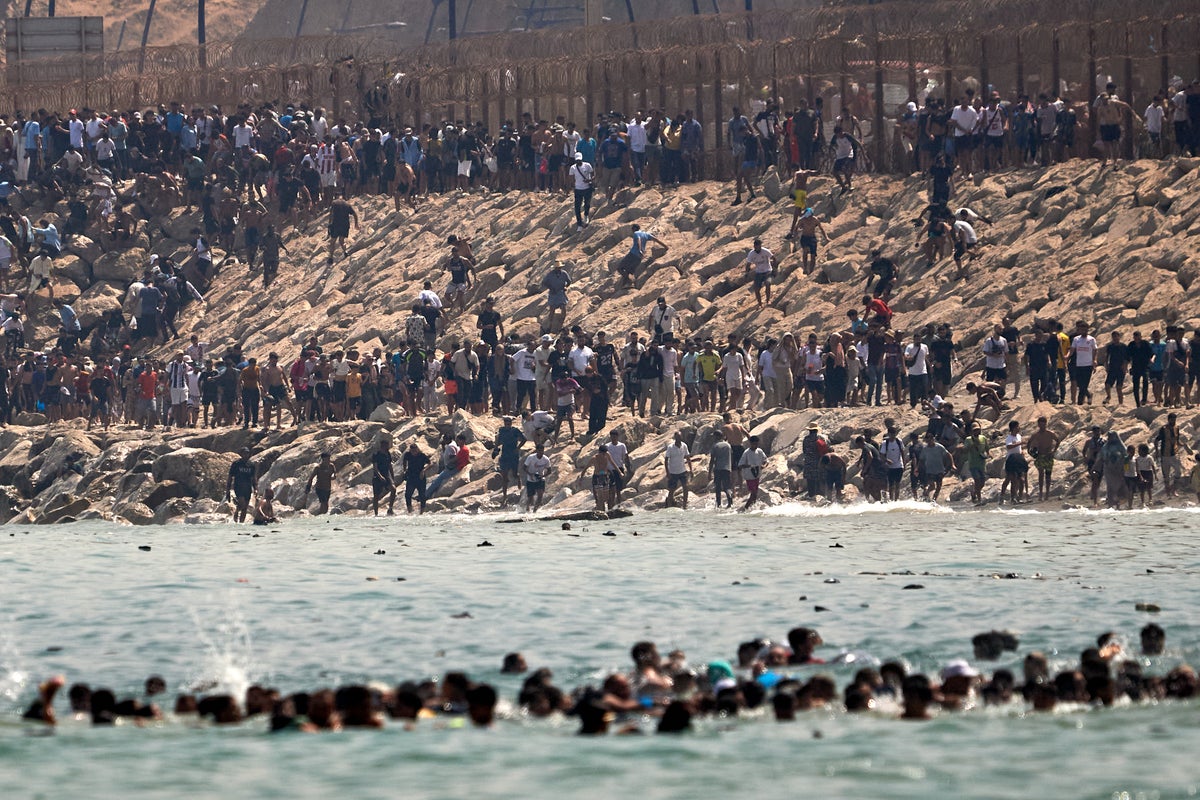
Spanish media reported that around 2,000 to 3,000 crossed from Morocco into the Spanish enclave of Ceuta on Thursday (AP)
“It’s not possible to give precise numbers, but there are thousands of migrants crossing,” he said, adding that the border had “totally collapsed”.
Video footage showed hundreds of migrants swimming over from the Moroccan side using inflatable inner tubes and other flotation devices, and others breaking through a gate in the fence and running into the city, many shouting, “Viva España!”
State television TVE reported that 2,000 to 3,000 people had crossed.
The scene was reminiscent of the crossing that occurred in May 2021, when some 10,000 people from Morocco and sub-Saharan Africa, many of them minors, entered the enclave of 85,000 people in a matter of days.
Achraf Maimouni, a member of the Moroccan Association for Human Rights in northern Morocco, described the situation as “exceptional.”
Footage showed crowds of people walking around the breakwaters at Tarajal beach (AP)
“The Tarajal border was opened under unusual circumstances this morning and people crossed,” he said.
The move to bring in the army comes after authorities in the tiny Spanish territory called on the government to declare a national emergency and send in the army.
Ceuta is located on the northern African coast, bordering Morocco. Spain is a main point of arrival into Europe for migrants seeking better economic opportunities or an escape from violence in their home countries.
The escalation at the border between Spain and Morocco comes after a surge in migrants attempting to reach the small exclave, mainly by swimming.
Spain stands out in Europe for its softer stance towards migrants (AP)
Spain’s interior ministry said it would guarantee the safety of its citizens and the nation’s border, but that the government could not declare a national emergency over migration concerns.
Footage showed crowds of people, mainly Moroccans, walking around the breakwaters at Tarajal beach onto local roads.
A Guardia Civil spokesperson said the migrants were “massively entering from the sea” through the Tarajal breakwater, but could not provide any estimates for the numbers. State news agency EFE said some had scaled the border fences without swimming.
Migrant rights activist Zakaria Zarroqui said the situation “remains out of control as we speak”, adding that people were still flocking to the Moroccan city of Fnideq in an attempt to cross into Ceuta.
Locals called for the army to be drafted in to deal with the situation (Reuters)
Juan Jesús Vivas, the head of Ceuta’s regional government, called for the national government to declare a national emergency on grounds of national security, asking for more police and for the army to be deployed on the border.
Mr Vivas said the additional police and soldiers would be necessary “to guarantee the inviolability of the frontier and citizen safety”.
He had warned on Wednesday that migrant reception centres were overwhelmed with hundreds of people sleeping on the streets.
Many local shops were shuttered. Enrique Serrano, who runs a women’s clothing store in central Ceuta, told Reuters business owners were organising themselves to protect their property and families in case of possible disturbances as they believed police resources would be insufficient.
“I’m not opening this afternoon because the situation is extremely tense … The first thing I have to do is protect my business and my family,” he said, adding that when the fence was breached after midnight, hundreds of migrants rushed through in a matter of minutes.
The interior ministry said that legislation covering a declaration of national emergencies does not consider migration flows as a risk to national security.
Government administrations are “coordinating to respond with speed and efficacy to the situation in Ceuta”, it said.
The ministry said the Moroccan government was “closely cooperating” with Spain to handle the situation, saying that Moroccan police are stopping “numerous people” trying to cross the border.
A local shopkeeper said that when the fence was breached after midnight, hundreds of migrants rushed through in a matter of minutes (AP)
Earlier this month, Spain’s Supreme Court ruled that migrants intercepted at sea while attempting to reach Ceuta or Melilla cannot be summarily returned under the enclaves’ special border-rejection regime. “It has been a slow trickle since the Supreme Court’s ruling, but today has been an explosion,” the Guardia Civil spokesperson told Reuters.
Spain’s Socialist government stands out in Europe for its pro-migrant stance, and has recently launched a programme to provide legal status for some 500,000 undocumented migrants, creating an influx of applications double that number.
Right-wing parties criticised the drive, arguing it would attract more migrants to Spain, and were quick to blame Mr Sanchez for allowing the situation in Ceuta to reach crisis proportions.