Overview:
Palau has reached a landmark moment in public leadership: all three bureaus under the Ministry of Agriculture, Fisheries and Environment are now headed by young Palauan women. Their leadership marks a generational shift in how the nation manages its land, food and marine resources—driven by cultural pride, technical expertise and a shared commitment to empowering future women leaders.
By: Summer Kennard
KOROR, Palau (December 11, 2025) — “Women are stronger than ever and taking on bigger roles,” says Ilima Kloulchad, one of three young Palauan women now leading all bureaus under the Ministry of Agriculture, Fisheries and Environment (MAFE), a milestone reflecting a broader shift in who stewards the nation’s natural resources.
For the first time, women serve simultaneously as directors of the Bureau of Environment, the Bureau of Agriculture and the Bureau of Fisheries—critical agencies shaping Palau’s sustainability and food security. Their appointments mark a notable rise in young female leadership across government, once dominated by men.
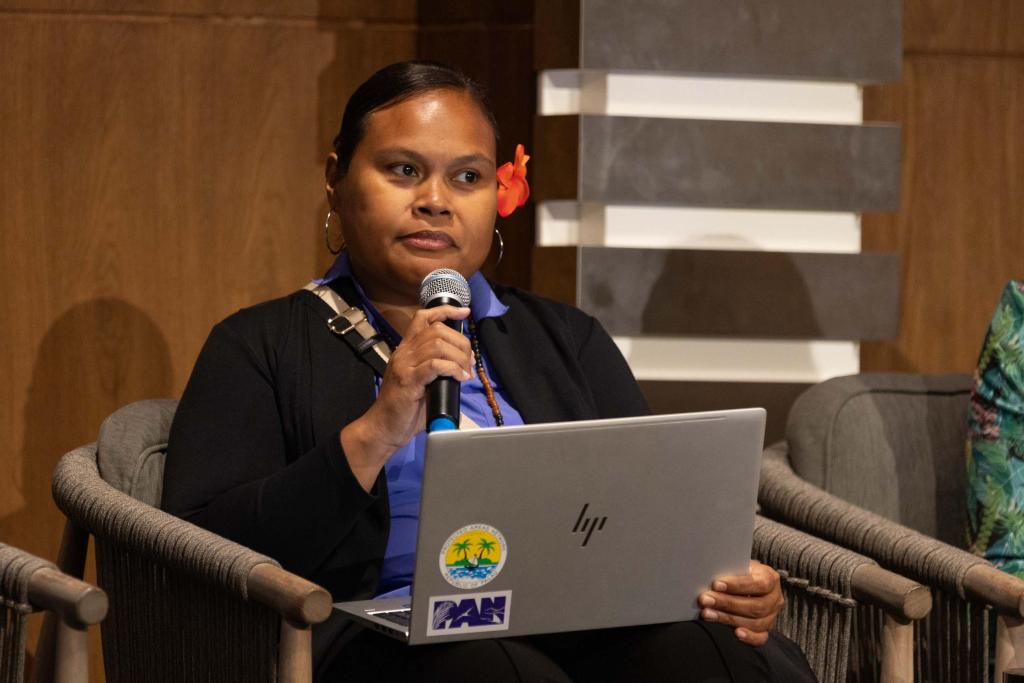
Ilima Kloulchad, Director of Bureau of Environment, Ministry of Agriculture, Fisheries and Environment. (Photo: Supplied)
Director of Environment Ilima Kloulchad, Director of Agriculture Jodean Remengesau and Director of Fisheries Persis Dilbudech Omelau bring different paths and professional backgrounds, but share a common commitment to strengthening their bureaus and opening doors for the next generation of women.
Leading with identity and purpose
Kloulchad said her motivation comes from her pride as a Palauan woman and her desire to safeguard the environment for her children.
“My love for the outdoors and the land and sea of our nation is what drives me,” she said.
She wants to see more women in environmental leadership and hopes to expand the Bureau of Environment into its own ministry within the next decade. Recruitment remains difficult, she said, citing challenges filling leadership roles such as the chief of the Division of Protected Areas and Species.
While gender-related obstacles have been rare locally, Kloulchad said they surfaced more often abroad. “In this administration, I can see that we empower the young generation and especially the women,” she said.
Jodean D. O. Remengesau, Director of Bureau of Agriculture, Ministry of Agriculture, Fisheries & Environment. (Photo: Supplied)
Building a path for young professionals and working mothers
Remengesau joined government leadership after feeling she could make a broader impact beyond project-based work. She saw an opportunity for sustainable and inclusive agricultural development—and for more women to enter the field.
“I hope to see more young working professionals, especially young mothers, be supported to build a career,” she said.
She emphasized that accessible childcare near workplaces is essential for women in government and the private sector. Remengesau also wants more Palauan families to see agriculture as a meaningful business path.
“There are so many avenues of business generation while keeping a sustainable environment,” she said.
In the bureau, she has prioritized planning, digitization, and restoring clarity and trust within staff. “I try to gauge my staff’s capacity while allowing them to perform,” she said.
A new era for fisheries management
Omelau entered leadership after years of technical work in oceanic fisheries and a series of major projects that strengthened her management experience. She served a year as acting director before being appointed permanently in 2024.
Persis Omelau, Director of Bureau of Fisheries, MAFE (photo: supplied)
“I’m very passionate about fisheries,” she said. “We can sustainably use our marine resources if we manage them in a healthy, responsible way.”
Omelau’s academic background spans fisheries studies at the University of Alaska and a climate-related master’s program in Malta. Her early internships with PICRC helped shape her understanding of Palau’s marine resource challenges.
In her first year, she focused on strengthening the bureau’s institutional capacity. “You can’t deliver quality services unless your foundation is strong,” she said. “Now we have clear goals and momentum.”
She believes women bring strong organizational and collaborative leadership styles. “In our culture, women ‘hold the fort,’” she said. “That shows in how we organize and lead.”
Creating pathways for future leaders
All three directors cited the importance of equitable access to training, higher education and professional development. Omelau noted that several bureau staff members are pursuing advanced degrees, supported by supervisors who encourage innovation and new ideas.
She believes a motivated workforce begins with strong internal culture. “Your team can only achieve great things if they feel supported,” she said, describing regular team-building activities, flexible idea-sharing and professional mentorship.
A generational shift
The presence of three young women at the helm of MAFE reflects a broader change in Palau’s public sector: more women stepping confidently into senior leadership roles, reshaping institutions that manage land, food and ocean resources.
Kloulchad said the shift is overdue. “We grew up thinking men controlled the workforce,” she said. “Today, we have blossomed into a new era.”
Like this:
Like Loading…