Overview:
Can two systems of governance truly function as one? At the Cheldebechel Forum, leaders from traditional, elected and civil society sectors confronted growing tensions between constitutional law and customary authority — with some calling for clearer separation and even constitutional revision.
By: Summer Kennard
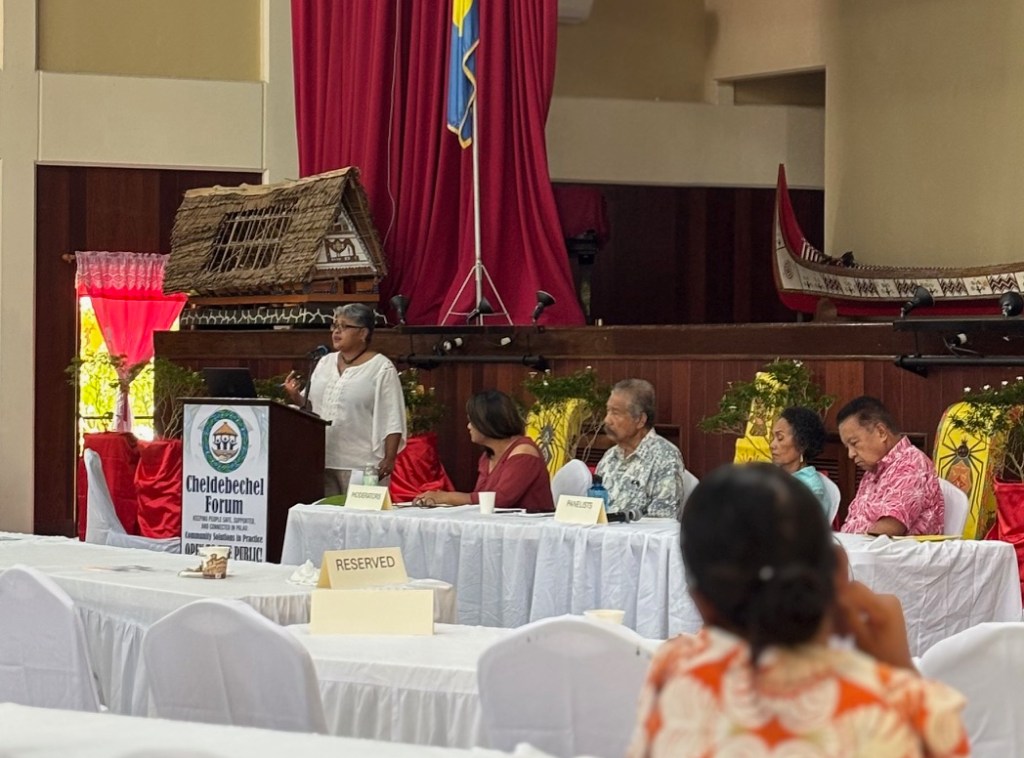
KOROR, Palau — The second panel of the Cheldebechel Forum tackled one of Palau’s most complex questions: how two recognized systems of governance — constitutional and traditional — operate side by side in everyday life, and what happens when their lines of authority blur.
Cheldebechel Forum tackled one of Palau’s most complex questions: how two recognized systems of governance — constitutional and traditional — operate side by side in everyday life. Feb. 25, 2026 (Photo credit: Island Times)
The session, titled “Two Systems, One Community: Making Governance Work in Our Daily Life,” was moderated by Leilani Reklai and brought together voices from traditional leadership, elected government and civil society.
Reklai opened the discussion by acknowledging the uniqueness of Palau’s structure, which recognizes both a national constitutional government and a traditional leadership system.
“Sometimes the lines can become blurred because these governments operate at the same time, and that can leave us confused about who is actually making the decisions,” she said. “When we find ourselves at these crossroads, how will we come to a final decision?”
Constitutional Protections and Customary Authority
Former President Johnson Toribiong, speaking from the perspective of traditional leadership, pointed to Article V of the Constitution, which protects the role and function of traditional leaders as recognized by custom and tradition.
He stressed that the government cannot prohibit or revoke those roles if they are consistent with the Constitution. Toribiong cautioned against elevating disputes within traditional leadership into the national government framework, arguing that doing so risks weakening constitutional protections for customary authority.
Ongoing tensions, he said, reflect broader challenges in balancing national law with customary systems that predate the republic.
State Leadership and Civil Society Perspectives
Governor Frances Rememgesau Vogt offered the view from elected governance, describing how state leaders must navigate decisions within the dual framework while remaining accountable to constitutional mandates.
Moses Uludong, representing civil society, called the issue one of the most pressing topics facing the community. He recalled his participation in early constitutional discussions through Rubekul Belau, where he and others proposed including chiefs and women chiefs in the formal lawmaking process.
Looking at present-day conflicts, Uludong said the original integration of the two systems may not have been fully examined.
“It is better off if we separate these two governments,” he said, arguing that clearer boundaries could help reduce recurring disputes over authority.
Bernadette Besebes, also speaking from civil society, presented findings from the “2024 Accountability Ecosystems Analysis: Palau Country Study,” conducted with Aidan Craney. The study distinguishes between formal accountability — written laws, constitutional provisions and policies enacted by elected officials — and informal accountability rooted in traditional practices, personal relationships and unwritten norms.
Using a tapioca plant as a metaphor, Besebes described the leaves as visible institutions such as the Constitution, the Compact of Free Association, Congress, chiefs, elections and oversight bodies. The stem, she said, represents the media, linking institutions to deeper social forces. The roots — the edible core — symbolize underlying realities shaping governance, including an aging population, migrant labor, front businesses, social media and urbanization.
Calls to Revisit the Constitution
During the question-and-answer session, audience member Joleen Ngoriakl cited Article XIV of the Constitution, which requires the Olbiil Era Kelulau to ask voters every 15 years whether to convene a constitutional convention.
Noting that the last convention was held in 2005, Ngoriakl asked what practical steps could be taken now, suggesting it may be time to revisit and revise the Constitution. She pointed to growing Western governance influences and urged action while experienced leaders remain available to guide potential reforms.
Toribiong agreed.
“I agree with you,” he said. “It is time we revise our constitution.”
The discussion focused on the enduring questions about how Palau’s traditional and constitutional systems can coexist effectively — and whether structural reforms are needed to clarify authority, reduce conflict and strengthen governance in a changing society.
Like this:
Like Loading…