Overview:
Palau has opened a first-of-its-kind Transition Facility at Belau National Hospital, giving discharged patients who can’t yet return home a safe and supportive place to recover. The new service aims to ease hospital overcrowding while providing dignified, short-term care in a home-like setting.
By: Summer Kennard
KOROR, Palau (December 11, 2025) — “We often have patients who are already medically cleared but continue to occupy beds because the hospital has no alternative placement,” Public Health Director Sher Madraisau said this week, as the Belau National Hospital opened its long-awaited Transition Facility — a new service and dedicated building designed to ease overcrowding and provide short-term care for discharged patients who are not yet ready to return home.
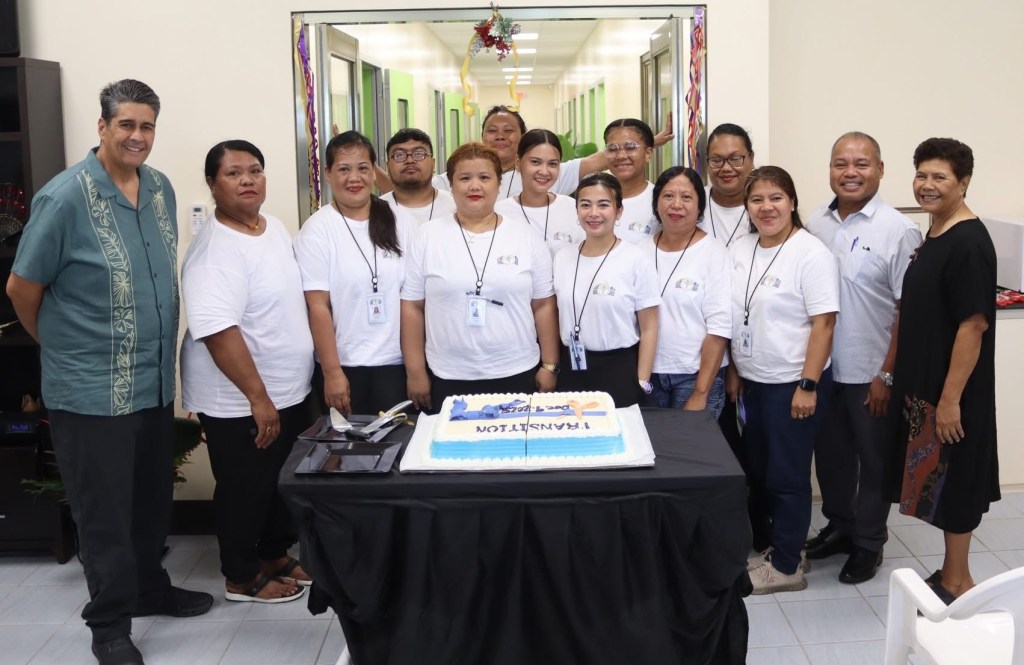
Transition Facility officially opens to serve people who no longer need hospital level care but requires temporary assistance. (photo: Office of the President)
The Transition Facility, which officially opened with a ribbon-cutting ceremony, is the first of its kind in the Freely Associated States. The service aims to support people who no longer need hospital-level treatment but still require temporary assistance, often because they have no immediate caregiver or suitable home environment.
The idea for a dedicated “step-down” space has been in development for years. Originally completed before the COVID-19 pandemic, the building was temporarily repurposed as an isolation ward when Palau faced surges in COVID cases, hospital officials said. Plans to open it as a transition facility were delayed until regulations, staffing plans, and funding sources could be finalized.
Hospital Administrator Darnelle Worswick previously explained that the need for such a facility became even clearer during the pandemic, when the hospital saw firsthand how quickly beds filled and how long some patients were forced to stay after they no longer required acute care.
Health officials said the service will help prevent those bottlenecks from happening again.
A Home-Like Setting for Recovery
The new building includes four rooms and can house up to 10 residents, with space for as many as 12 when needed. Instead of a clinical hospital setup, the facility was designed to feel warm and home-like, offering a living room-style common area where residents can rest, socialize, and gradually adjust before going back to their community.
Residents will receive support from a team of 11 trained caregivers, along with hospital-based services such as physical therapy, home health nursing and check-ins from clinicians. Belau National Hospital will continue providing meals and laundry services.
“This helps free up our beds while still giving discharged patients the support they need,” Madraisau said. “It’s a service Palau has needed for a very long time.”
Background and Funding
According to earlier updates from the Ministry of Health and Human Services, the building was originally constructed as part of a hospital expansion meant to accommodate patients who had finished their medical treatment but had no safe or stable home to return to. The project was known at the time as the “step-down facility.”
Former Health Minister Gaafar Uherbelau said in late 2022 that the building had been completed well before its opening, but its use depended on establishing clear rules and identifying reliable funding sources for long-term operation. At the time, the Ministry was still determining whether support would come from Medical Savings Accounts (MSA) or other government programs.
Today, the Ministry says the operational funding plan is in place. Construction of the facility was supported through Taiwan Stimulus assistance, staffing is funded through a U.S. CDC federal grant, and caregiver training was provided through collaboration between Palau Community College and the Ministry of Health.
Madraisau said partnerships were critical to launching the service. “We’re proud to open this facility and to be the first in the Freely Associated States to establish this kind of service. Other island nations are watching closely as they explore similar models.”
The Transition Facility is expected to welcome its first residents next week.
Like this:
Like Loading…