Overview:
Nearly 40,000 coral juveniles have been successfully produced by the Palau International Coral Reef Center (PICRC) in a major breakthrough for reef restoration and climate resilience efforts in Palau. The milestone was achieved through a controlled spawning of Acropora tenuis, strengthening ongoing efforts to restore degraded reef areas and build resilience against rising ocean temperatures and climate impacts. Supported by partners including Coralassist Lab, SECORE International, The Nature Conservancy, and Great Barrier Reef Foundation, the initiative marks another step forward in scaling up science-based coral restoration in Palau.
Rising ocean temperatures, the intensification of typhoons, and other climate change-related impacts are placing coral reefs under increasing stress, leading to large-scale bleaching events and coral mortality worldwide.
Palau’s reefs represent a particular case, as they have generally fared better against these global threats than reefs in many other parts of the world. Nevertheless, some have experienced damage from which recovery without assistance remains difficult. This, combined with the need to strengthen reef resilience and improve response capacity to future threats, continues to motivate the Palau International Coral Reef Center (PICRC) to further implement and enhance its coral research and restoration efforts.
As part of these initiatives, PICRC researchers recently facilitated the natural spawning of the branching coral species Acropora tenuis at the Center, resulting in the production of nearly 40,000 coral juveniles that will be used to support the restoration of degraded reefs.
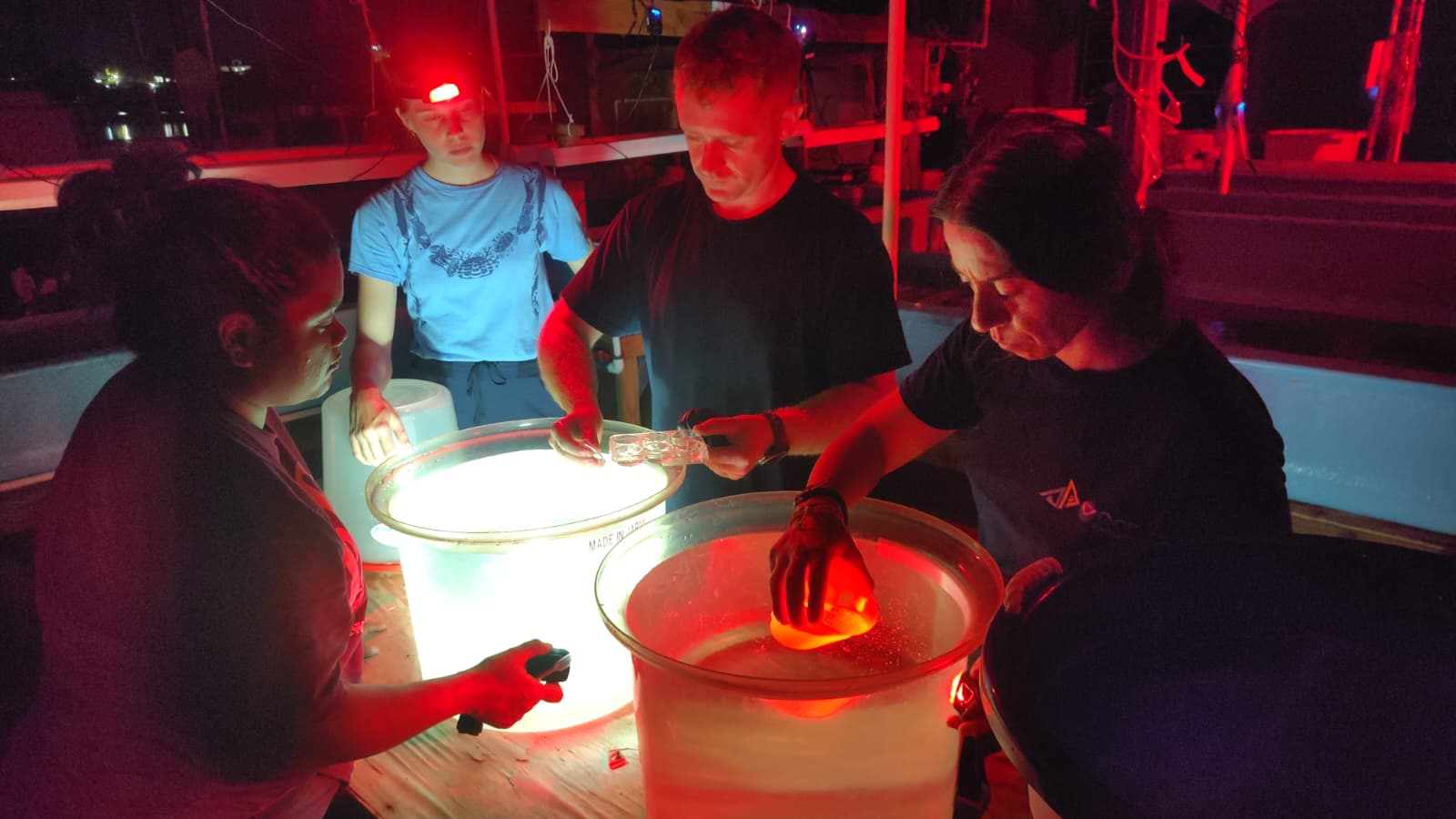
To achieve this, the team monitored 37 coral colonies at PICRC in early April around the full moon period, when spawning—the release of coral gametes, or reproductive cells—was expected to occur. Once spawning took place, researchers worked to facilitate high fertilization rates among the coral colonies and create suitable conditions for embryo development. The embryos later transformed into coral larvae, which eventually settled onto substrate devices placed by the researchers, where the larvae will remain permanently attached and continue to grow. These devices were specifically designed by the Coralassist Lab and SECORE International to enhance coral settlement, survival, and growth.
The coral juveniles will continue developing at PICRC until they reach a suitable size to be transferred to current restoration sites. There, they will grow under the monitoring and care of the Center’s researchers, contributing to the recovery of damaged reefs.
This marks the second time the PICRC team has successfully raised corals at its facilities. The first took place last year, when researchers produced and outplanted 1,600 substrate devices containing up to 12,000 coral juveniles at restoration sites in Koror. This initiative adds to PICRC’s ongoing coral restoration projects, which also include the installation of reef stars—structures designed to hold coral fragments and be placed on the seafloor to become part of the reef—and the selection of coral colonies with the potential of being more tolerant to higher temperatures for use in climate-smart restoration efforts.
PICRC extends its sincere gratitude to its partners from Coralassist Lab, whose training delivered last year with funding support from The Nature Conservancy (TNC) and the Great Barrier Reef Foundation (GBRF) was instrumental in enabling the successful spawning and development of coral juveniles this year.