Last April, the Trump administration rolled out its latest tool in the fight against Mexican cartels: an aggressive crackdown on money transfers near the US-Mexico border.
The administration said that, in an effort to stop money laundering and other illicit activity, it would now require any business providing financial services in the region to report cash transactions over $200. Previously, the amount had been $10,000.
But rather than dealing a crushing blow to the cartels, business owners and legal experts say the policy has devastated small businesses across the region, and the largely immigrant communities who rely on them to pay rent and bills and send money to family.
One of those mom-and-pop businesses is Nachita’s, a grocery store in one of El Paso, Texas’s oldest neighborhoods that also provides small-scale financial services.
The family-run grocery has been a community lifeline for generations, says owner Evangelina Ornelas. In a working-class neighborhood near the US-Mexico border, where many people don’t have a bank account, these money services are a vital resource. For years, the predominantly Latino residents of numerous apartments surrounding Ornelas’s store used to regularly walk in to pay bills, pick up money orders for rent and wire money to families south of the border. The grocery store – along with its on-site kitchen – also benefited.
“People would come in to do a money transfer, and while they were here they’d get a burrito or purchase grocery items,” she recalled.
But last year, when a new policy from the US treasury department’s financial crimes enforcement network (FinCen) came into effect, it upended her operations. Now she had to report these low-level transactions, along with addresses, Social Security numbers and other personal identifying information.
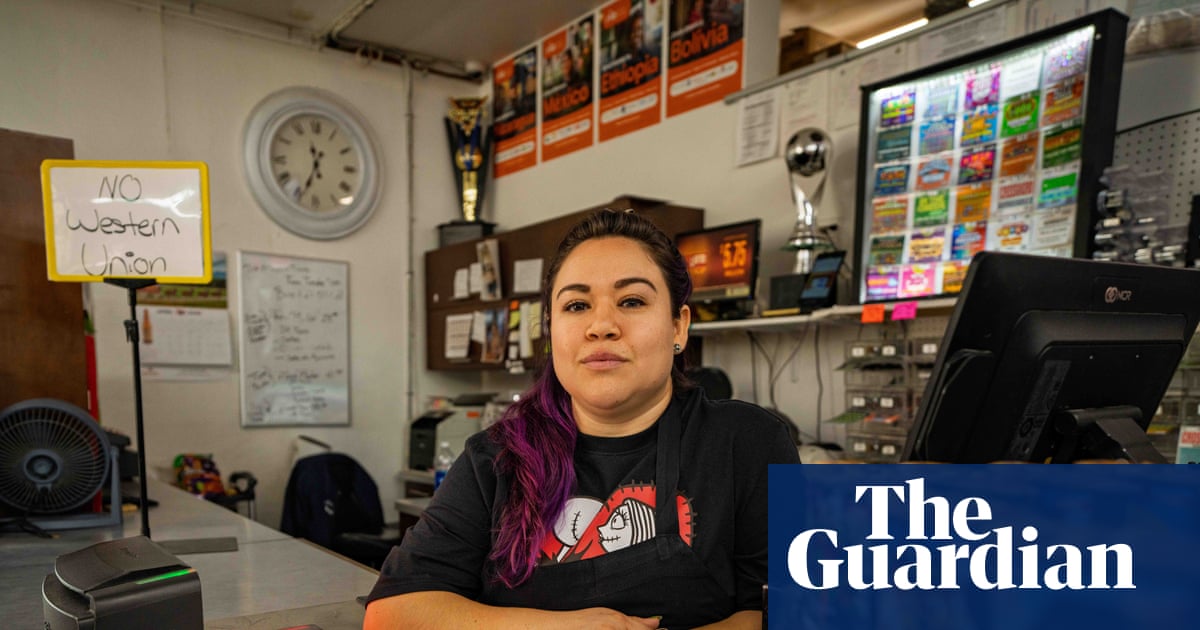
Nachita’s Grocery in El Paso, Texas. For years, primarily Latino customers regularly paid bills, picked up money orders and wired money to family in Mexico.
With the changes, people became reluctant to make these transactions, Ornelas said, because they worry it will open them up for government surveillance or targeting by immigration authorities in the current intensified enforcement. Many elderly customers with limited mobility could no longer pay bills, and renters are unable to purchase money orders to pay for housing. The long lines of immigrants waiting to send money home have dwindled.
“I don’t think it was to prevent money laundering,” Ornelas said of the policy. “It didn’t look like it from what I was seeing. I was seeing a lot of people who were just not able to pay their bills or not able to send money to their families.”
Casas de cambio, as businesses that provide money services are commonly known in Spanish-speaking communities, have long been an integral part of the border region’s financial ecosystem. They’re at dedicated storefronts and grocery stores like Nachita’s as independent businesses or authorized agents for industry giants such as Western Union and Moneygram. Residents, tourists and those who lack bank accounts, or just prefer the businesses to traditional banks, regularly use them to conduct transactions.
The new FinCen policy has faced criticism from legal and privacy experts, and has been met with legal challenges that call it arbitrary, unjustifiable and a violation of the fourth amendment that protects the rights of people against unreasonable searches and seizures. The transaction threshold was eventually raised from $200 to $1,000 in September 2025, but small business owners say even this amount has still drowned them in paperwork, made compliance tasks challenging for their bare-bones staff and caused steep business losses.
“It’s invasive and it’s unconstitutional,” Rob Johnson, a senior attorney at the Institute for Justice, said of the policy. Shortly after it took effect in Texas and California, the non-profit law firm and the Texas Association of Money Services Businesses sued the Trump administration on behalf of small business owners.
At Nachita’s Grocery, the long lines of people waiting to send money home have dwindled.
Johnson said the higher, $1,000 threshold remains problematic. “Two hundred dollars is the equivalent of a grocery cart, but $1,000 is the equivalent of a monthly rent payment,” he said. “And either way, you’re talking about an amount of money that is an ordinary, normal amount of money for an ordinary person to be using.”
In and out of court, the heightened surveillance has raised alarm over perceived government overreach that targets establishments in neighborhoods primarily with residents of Mexican descent.
The FinCen policy throws a blanket of suspicion, critics say, on everyone making everyday cash transactions. “It’s really an unfair measure,” said Esperanza Gómez, who runs a small business that provides money services in San Diego. “And on top of that, it’s going to put us out of business.”
For Ornelas, the regulations that came with the threat of hefty fines, even for inadvertent errors, were confusing, deeply upsetting and difficult to manage. She was buried in mounds of new paperwork from cash transactions that exceeded $200 and grew frustrated over steadily losing customers worried about their privacy who would not, or could not, provide a Social Security number or other required US government document.
By the time the reporting threshold was bumped to $1,000, the money services portion of Ornelas’s business was all but dead.
A legal battle over reporting requirements
Cross-border money transfers – also known as remittances – from immigrants are a brisk business for casas de cambio and a lifeline for households across the globe whose livelihood often depends on them. In Mexico alone, the world’s top recipient of US remittances, the amount of money flowing south from 2023 to 2025 exceeded $60bn each year. The cash transactions are a thorn in the side of the Trump administration, which considers them a loophole that allows undocumented people to send home money they have earned working in the country illegally.
Money transfers from immigrants are brisk business for casas de cambio and a lifeline for households across the globe whose livelihood often depends on them.
In July 2025, Donald Trump signed into law sweeping federal legislation that included a 1% tax on international money transfers. Congressional Republicans originally had sought to require a 5% tax along with proof of US citizenship for these transactions to discourage illegal immigration, but modified it after intense pushback. This year, several states – including Arizona– considered legislation to mandate verification of legal status for those wiring money out of the country, but ultimately failed to pass it.
Such attempts have not gone unnoticed in Latino and immigrant communities, where the FinCen policy has become intertwined with Trump’s aggressive campaign to deport those living in the country unlawfully. “We are going through difficult times generally speaking,” said Gómez, who is fighting the policy in court. “But it has really hit us twice as hard because the immigration raids are obviously targeting our people, and now they’re really going after the customers we serve.”
When FinCen issued its sweeping order in March 2025, it set off a legal battle.
The policy took effect a month later. Known as a geographic targeting order, it first covered 30 zip codes along the border in Texas and California for six months. FinCen has since renewed it multiple times, and in March 2026 the agency broadened its scope to cover several more counties – some far from the border – including New Mexico’s Bernalillo county and Arizona’s Maricopa county. As of 23 February, a total of 86 businesses covered by the policy had filed 700,000 reports, according to a partly redacted FinCen internal memo reviewed by the Guardian.
Multiple businesses have filed at least four lawsuits over the policy, and to some degree the pushback has been successful. Federal district judges have blocked the policy’s implementation for all affected businesses in California, and for the businesses in Arizona and Texas that have sued. The federal government appealed and in July the ninth circuit court of appeals upheld the pause. A decision from the fifth circuit court of appeals is pending.
Andy Payan, who runs a convenience store and gas station in El Paso, Texas, that offers check-cashing services, is among the small businesses that are part of the Institute for Justice lawsuit.
While some of the lawsuits now playing out stem from the initial policy’s $200 reporting threshold, the new, $1,000 threshold has also been challenged by a small business in Phoenix, Arizona, that sued FinCen in April. The plaintiff in the case, Kiosko Multiservicios, contends the requirement is a time-consuming, unsustainable burden that threatens to crush its business because it cannot afford to hire more employees to comply with it.
In its suit, Kiosko Multiservicios notes that in March, about 4,000 of transactions processed – including payroll check cashing and sales of money orders – exceeded $1,000. And, according to the government’s own estimate, for small businesses without automated filing procedures like Kiosko, each report takes 24 minutes to complete. That’s in addition to time spent explaining to customers why the detailed personal information is needed, the suit states.
Like banks and other financial institutions, casas de cambio were already required to comply with state and federal regulations. Ashley Light, the owner of a small family business in downtown El Paso, said that besides adhering to strict regulations, the establishments must comply with anti-money-laundering programs that include training on how to identify suspicious transactions. But unless there’s suspected wrongdoing, she said, it would be an invasion of privacy to include identifying information of customers making legal, everyday transactions in a database used for criminal investigations. FinCen’s collected data is shared with the Internal Revenue Service and various law enforcement agencies.
Ashley Light, the owner of a small family business in downtown El Paso, says her business already complies with strict state and federal regulations.
Light and Andy Payan, who runs a nearby convenience store and gas station that offers check-cashing services, are both part of the Institute for Justice lawsuit. While he’s all for battling financial crime, Payan said, he thinks the policy’s focus on small businesses like his family’s is off the mark. “The amounts that money launderers would need to launder are much too big to be laundered through here,” he said. “They buy gold, they buy real estate, they buy cars.”
Neither FinCEN, nor the US Treasury Department, responded to requests for comment.
A secretive surveillance program?
About two miles from Payan’s business, Nachita’s Grocery stands out on a corner within the city’s south side. Painted in brilliant blue and white, its walls depict its strong roots in the historic neighborhood through images of the original store and its founders, the great-grandparents of Evangelina Ornelas.
She and her mother, Evangelina Terrones, now manage the business in El Segundo Barrio, or the Second Ward. Their neighborhood is within walking distance of the Rio Grande, the natural boundary between El Paso and Mexico’s Ciudad Juárez, and was largely shaped by waves of immigrant arrivals from south of the border dating to the 19th century. The enclave stretches across a square mile punctuated with colorful murals and multi-story brick tenements known as presidios that bond its present to its past.
Ornelas, 35, grew up in the neighborhood and regularly helped out at the store, then at another nearby location, when her grandparents were at the helm. “My childhood revolved around the grocery store,” she fondly recalled during a work break. Years later, after her mother took the reins, Ornelas joined the family business full-time. Overseeing the money services section became her responsibility.
Evangelina Ornelas, co-owner of Nachita’s Grocery, grew up helping her grandparents in the store and now oversees the money services section.
Now concerns are mounting about how the government will use the vast trove of the personal data being collected on ordinary customers. While it’s not exactly clear how FinCen and its law enforcement partners – including Customs and Border Protection and Homeland Security Investigations, the intelligence arm of Immigration and Customs Enforcement (ICE) – plan to use it, their fears are based on precedent.
Saira Hussain, a senior attorney with the Electronic Frontier Foundation, a non-profit that advocates for people’s digital rights, said the FinCen policy has shades of a secretive surveillance program, run by a non-profit known as the Transaction Records Analysis Center (Trac) with the blessing of the Arizona attorney general’s office. For years, it has collected millions of financial records sent to or from Mexico, but FinCen bypassed this program in favor of the geographical targeting order that explicitly targets small-dollar transactions common at mom-and-pop businesses like Nachita’s.
In 2022, Ron Wyden, the senator from Oregon, exposed the obscure program, which deposited massive amounts of records in a database accessible to hundreds of law enforcement agencies. And in 2025, the Honolulu Civil Beat reported that the database was used to track a man for deportation who had no criminal record but had wired money to family in Mexico multiple times.
Hussain said she believes the FinCen policy is part of the Trump administration’s efforts to create fear in immigrant communities and squeeze out undocumented people from the nation’s financial system. “It really does sound like they’re trying to bend the laws that exist to carry out those whims.”
Nachita’s Grocery, where the money services area will be soon shut down.
Back in El Segundo Barrio, these days immigrants rarely stop by Nachita’s to send money home and Ornelas cannot sell money orders, which she said are much needed for rent in the neighborhood. She’s getting ready to shut down the money services side of the store, but not without regret.
She thinks about customers she’s known most of her life. “The elderly who live a block away, where are they going to go?” she wondered.
Reporting for this story was supported by the Fund for Investigative Journalism