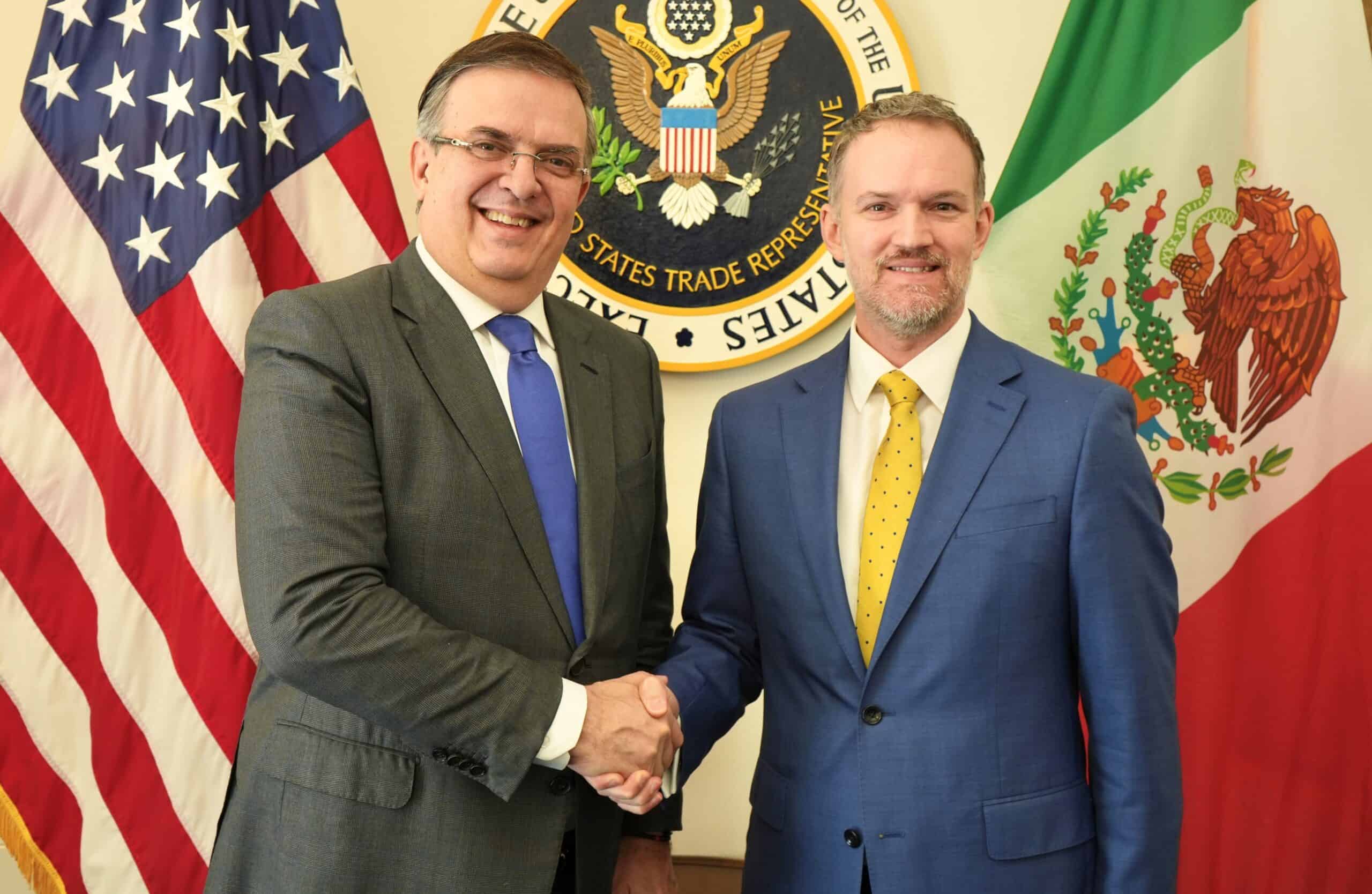
Mexico and the United States have set March 16 as the date to initiate the first round of formal talks in preparation for the Joint Review of the United States–Mexico–Canada Agreement (USMCA).
Missing from that first session in Washington, D.C., will be Canada. Mexico’s Economy Ministry (SE) and the Office of the U.S. Trade Representative (USTR) said the Canadians are expected to join the negotiations at an unspecified later date.
In a video posted to social media, Economy Minister Marcelo Ebrard said he and USTR Jamieson Greer agreed to begin the discussions “with a perspective of reviewing the USMCA” and enhancing trade integration.
In a March 5 statement, the USTR said “The ministers instructed negotiators to begin a scoping discussion on the necessary measures to ensure the benefits of the Agreement accrue primarily to the parties, including by reducing dependence on imports from outside the region, strengthening rules of origin, and enhancing the security of North American supply chains.”
After these initial talks, the USTR said the two sides would “meet regularly thereafter.”
The bilateral arrangement is not a new development. Last October, both Mexican and U.S. officials said they expected much of the negotiations during the 2026 review of the trilateral pact to be bilateral. In January, it was confirmed that bilateral discussions would indeed be held.
Sources within Mexico’s Economy Ministry told the newspaper La Jornada that Mexico will talk separately with Canada — which has its own strategy with regard to the U.S. — “in the coming weeks.” These talks will focus on strengthening cooperation on trade and security.
According to the USMCA bylaws, the first review of the agreement is scheduled for this year, 2026. If the partner countries agree, the treaty would be renewed for another six years, extending its expiration date from 2036 to 2042.
In the event that there is no agreement this year, successive annual reviews would follow until the parties agree to the renewal.
Mexico, the U.S. and Canada began preparations for this year’s USMCA review process months ago, holding domestic public consultations to assess the agreement’s performance and identify areas for improvement.
The USTR expressed concern about several policies of its partners that it believes undermine the spirit of the USMCA though it also acknowledged widespread support from the U.S. business community for the agreement.
Among the issues the USTR criticized are Mexico’s policy of favoring its state-owned energy companies and its lax labor laws.
Since the USMCA went into effect as the successor to NAFTA, Mexico has solidified its position as the main U.S. trading partner and vice versa. (X)
The Associated Press noted that the USMCA has allowed Mexico to largely avoid U.S. protectionist measures since many Mexican goods are covered within the trilateral agreement.
However, medium- and heavy-duty trucks, which face a 25% tariff and steel, aluminum and copper tariffs (50%) remain in effect, as does a 17% tariff on Mexican tomatoes.
Still, Mexico has solidified its position as the main U.S. trading partner and vice versa. According to the U.S. Department of Commerce, in 2025 the value of trade between the two countries (the sum of exports and imports) exceeded US $870 billion, a record high.
With reports from La Jornada, The Associated Press and El Economista