Your support helps us to tell the story
From reproductive rights to climate change to Big Tech, The Independent is on the ground when the story is developing. Whether it’s investigating the financials of Elon Musk’s pro-Trump PAC or producing our latest documentary, ‘The A Word’, which shines a light on the American women fighting for reproductive rights, we know how important it is to parse out the facts from the messaging.
At such a critical moment in US history, we need reporters on the ground. Your donation allows us to keep sending journalists to speak to both sides of the story.
The Independent is trusted by Americans across the entire political spectrum. And unlike many other quality news outlets, we choose not to lock Americans out of our reporting and analysis with paywalls. We believe quality journalism should be available to everyone, paid for by those who can afford it.
Your support makes all the difference.Read more
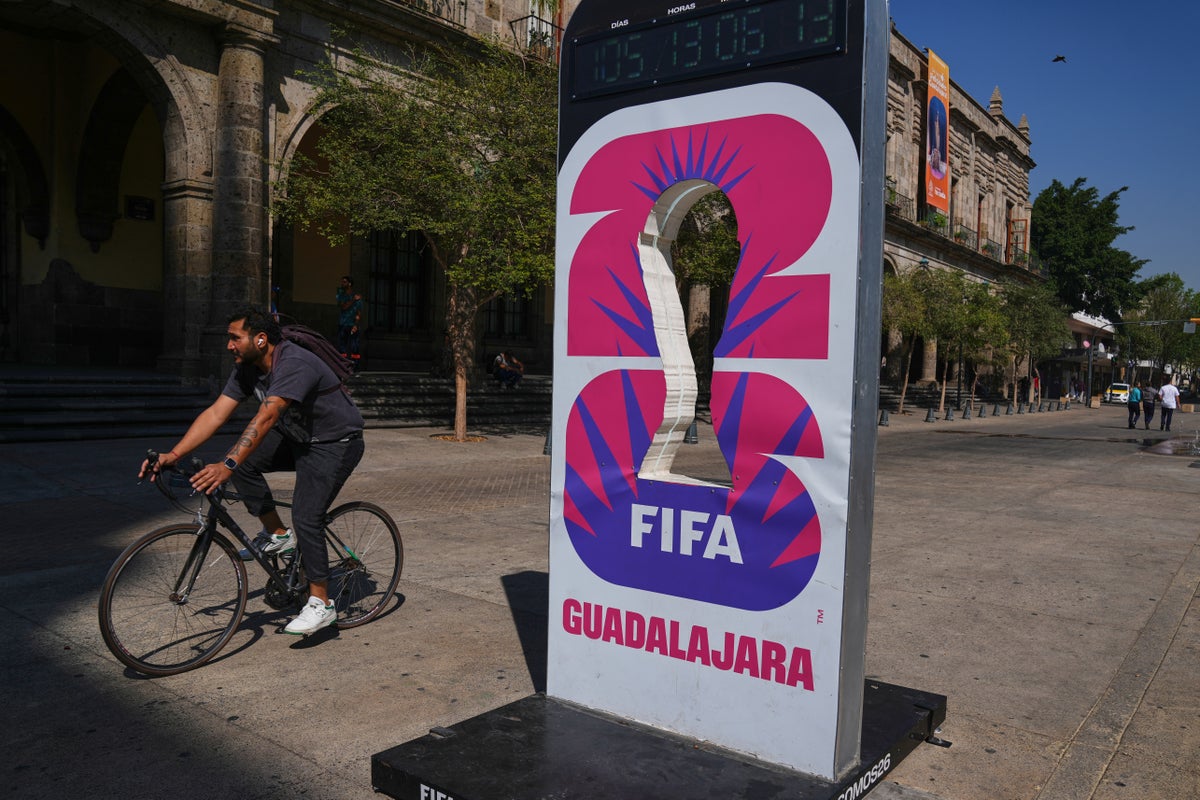
Mexican President Claudia Sheinbaum visited the western state of Jalisco on Friday to address growing security concerns ahead of the upcoming FIFA World Cup following a wave of violence in the region.
The violence was triggered by the killing of the most powerful drug lord in Mexico — Nemesio Oseguera Cervantes, or “El Mencho” — by Mexico’s army last month. Clashes between cartel gunmen and the burning of cars erupted across Mexico, but the violence has been most intense in Jalisco and its capital, Guadalajara, one of Mexico’s three host cities for the World Cup.
The wave of violence left more than 70 people dead, including 25 National Guard members, and sowed doubts in Mexico and beyond over the viability of the city hosting thousands of visitors.
Accompanied by her Security Cabinet and senior military commanders on Friday, Sheinbaum hosted her morning news briefing from military headquarters in the municipality where “El Mencho” was buried earlier this week under heavy guard and where the stadium that will host World Cup games is located.
“We are here … to tell everyone in Jalisco, all the people of Jalisco, that we are together, that we are working for peace, security and the well-being of the inhabitants of this beautiful state,” Sheinbaum said.
With fewer than 100 days until the World Cup, Sheinbaum and security officials detailed a security plan to be deployed during the summer sporting event involving more than 20 federal government agencies, including the Army and Navy, as well as local authorities.
Mexican Security Secretary Omar García Harfuch, the man behind Mexico’s offensive on the cartels, said that Mexico has worked with authorities in the United States, Canada and FIFA to strengthen planning and risk responses.
He added that the Mexican plan will include specialized training for officials, planning and operational exercises, early warning systems, security deployments around stadiums, airports, roadways and lodging centers, and protection schemes for delegations and attendees.
Sheinbaum has sought to project confidence in the face of doubts, including holding a phone call shortly after the burst of violence in late February with FIFA President Gianni Infantino, who expressed his “full confidence” that Mexico will be able to host part of the World Cup. Earlier in the week, she wrapped a FIFA scarf around her neck and posed next to the World Cup trophy.
On Friday, Gen. Román Villalvazo, who leads security coordination for the 2026 FIFA World Cup, said they had created three joint task forces in World Cup host cities Mexico City, Guadalajara and Monterrey.
“The 2026 FIFA World Cup organized by Mexico, the United States and Canada represents an unprecedented event,” he said.
“For Mexico, it entails two challenges: to present a reliable and secure country before the international community, and to have the capacity to confront any threats that undermine national security.”
___
Follow AP’s coverage of Latin America and the Caribbean at https://apnews.com/hub/latin-america