The National Institute of Statistics and Geography (INEGI) reported over 5,000 more homicides in 2025 than the federal government’s Executive Secretariat of the National Public Security System (SESNSP), the largest gap in more than a decade.
INEGI reported on Tuesday that there were 29,488 homicides (or alleged homicides) in Mexico in 2025. According to INEGI’s “Registered Death Statistics” report, homicide was the eighth leading cause of death in Mexico last year.
INEGI’s homicide count is 5,140 higher than the combined number of homicides and femicides reported by the SESNSP in 2025. In percentage terms, the number of homicides reported by INEGI is 21.2% higher than the 24,348 homicides and femicides reported by the SESNSP.
The gap between the two numbers is the highest in the last 11 years, according to the news outlet Animal Político.
The difference is 95.3% higher than in 2024, when INEGI’s homicide total was 2,632 higher than the SESNSP count. It should be noted that the SESNSP’s homicide data is compiled from statistics it receives from the Attorney General’s Offices in Mexico’s 32 federal entities.
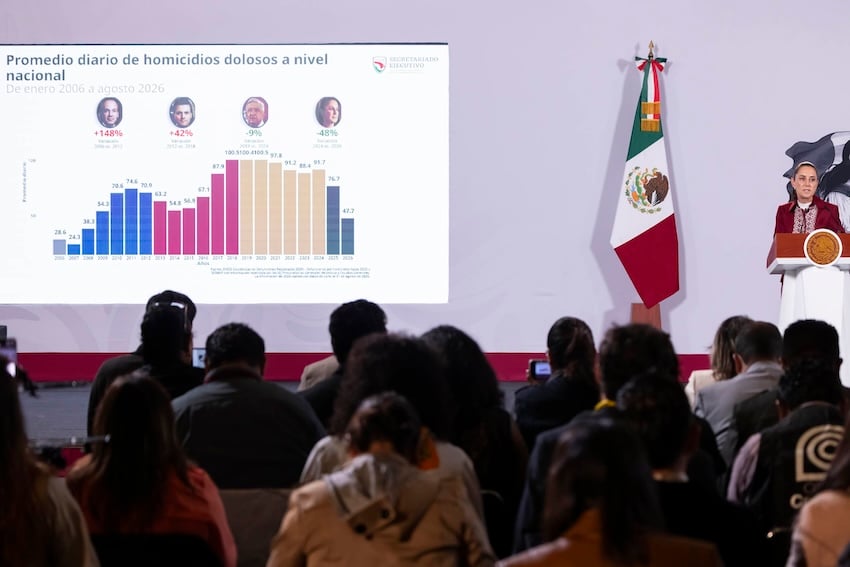
Marcela Figueroa, the head of the National Public Security System, reports the compiled data on a monthly basis at President Claudia Sheinbaum’s morning press conferences.
As Mexico News Daily reported in January, the reliability of the statistics the state-based Attorney General’s Offices provide to the SESNSP is considered by many to be questionable. There have also been claims that the decline in homicides during Sheinbaum’s presidency is related to an increase in disappearances.
“State Attorney General’s Offices don’t work in a vacuum,” Alberto Guerrero Baena, a public security consultant and academic, wrote in a column published by the news outlet Expansión in January.
“They operate under budgetary, political and media pressures. When a homicide is difficult to prove or requires lengthy investigation, there is an incentive to reclassify it as injury, accidental death or a lesser crime. … An unresolved homicide looks bad in the statistics. A [fatal] injury unrelated to homicide looks better,” Guerrero wrote.
Is security in Mexico improving or are the numbers being manipulated?
The homicides reported by the SESNSP (and referred to above) are homicidios dolosos, or intentional homicides. Homicidios culposos — negligent or culpable homicides — are categorized separately by the federal government agency.
Why the discrepancy?
In a report published on Wednesday, Animal Político noted that the difference between INEGI’s homicide statistics and those of the SESNSP is not new, although it has increased significantly in recent years. The difference, the news outlet added, is explained, “in part,” by their methodologies.
For its homicide count, INEGI looks at death certificates and records as well as information from civil registry offices, forensic services and Attorney General’s Offices. In classifying a death as a homicide, INEGI looks closely at the cause of the death.
The SESNSP simply compiles the statistics it receives from the Attorney General’s Offices in Mexico’s 32 federal entities. It essentially takes the fiscalías, as the offices are called, at their word, despite allegations that they — or at least some of them — are fudging the numbers.
In an Oct. 30 column published by the Saltillo-based newspaper Vanguardia, Víctor Manuel Sánchez Valdés, a professor and researcher at the Autonomous University of Coahuila, wrote that INEGI’s statistics “are usually more reliable” than those of the SESNSP as INEGI “cross-checks various sources.”
Most of Mexico’s fiscalías — but not all— are formally autonomous of the governments in the states in which they operate. Still, there are claims by opposition politicians and others that fiscalías in states governed by Morena, Mexico’s ruling party, are manipulating data to make the country’s homicide toll appear lower than it actually is.
“Morena doesn’t fight violence, it covers it up,” National Action Party Senator Mayuli Martínez said in June.
“… It is concerning that in Quintana Roo there are six times as many homicides classified as negligent [homicidio culposo] as there are those classified as intentional [homicidio doloso],” she said.
“When more cases [involving the death of a person] are classified under categories other than intentional homicide, it creates an artificial impression of improvement in public safety indicators,” Martínez said.
Quintana Roo is one of 23 states governed by Morena. Data showing declining homicide numbers is, of course, politically beneficial to the federal government and Morena.
President Sheinbaum and other federal officials frequently cite the homicide statistics reported by the SESNSP as evidence that the government’s security strategy is working. On Tuesday, Figueroa, the National Public Security System chief, reported that homicides were down 50% in October compared to September 2024, the final month of Andrés Manuel López Obrador’s presidency.
President Sheinbaum has achieved an impressive reduction in homicides since taking office. Doubts surrounding the government’s collection of that data resurfaced on Tuesday, however, following the striking revision to México state’s October homicide rate. (Juan Carlos Ramos/Presidencia)
Among the five states that recorded the biggest year-over-year reductions in homicides in the first 10 months of 2026, three are governed by Morena (Nayarit, Quintana Roo and Baja California Sur), one is governed by the Green Party (San Luis Potosí), an ally of Morena, and one is governed by the Citizens Movement Party (Nuevo León).
Sheinbaum has rejected claims that state fiscalías are manipulating statistics.
“Homicide is homicide, there is no manipulation. It’s not that there are crimes that go from [being classified as] one crime to another crime,” she said at her July 14 press conference.
At the same press conference, Figueroa said that the methodology that state Attorney General’s Offices are required to follow when classifying crimes is “very clear” and “public.”
Still, not everyone is buying federal officials’ assurances that state fiscalías’ homicide figures are accurate.
In his Oct. 30 column, Sánchez poses the question on many Mexicans’ lips: Is violence in Mexico really decreasing?
“The quick answer is yes, but we don’t know the exact extent [of the reduction],” he wrote.
“… Despite these [alleged] manipulations that seek to artificially reduce intentional homicides, everything indicates that there has been a reduction [in violence] since Claudia Sheinbaum came to power and the [new] security strategies were implemented by [Security Minister] Omar García Harfuch,” Sánchez wrote.
In other words, he (and many other Mexicans) believes that homicides have gone down, but not as much as the data compiled by the SESNSP indicates.
Security Ministry: SESNSP homicide numbers are ‘complementary’ and ‘show the same trend’
In early August, shortly after INEGI published preliminary homicide data for 2025, the federal Security Ministry (SSPC) released a statement titled “INEGI’s vital statistics confirm the decline in intentional homicides in 2025.”
INEGI’s preliminary statistics showed a 16.6% year-over-year reduction in homicides in 2025, more than four points higher than the 12.1% decline according to the final data published on Tuesday. According to SESNSP data, the year-over-year reduction in homicides in 2025 was 21.2%. At 9.1 percentage points, the difference between the reduction in homicides reported by INEGI and the decline reported by the SESNSP is not insignificant.
In its statement, the SSPC wrote that “the measurement of intentional homicide by INEGI and SESNSP are complementary exercises that use different methodologies and serve different purposes.”
The ministry said that the difference between their homicide numbers is “expected” as “each institution performs different functions, uses different [data] integration procedures, has different collection, validation, and publication periods, and generates information for specific purposes.”
Still, “the trend shown by both sources” is “consistent” with the progress made under the national security strategy, the SSPC said.
“Both sources show the same trend with respect to the evolution of intentional homicide,” the ministry said.
INEGI’s 2025 homicide data in brief
- INEGI reported that there were 29,488 homicides in 2025, a reduction of 12.1% compared to the 33,550 homicides in 2024.
- Almost nine in ten homicide victims in 2025 (87.5%) were men. Women accounted for 11.3% of victims while the sex of the deceased person wasn’t specified in 1.2% of cases.
- Almost three in ten homicide victims (28.2%) were men aged 25 to 34.
- Homicide was the leading cause of death in 2025 for men aged 25 to 34 and men aged 35 to 44.
- Mexico recorded 22.6 homicides per 100,000 residents in 2025. There were 40.5 homicides per 100,000 men and 5 homicides per 100,000 women.
- Among Mexico’s 32 federal entities, Guanajuato recorded the highest number of homicides in 2025 with 3,334. México state ranked second with 2,618 homicides, followed by Chihuahua (2,291), Baja California (2,144) and Sinaloa (1,966).
- Mexico City recorded 830 homicides last year, the 16th highest total among the 32 federal entities.
- Yucatán was the only entity that recorded fewer than 100 homicides in 2025. There were 59 homicides in the state.
- Colima recorded the highest number of homicides per 100,000 residents in 2025, with 92.6. Sinaloa ranked second with 62.3 homicides per 100,000 people, followed by Morelos (58.6), Chihuahua (58) and Baja California (56.8).
- The cause of death in 70.6% of homicides was a gunshot wound or wounds. Stabbings were the second most common means of homicide, accounting for 9.5% of cases. About one in 15 homicides (6.6%) involved hanging, strangling or suffocation.
With reports from Animal Político