The recent opinion piece in Times of Malta penned by MTA CEO Carlo Micallef rightly questions whether headcount alone is an intelligent way to assess tourism performance. On that point, there should be broad agreement that measuring headcount alone is not enough.
Measuring success purely by arrivals is a blunt instrument. It tells us how many people entered the country but it says nothing about the quality of their experience, the pressure exerted on infrastructure or the real economic value retained.
However, replacing arrivals with guest nights does not fundamentally change the paradigm. It risks being a more technical version of the same volume-driven logic. Within the hospitality sector, guest nights are a standard and useful operational key performance indicator (KPI). They combine occupancy and length of stay into a single figure. But, at national policy level, guest nights still incentivise throughput. They remain a measure of scale, not of value.
Consider a simple example. Ten guest nights can be generated in two ways: two guests staying five nights each or five guests staying two nights each. Statistically, both scenarios produce the same result – 10 guest nights. In practice, the impact differs significantly.
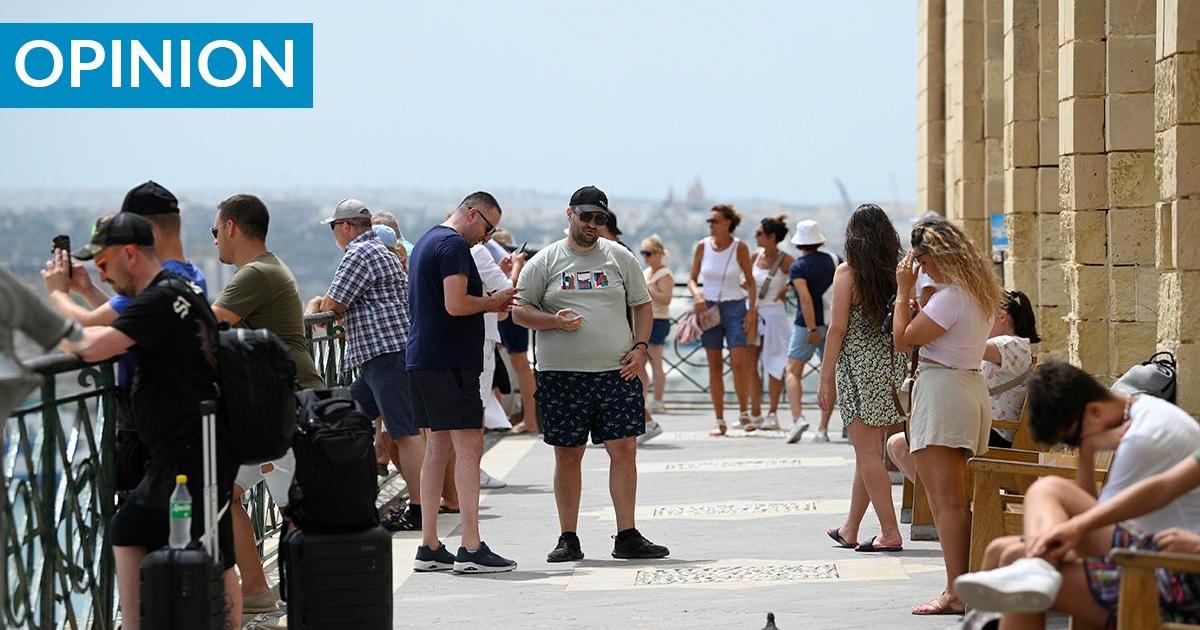
Five short-stay guests create more concentrated movement. With limited time, they are more likely to focus on the “must-see” sites, clustering in Valletta, Mdina, Comino and other high-profile locations during peak hours. They generate more airport movements, more frequent check-ins and check-outs and more compressed demand on transport, public spaces and heritage assets. The dispersion through time and place is reduced.
Two longer-stay guests, by contrast, are more likely to pace their visit. They have time to explore secondary localities, return to the same neighbourhood and participate in more immersive experiences. The economic return per visitor may be higher, while the intensity of daily pressure is lower.
Guest nights do not distinguish between these realities. They reward accumulation, not optimisation.
If we accept the principle that what gets measured shapes behaviour, then the choice of metric is not neutral. A volume-based indicator will inevitably push marketing, route development and planning policy toward increasing flows. The system will be calibrated to maximise numbers, because numbers are what signal ‘success’.
Yet, tourism sustainability is not fundamentally a mathematical problem. It is a social one.
Rather than invoking the often-contested notion of ‘carrying capacity’, it may be more precise to speak about limits of acceptable change. Every community has a threshold beyond which tourism alters daily life in ways that residents find intrusive or unfair. These limits are not fixed and cannot be reduced to a single number. They relate to congestion, housing pressures, noise, environmental degradation and the perception that public spaces are no longer primarily for residents.
Growth should be measured by improvement in value per visitor– Alan Arrigo
The question, therefore, is not simply how many tourists Malta can host. It is how tourism growth affects the lived experience of residents and whether the economic value generated justifies the social trade-offs.
This is why inflation-adjusted expenditure per tourist is a more intelligent national indicator.
Adjusting for inflation removes distortions caused by rising prices. Nominal increases in spending can simply reflect cost escalation, not genuine upgrading of the tourism offer. Measuring expenditure per tourist, in real terms, focuses attention on value creation rather than raw expansion.
It captures several critical dimensions at once: length of stay, depth of experience, product quality and the destination’s ability to command a premium because of authenticity and differentiation. It discourages strategies that chase high volumes at low margins. Instead, it encourages upgrading.
The Malta Chamber has long argued that this is the most meaningful benchmark of performance. If real expenditure per tourist rises sustainably over time, it signals that Malta is delivering a higher-quality experience and attracting segments that contribute proportionately more to the economy relative to their footprint.
In 2025, Malta recorded a modest improvement in inflation-adjusted expenditure per tourist. The increase was only marginal, as inflation absorbed much of the nominal growth and average length of stay declined. This should temper any celebratory tone. When stays shorten while flows increase, pressure intensifies without a commensurate uplift in real value.
If we are serious about aligning tourism with resident well-being, the policy framework must follow the metric.
Promotion should prioritise longer stays and experiential depth rather than short, compressed visits. Planning policies should emphasise qualitative upgrading over bed proliferation. Product development funds should support heritage, culture, environmental enhancement and niche segments that justify extended visits.
This approach does not reject growth. It reframes it. Growth should be measured by improvement in value per visitor, not by expansion in headcount or guest nights alone.
Tourism policy cannot be reduced to a scoreboard of ever-rising figures. The real benchmark is whether the sector generates sufficient value to maintain public support, protect environmental assets and enhance, rather than erode, daily life.
Celebrating guest nights instead of arrivals may appear progressive. But unless we shift toward measuring real value per tourist, we risk continuing to optimise for volume while debating, year after year, why residents feel the strain.
The metric we elevate shapes the system we build. If we want tourism that is economically robust and socially acceptable, we must measure accordingly.
Alan Arrigo is a board member and council member of The Malta Chamber of Commerce Enterprise and Industry.