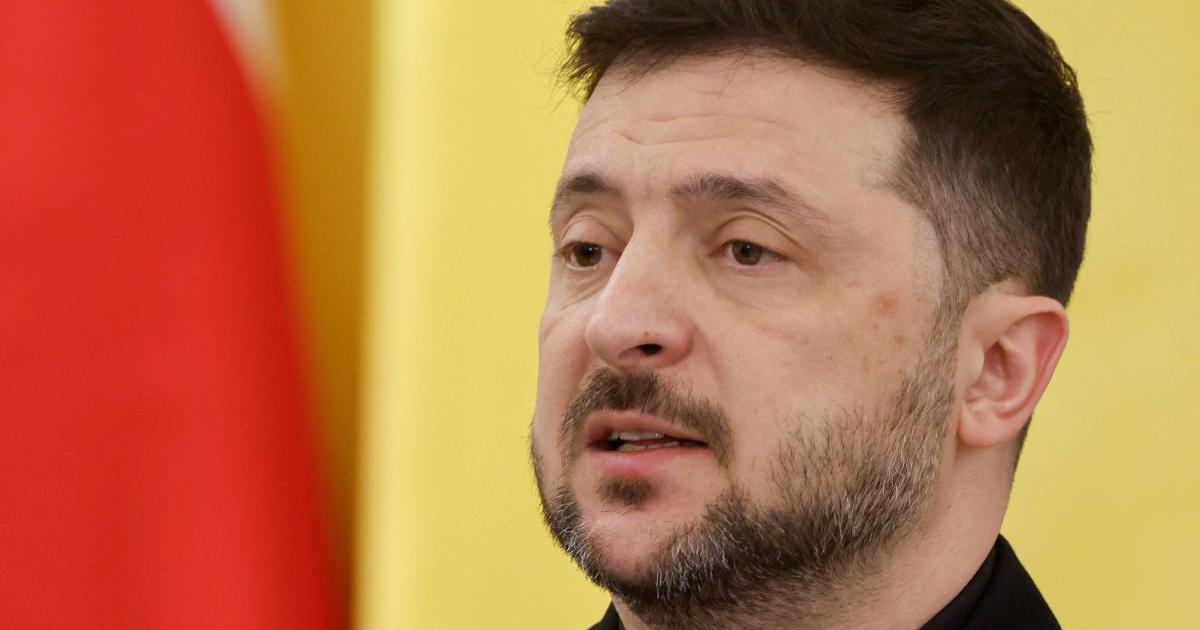
Ukrainian President Volodymyr Zelensky has revealed details of the latest US-led plan to end the war in Ukraine, saying it had been agreed between negotiators from Kyiv and Washington and sent to Moscow for feedback.
The document will be supplemented by additional bilateral agreements between the United States and Ukraine on security agreements and reconstruction.
Zelensky did not publish a draft of the document, but outlined the plan’s contents point-by-point in a briefing with journalists, including AFP, in Kyiv.
He said the latest version of the plan to end the Russian invasion would freeze the front line, but still pave the way for Ukrainian withdrawals and the creation of demilitarised zones.
The Kremlin is unlikely to abandon its hardline territorial demands and Zelensky also conceded there are some points in the document that he does not like.
But it appears Kyiv has managed to shift the plan away from an original 28-point US proposal, which adhered to many of Russia’s core demands.
That plan had demanded that Ukraine withdraw from the 20 percent of the Donetsk region it still controls and that land occupied by Moscow be recognised as Russian territory.
A requirement for Kyiv to legally renounce its bid to join NATO has also been dropped from the latest plan, though the United States has long said it would not admit Ukraine to the bloc.
“In the Donetsk, Lugansk, Zaporizhzhia, and Kherson regions, the line of troop deployment as of the date of this agreement is de facto recognised as the line of contact,” Zelensky said of the latest version.
“A working group will convene to determine the redeployment of forces necessary to end the conflict, as well as to define the parameters of potential future special economic zones,” he added.
New options
Zelensky’s latest plan opens the way for, but delays, options that Ukraine was previously reluctant to consider – a withdrawal of troops and the creation of demilitarised zones.
“We are in a situation where the Russians want us to withdraw from the Donetsk region, while the Americans are trying to find a way,” Zelensky said.
“They are looking for a demilitarised zone or a free economic zone, meaning a format that could satisfy both sides,” he continued.
Ukraine also suggested Energodar, a city occupied by Russia that manages the Zaporizhzhia power plant, could become a demilitarised zone.
Any plan that involves Ukraine pulling back its troop would need to pass a referendum in Ukraine, Zelensky said.
“A free economic zone. If we are discussing this, then we need to go to a referendum,” Zelensky said.
The plan also sees joint US-Ukrainian-Russian management of the Zaporizhzhia plant, occupied by Russian troops. Zelensky said he does not want any Russian oversight of the facility.
He also said Ukraine would hold presidential elections only after an agreement is signed.
The 20-point plan
Here is a verbatim transcript of how Zelensky described the contents of the deal, translated from Ukrainian.
1. Ukraine’s sovereignty will be reaffirmed. We state that Ukraine is a sovereign state, and all signatories to the agreement confirm this through their signatures.
2. This document constitutes a full and unconditional non‑aggression agreement between Russia and Ukraine. To support long‑term peace, a monitoring mechanism will be established to oversee the line of contact through space-based unmanned monitoring, to ensure early notification of violations, and to resolve conflicts. Technical teams will agree on all details.
3. Ukraine will receive strong security guarantees.
4. The strength of the Armed Forces of Ukraine will remain at 800,000 personnel in peacetime.
5. The United States, NATO, and the European signatory states will provide Ukraine with security guarantees that mirror Article 5.
a. If Russia invades Ukraine, in addition to a coordinated military response, all global sanctions against Russia will be reinstated.
b. If Ukraine invades Russia or opens fire on Russian territory without provocation, the security guarantees will be considered null and void. If Russia opens fire on Ukraine, the security guarantees will enter into force.
d. Bilateral security guarantees are not excluded under this agreement.
6. Russia will formalise a policy of non‑aggression toward Europe and Ukraine in all necessary laws and all required documents on ratification documents.
7. Ukraine will become a member of the European Union within a specifically defined period of time, and Ukraine will receive short‑term privileged access to the European market.
8. A strong global development package for Ukraine, to be defined in a separate agreement on investment and future prosperity. This will cover a broad range of economic areas, including but not limited to:
a. The establishment of a Ukraine Development Fund to invest in high‑growth sectors, including technology, data centres, and artificial intelligence.
b. The United States and US companies will cooperate with Ukraine and jointly invest in recovery, as well as in the development, modernisation, and operation of Ukraine’s gas infrastructure, including its pipelines and storage facilities.
c. Joint efforts will be made to reconstruct war‑affected areas, with the aim of restoring, rebuilding, and modernising cities and residential neighbourhoods.
d. Infrastructure development.
e. The extraction of minerals and natural resources.
f. The World Bank will provide a special financing package to ensure funding to accelerate these efforts.
g. A high-level working group will be established, including the appointment of a leading global financial leader as a prosperity administrator to organise the implementation of the strategic recovery plan and to maximise opportunities for future prosperity.
9. Several funds will be established to address the recovery of Ukraine’s economy, the reconstruction of damaged areas and regions, and humanitarian issues
a. The United States and European countries will establish a capital and grants fund with a target size of $200 billion for transparent and effective investment in Ukraine.
b. A broad range of capital investments and other financial instruments will be deployed for Ukraine’s post-war reconstruction. Global reconstruction institutions will use mechanisms to bolster and facilitate these efforts.
c. Ukraine will implement best global standards to attract foreign direct investment.
d. Ukraine reserves the right to compensation for the damage inflicted.
10. Following the conclusion of this agreement, Ukraine will accelerate the process of concluding a free trade agreement with the United States.
11. Ukraine confirms that it will remain a non‑nuclear state in accordance with the Treaty on the Non‑Proliferation of Nuclear Weapons.
12. The Zaporizhzhia Nuclear Power Plant will be jointly operated by three countries: Ukraine, the United States, and Russia.
13. Both countries commit to implementing educational programs in schools and across society that promote understanding and tolerance toward different cultures and that eliminate racism and prejudice. Ukraine will implement European Union rules on religious tolerance and the protection of minority languages.
14. In the Donetsk, Luhansk, Zaporizhzhia, and Kherson regions, the line of troop deployment as of the date of this agreement is de facto recognized as the line of contact.
a We de facto confirm as parties that this is the line of contact – where we are currently positioned.
b. A working group will convene to determine the redeployment of forces necessary to end the conflict, as well as to define parameters for potential future special economic zones.
c. After an equivalent basis for the movement of forces, international forces will be deployed along the line of contact to monitor compliance with this agreement. Should a decision be made to establish such a zone, it will require special approval by the Ukrainian parliament or a referendum
d. The Russian Federation must withdraw its troops from the Dnipropetrovsk, Mykolaiv, Sumy, and Kharkiv regions for this agreement to take effect.
e. The parties agree to adhere to the rules, guarantees, and obligations of the 1949 Geneva Conventions and their additional protocols, which apply in full to the territory, including universally recognised human rights.
15. After reaching an agreement on future territorial arrangements, both the Russian Federation and Ukraine undertake not to alter these agreements by force.
16. Russia will not obstruct Ukraine from using the Dnipro River and the Black Sea for commercial purposes.
17. A humanitarian committee will be established to resolve outstanding issues.
a. All remaining prisoners of war, including those convicted by the Russian system from 2014 to the present, will be exchanged on an all‑for‑all basis.
b. All detained civilians and hostages, including children and political prisoners, will be returned.
c. Measures will be taken to address the problems and suffering of conflict victims.
18. Ukraine must hold elections as soon as possible after the agreement is signed.
19. This agreement is legally binding. Its implementation will be monitored and guaranteed by a Peace Council chaired by President Trump. Ukraine, Europe, NATO, Russia, and the United States will be part of this mechanism. Sanctions will apply in case of violations.
20. Once all parties agree to this agreement, a full ceasefire will take effect immediately.