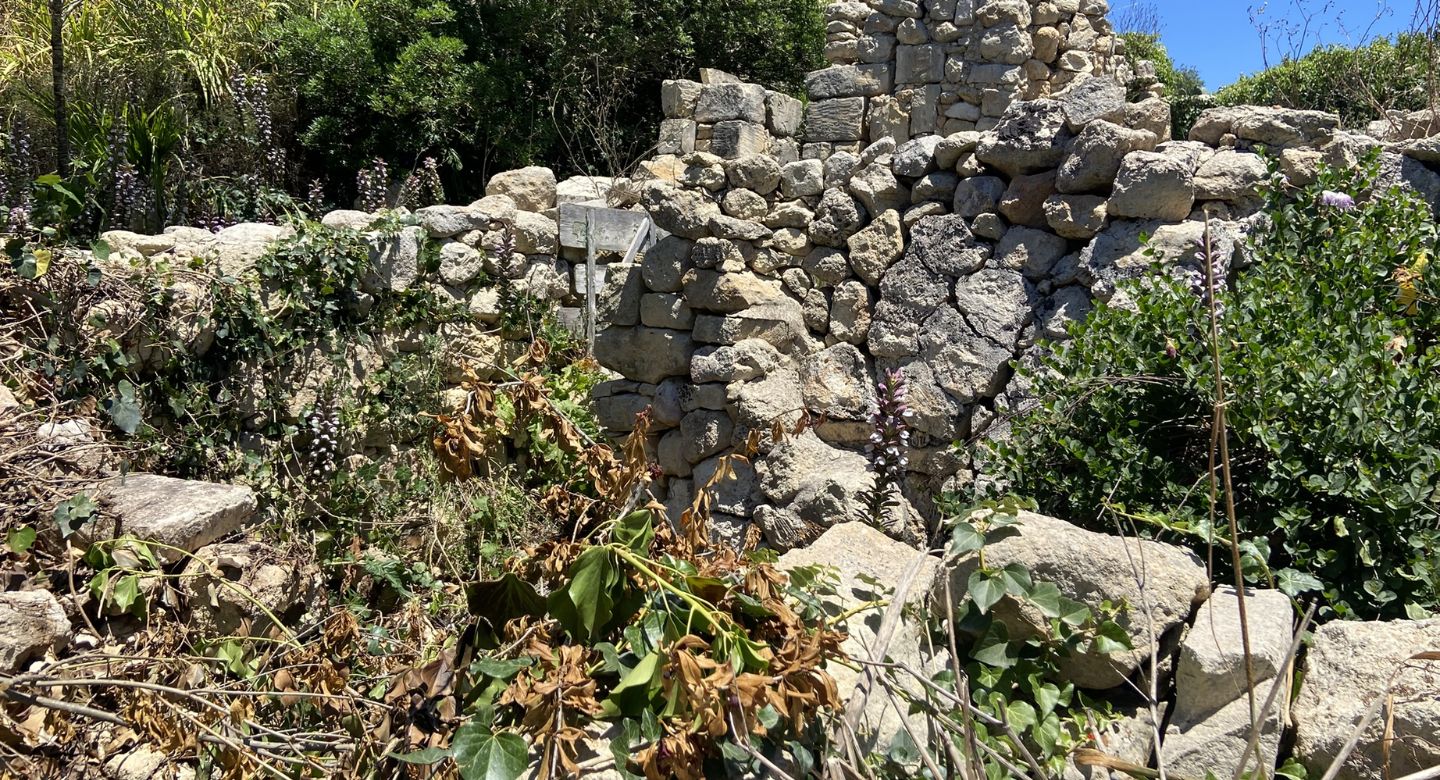
Two government watchdogs have performed a dramatic U-turn on a controversial plan to convert protected ruins in the heart of Buskett into so-called “farmer’s quarters”, reviving an application that the Planning Authority’s own technical experts continue to insist should be refused.
The latest reversal, involving the Environment and Resources Authority (ERA) and the Superintendence for Cultural Heritage, is set to place the controversial proposal back before the Planning Commission next week and has reignited concerns about how Malta’s planning system is operating.
The application, filed by developer Alex Tanti, seeks to convert a dilapidated rural structure at Ta’ Żejnu into what is described as a farmer’s dwelling complete with living quarters and a cesspit, a common tactic to justify a pool.
Since first revealing the application last year, The Shift has reported extensively on the proposal because the site lies within one of Malta’s most environmentally protected locations, forming part of the Natura 2000 Buskett and Wied il-Girgenti protected area.
The application had appeared destined for refusal.
Last year, ERA described the proposal as environmentally unacceptable, warning it would introduce urban-type development into protected countryside, degrade the site’s rural character and create pressure for similar developments in one of Malta’s most sensitive landscapes.
The Superintendence for Cultural Heritage had also refused to endorse the proposal, demanding substantial revisions and additional technical studies before taking any position.
Following those objections, the PA’s case officer recommended refusal, and the applicant requested a suspension to revise the project.
However, after months behind closed doors, both regulators have quietly changed their position.
Internal PA documents seen by The Shift show that ERA has now withdrawn its objections and issued a clearance subject to conditions. The Superintendence has also granted its clearance, likewise subject to conditions and a bank guarantee.
Neither Authority has publicly explained what changed to justify abandoning the objections they had previously considered fundamental.
Despite the regulators’ reversal, the PA’s own Development Management Directorate has so far remained consistent.
In a fresh assessment prepared ahead of next week’s hearing, the Directorate concludes that the proposal still breaches rural planning policies and should be refused.
Officials point out that this is already the third attempt to develop the site after two previous applications were withdrawn. They maintain that there is no evidence that the existing structure was roofed before 1967 or 1978, that no planning permits have ever existed for a dwelling on the site, and that no evidence has been produced that anyone ever legally resided there.
The Directorate is also rejecting the applicant’s claim that the project qualifies as a farmer’s residence.
The area targeted for development.
It noted that the Agricultural Advisory Committee concluded there was no genuine agricultural need to justify such development after finding that the applicant’s registered holding is not under cultivation. The landholding is relatively small, and no evidence of active farming has been produced.
According to the Directorate, the proposal would effectively create a brand new residence outside the development zone under the guise of a farmer’s quarters.
Officials further concluded that the rebuilding itself is excessive.
They argued that the proposed additions substantially exceed what is permitted under rural planning policy and criticised the extensive use of glass as incompatible with the surrounding rural landscape.
The Directorate is insisting that the proposal breaches the Rural Policy and Design Guidance because there is no lawful residential building capable of conversion, no genuine agricultural justification and no planning basis for creating a new dwelling in protected countryside. It therefore recommends outright refusal.
The case will now be determined by the Planning Commission, which is not bound by the Directorate’s recommendation.
The Buskett application is the latest example of a recurring pattern within Malta’s planning system, where projects initially opposed by technical regulators are kept alive through suspensions, revised submissions and unexplained changes in position by public authorities.
Even illegal construction is kept alive through a sanctioning process introduced by the government, allowing a practical free-for-all.