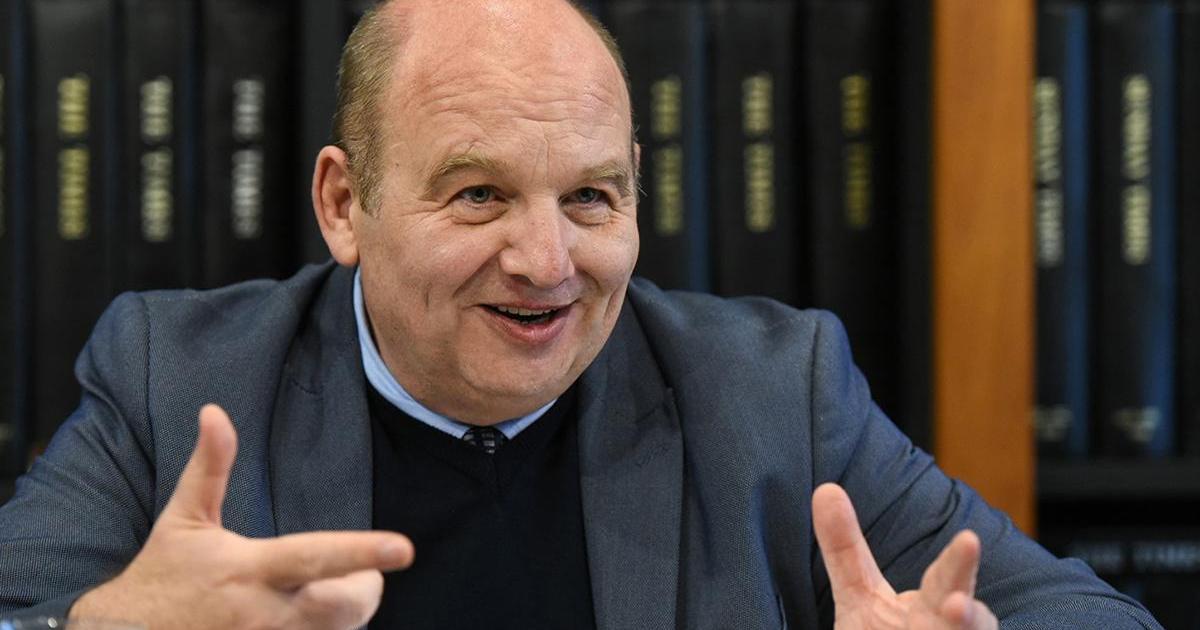
The head of the European Parliament’s translation service has described EP president Roberta Metsola as “one of the biggest defenders of multilingualism” while highlighting recent steps taken to beef up Maltese interpretation services at the EU.
Director general for translation at the EP, Valter Mavrič, heads up around 1,200 translators, which he notes is the biggest service within the parliament.
Describing Maltese as one of an “elite group” of 24 languages that are represented at every EU meeting, Mavrič said all languages were considered equal across the Union, with documents provided in all official European languages.
When it comes to interpretation services, however – referring to providing different language services for the spoken word, versus the written word, in the case of translation – he pointed to a gap in Maltese.
Because while Maltese interpretation is provided for every plenary session at the parliament, as well as committee meetings where Maltese members are scheduled to attend, a lack of interpreters meant it was not possible to provide interpretation services in every meeting, he explained.
“To have the perfect organisation, you need to have a permanent structure of people, and in translation, we have had that for more than 10 years. But for interpretation, they have had a few issues,” he said.
That gap means that every six months, when a report on languages is prepared for the Bureau of the European Parliament – a body led by the EP president – an “exemption” must be noted for Maltese, as well as Irish, which also faces challenges.
The number of Maltese interpreters available on the market remains limited– EP Press Services
“Every six months, unfortunately, we still have to say that for Irish and Maltese interpretation, there is a derogation [exemption], meaning there is not the full possibility of having Maltese and Irish for every meeting,” said Mavrič.
A lack of Maltese translators has remained a sticking point for some time; in 2023, MEPs Alex Agius Saliba and David Casa branded the lack of interpreters available for committee meetings as “unacceptable”.
And in 2005, former Labour MEP and later Prime Minister Joseph Muscat refused to continue addressing the EP after being informed no interpreters were present.
The EP press services told Times of Malta that it employed one staff interpreter and 29 freelancers, with at least three interpreters required for each booth to operate effectively.
“Despite important interinstitutional efforts, the number of Maltese interpreters available on the market remains limited”, it said.
Reskilling translators
One person who has been keen to address this gap is the EP president, Mavrič noted.
“You guys have the best defender of multilingualism, because she comes from such a language,” he said, referring to Metsola.
“She’s really one of the biggest defenders of multilingualism in our house, and she’s genuinely always interested in what we do, and supports our services a lot”.
And that support has extended to a recent initiative to draft more interpreters into service by reskilling existing translators, a programme that recently saw four Maltese translators graduate from an intensive 20-week course at the European Parliament Interpreting Academy.
Translators Victor Bonanno, Josette Borg, Gavin Muscat and Aidan De Carlo passed their final exam last week, graduating as interpreters.
Four translators have reskilled as interpreters to help fill a gap in Maltese interpretation services at the European Parliament. Photo: European Parliament
Addressing the four at their graduation, Metsola emphasised that, “What you do as translators and interpreters matters. As elected members, our responsibility is to speak for the people we represent and to explain our decisions clearly. But if it weren’t for you, that would be impossible”.
But the initiative did not end there.
Malta workshops
In fact, Mavrič was speaking to Times of Malta during a recent visit to the country, when he ran a series of workshops, held at parliament, for those interested in becoming translators, and perhaps eventually, interpreters.
“We talked to many university students this week and did a lot of workshops,” he said of the initiative. “I’m really happy we did this project and contributed to solving the problem of interpretation”.
Mavrič noted that the workshops had seen good attendance, despite being organised across a public holiday, with the first part of the course carried out in English, explaining the role of translators, and the second, involving translation exercises, in Maltese.
Mavrič also visited the University of Malta to speak to students about a career in translation. Photo: University of Malta/Facebook.
So, what skills make for a good translator?
“It’s love of the mother tongue – and this is common both to interpreters and translators,” he said. “I am reminded of this when I come to Malta; wherever I go, people are so proud that their language is one of the EU’s elite group of 24 languages”.
Maltese did ‘really well’ in AI testing
Despite the rapid rise of artificial intelligence, Mavrič noted that, at least for now, translation and interpretation services were still carried out by professionals, whom he stressed played an important role in determining the most appropriate translation of critical documents such as new European laws and texts on human rights, for example.
However, testing of AI models for translation of official texts is underway at the EU – testing in which Maltese has excelled.
“Maltese did really well; it ranked first out of 23 languages for how well the machine behaved,” he said, attributing the results to Malta’s young and technology-embracing language community, who he said had trained AI models by frequently using them.
This is the best job in the world– Valter Mavrič
Yet while EP translators already use an in-house ‘memory cloud’ to compare new texts requiring translation to those already translated, the director warned that using AI more in their work would likely create more work for language professionals than ease their workload.
“It’s more work than with the memory system, because that, at least, colour-codes sections that are not translated, for example, the AI would just give you a new solution,” said Mavrič, while acknowledging the technology could yet prove to be a useful tool as it develops.
‘Dream job’
What would he say to those considering joining the ranks of EP translators?
“For language professionals, this is the best job in the world – not only because of financial reasons, but also for professional reasons,” he said.
“When I was studying languages, we all knew that sooner or later we would like to have a job there [the EP], that it would be our dream job – and that is still present nowadays in universities.”