Your support helps us to tell the story
From reproductive rights to climate change to Big Tech, The Independent is on the ground when the story is developing. Whether it’s investigating the financials of Elon Musk’s pro-Trump PAC or producing our latest documentary, ‘The A Word’, which shines a light on the American women fighting for reproductive rights, we know how important it is to parse out the facts from the messaging.
At such a critical moment in US history, we need reporters on the ground. Your donation allows us to keep sending journalists to speak to both sides of the story.
The Independent is trusted by Americans across the entire political spectrum. And unlike many other quality news outlets, we choose not to lock Americans out of our reporting and analysis with paywalls. We believe quality journalism should be available to everyone, paid for by those who can afford it.
Your support makes all the difference.Read more
Pieces of rocket debris bearing the logo of India’s space agency have been recovered on a remote, uninhabited island in the Maldives.
A resident of L Kunahandhoo, one of the islands of Laamu Atoll, reportedly discovered the fragments while out fishing.
The regional council president told local news that the man found the fragments on an uninhabited island and brought them to Kunahandhoo, unaware that they were rocket parts.
“It was only after they were placed in the Kunahandhoo boatyard area and seen by some youths that it was realised (they were parts of a rocket),” the council president Ibrahim Shakeeb said.
Writings on the fragments indicate they were from a rocket launched in 2025.
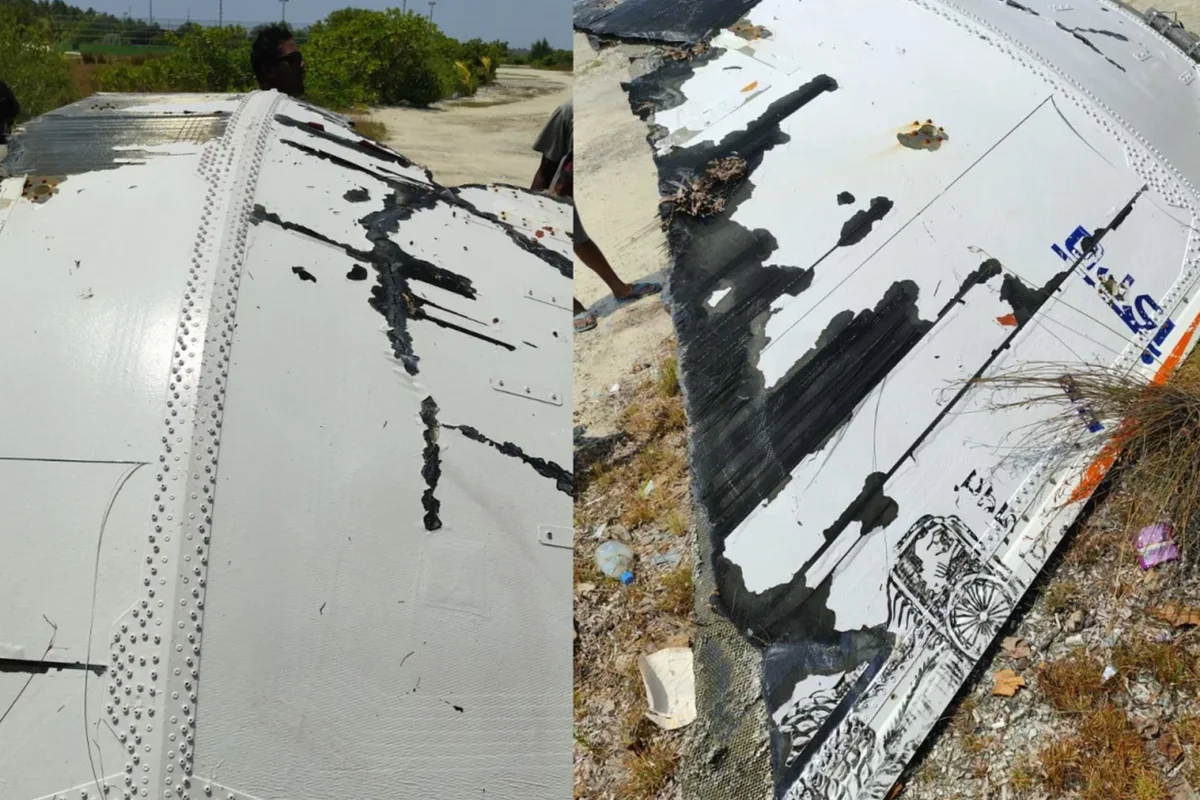
The logo of the Indian Space Research Organisation (Isro) can be seen on the debris in photos shared by the Kunahandhoo Council, along with scorch marks likely from space re-entry.
Local authorities have collected the fragments for further analysis.
Isro is yet to issue an official statement regarding the discovery.
Debris thought to be from Indian rocket (Kunahandhoo Council)
Images shared on social media show a white painted structural component with rivets, composite panels, and abrasion marks.
Numbers on the debris hint it may have been part of an Isro payload fairing, which protects satellites against heat and pressure during a space rocket’s ascent.
Fairings are made to burn and fall away when satellite payloads separate in space, and the remaining fairing fragments tend to end up in the sea, far away from human habitation.
They are made of lightweight composite material that breaks apart further as they sink in the ocean.
But ocean currents sometimes carry such debris from their drop zones in the seas.
Rocket fragments have previously been found in Sri Lanka following Indian launches due to strong surface currents in the Indian Ocean.
A suspected piece of Isro’s LVM3 rocket hardware was spotted on a beach near Trincomalee, Sri Lanka.
In 2023, a heavy rocket component suspected to be part of an Indian launch vehicle washed ashore near Green Head in Western Australia.
Until now, there have been no reported cases of threats to people or wildlife linked to rocket fairings washing ashore, but experts have called for designated splashdown zones where such debris usually lands to be monitored more closely.