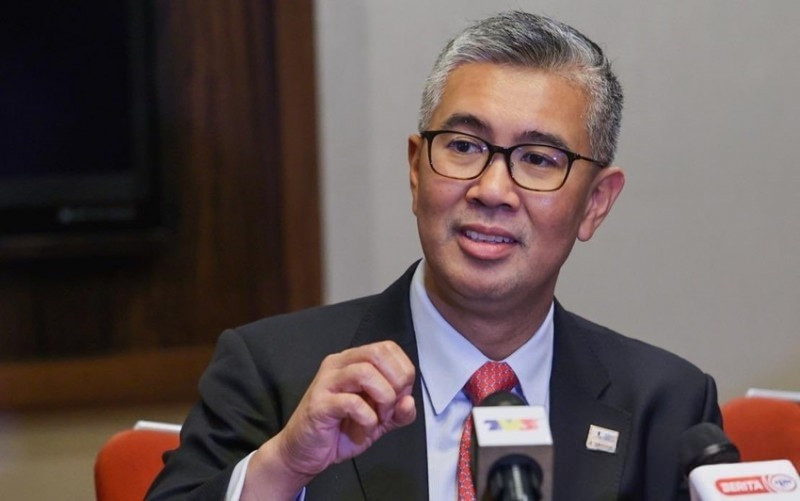
MALAYSIA must position itself as a credible and compelling destination for global investment as geopolitical instability in West Asia prompts investors to reassess risk and reallocate capital, according to Malaysian Investment Development Authority (MIDA) Chairman Tengku Zafrul Abdul Aziz.
He said the ongoing tensions involving the United States and Iran are already fuelling higher energy prices, rising logistics costs and renewed inflationary pressures, contributing to a more uncertain global economic landscape.
In a statement shared via Facebook, he noted that such disruptions have historically triggered structural shifts in the global economy, with capital flows redirected, supply chains reconfigured and new strategic openings emerging for countries prepared to act.
“Investors, sovereign wealth funds, and multinational firms are inherently cautious, and naturally gravitate towards jurisdictions that offer stability, policy clarity, and institutional credibility. In a more uncertain world, these qualities become even more valuable.
“Malaysia is well positioned in this regard, being politically stable, strategically located at the heart of Asean, deeply integrated into global trade networks, and capable of bridging regions through its strengths in Islamic finance, a trusted halal ecosystem, and long-standing ties with both East Asia and the Gulf,” he said.
He highlighted the Gulf region as a key opportunity, noting that sovereign wealth funds there collectively manage around US$5 trillion, with a portion of that capital likely to be redeployed into more stable markets amid heightened regional uncertainty.
“Malaysia is well placed to attract a share of these flows. As a Muslim-majority country with longstanding economic and cultural ties to the region, we are a familiar and credible partner,” he said.
He added that priority sectors aligned with national development goals include data centres, renewable energy, power and grid infrastructure, logistics, industrial parks, healthcare, food security, halal industries and advanced manufacturing.
He also pointed to ongoing negotiations between Malaysia and the Gulf Cooperation Council on a free trade agreement, which began in May 2025, describing the timing as strategically significant.
“This FTA is significant not only from a trade perspective, but as a signal of deepening institutional alignment and long-term economic partnership supporting sustained investment mobilisation,” he said.
Emphasising the importance of policy execution, he said Malaysia’s response to global uncertainty would ultimately determine its economic trajectory.
“If investors are reassessing risk, Malaysia must present itself as a credible and compelling alternative.
“If capital is seeking new destinations, we must offer a strong pipeline of bankable, execution-ready projects. If the world is becoming more fragmented, Malaysia must stand out as a place where stability, connectivity, and credibility converge,” he said.
He stressed the need for faster approvals, coordinated investor facilitation and a sharper focus on strategic sectors, alongside continued efforts to strengthen Malaysia’s positioning as a safe haven for global capital.
“Additionally, we must ensure that the benefits of investment are widely felt, through job creation, infrastructure development, and greater economic resilience for our people. All these must continue to be complemented by disciplined economic and fiscal reforms.
“Malaysia’s opportunity does not lie in the crisis itself, but in our ability and capacity to respond to a changing world. That is the essence of economic statecraft, not merely to withstand external shocks and survive, but to navigate them with clarity, purpose and resolve,” he said. – March 24, 2026