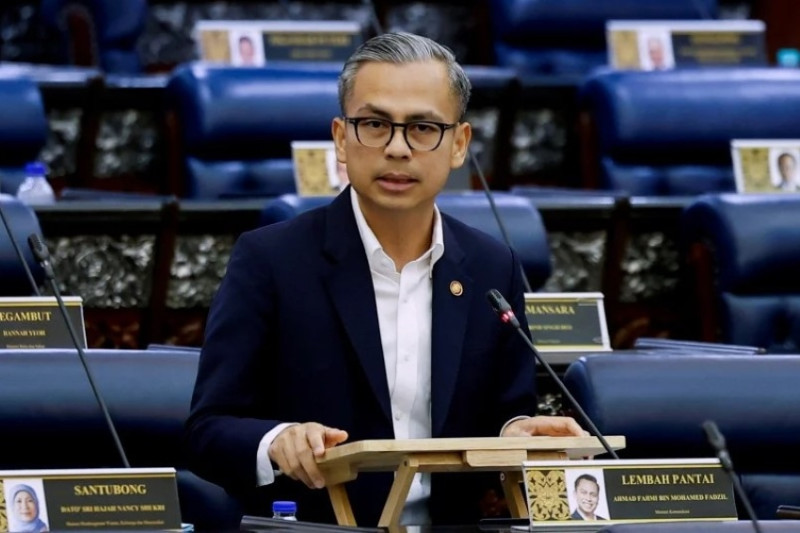
THE Ministry of Communications presented a detailed account of initiatives aimed at safeguarding digital spaces, reinforcing media responsibility, and expanding the nation’s digital infrastructure.
Communications Minister Datuk Fahmi Fadzil, in the Dewan Rakyat on Wednesday, addressed the growing concerns over artificial intelligence and deepfake technology.
The minister cited questions raised by several MPs, highlighting the need for a coordinated approach among government agencies.
He explained that misuse of AI for harmful purposes is subject to enforcement under the Online Safety Act 2025 [Act 866] or the Communications and Multimedia Act 1998 [Act 588], administered by the Malaysian Communications and Multimedia Commission (MCMC).
“Efforts to tackle the misuse of AI require inter-agency collaboration. The MCMC provides technical assistance, including profiling information and digital forensic analysis, to support investigations by law enforcement authorities,” he said.
Fahmi noted that the proliferation of online content, including misinformation, fraud, provocation, and security threats, has been accelerated by AI-generated materials, which have the potential to mislead users and disrupt public harmony.
In response, MCMC actively monitors social media discussions of public interest, crime, misuse, threats, and provocative content.
Collaborative initiatives with social media platforms and enforcement agencies are ongoing to curb the spread of false and AI-generated content.
From 1 January 2022 to 15 January 2026, MCMC submitted 5,409 requests for the removal of image and deepfake content, of which 4,955 (92%) were successfully removed.
Requests concerning other forms of false content totalled 59,967, with 51,912 (87%) removed, all in accordance with platform guidelines and national laws.
The minister further highlighted that under amendments to Section 233(1) of Act 588, content deliberately intended to defraud may result in fines up to RM500,000, imprisonment for up to two years, or both, with additional daily fines of RM5,000 for ongoing violations.
He also outlined the Online Safety Act 866, effective 1 January 2026, which obliges licensed service providers to regulate harmful content. Supporting instruments are being finalised to clarify these responsibilities, including proposals for labelling AI-generated or manipulated content such as deepfakes, images, and voice recordings, to assist users in identifying misleading material. Since the Act’s enforcement, two cases of harmful content have already been successfully removed.
Turning to applications promoting immoral or pornographic content, the minister emphasised proactive monitoring and enforcement against harmful online materials.
Between 1 January 2022 and 15 January 2026, 76,408 takedown requests were submitted to service providers, with 56,929 (75%) of the content removed, alongside the blocking of 4,841 websites containing obscene material.
Formal registration requirements for major messaging and social media platforms with eight million or more Malaysian users took effect under Section 46A of Act 588 on 1 January 2026, ensuring accountability and adherence to Malaysian laws.
The minister highlighted the establishment of the Online Safety Committee, advising MCMC on digital security matters, with representation from relevant ministries, the Royal Malaysia Police, the National Security Council, the Commissioner for Children, and licensed service providers.
These measures reflect a structured, phased regulatory approach to protect public values, morality, and social wellbeing.
On freedom of speech and media, the minister reaffirmed that these rights are guaranteed under Article 10 of the Federal Constitution but are subject to responsible and ethical use, considering Malaysia’s diverse cultural and religious landscape.
Amendments to Section 233 of Act 588, effective 11 February 2025, provide clearer guidance for enforcement, investigation, prosecution, and adjudication, ensuring fairness while enhancing digital security and accountability.
Fahmi also explained mechanisms for appeal and redress, including complaints to MCMC, appeals to the Tribunal of Appeal chaired by a High Court judge, and judicial review under Section 121 of Act 588.
Regarding previous enforcement actions against Sin Chew Daily and Sinar Harian, fines were imposed in line with Section 233(1)(a), with both publications having their fines reduced upon appeal and subsequently settled in full.
He noted that the Malaysian Media Council, established under the Malaysian Media Council Act 2025 [Act 868], is tasked with developing ethical journalism standards, monitoring new technologies in reporting, and promoting media literacy and constructive dialogue between media practitioners and the public.
On digital infrastructure, the minister highlighted the government’s commitment to equitable internet access, particularly in rural and remote areas.
Through the National Digital Network Plan (JENDELA), internet and communications coverage in populated areas reached 99.71% by 31 December 2025, up from 91.80% prior to the initiative, demonstrating significant progress towards inclusive connectivity for all Malaysians.
Fahmi expressed gratitude to His Majesty the Yang di-Pertuan Agong for the royal speech and prayed for the King’s continued protection and blessings.
He also acknowledged the 23 Members of Parliament who contributed to discussions on the ministry’s key areas, including online safety, freedom of expression and media, and digital infrastructure. – February 4, 2026