Liviri River in Kasungu District does not begin as a harbinger of death.
Its journey starts with clean flow from Kalonje Village, but slowly gets soiled as it snakes past rolling hills and tobacco fields that have replaced lush forests.
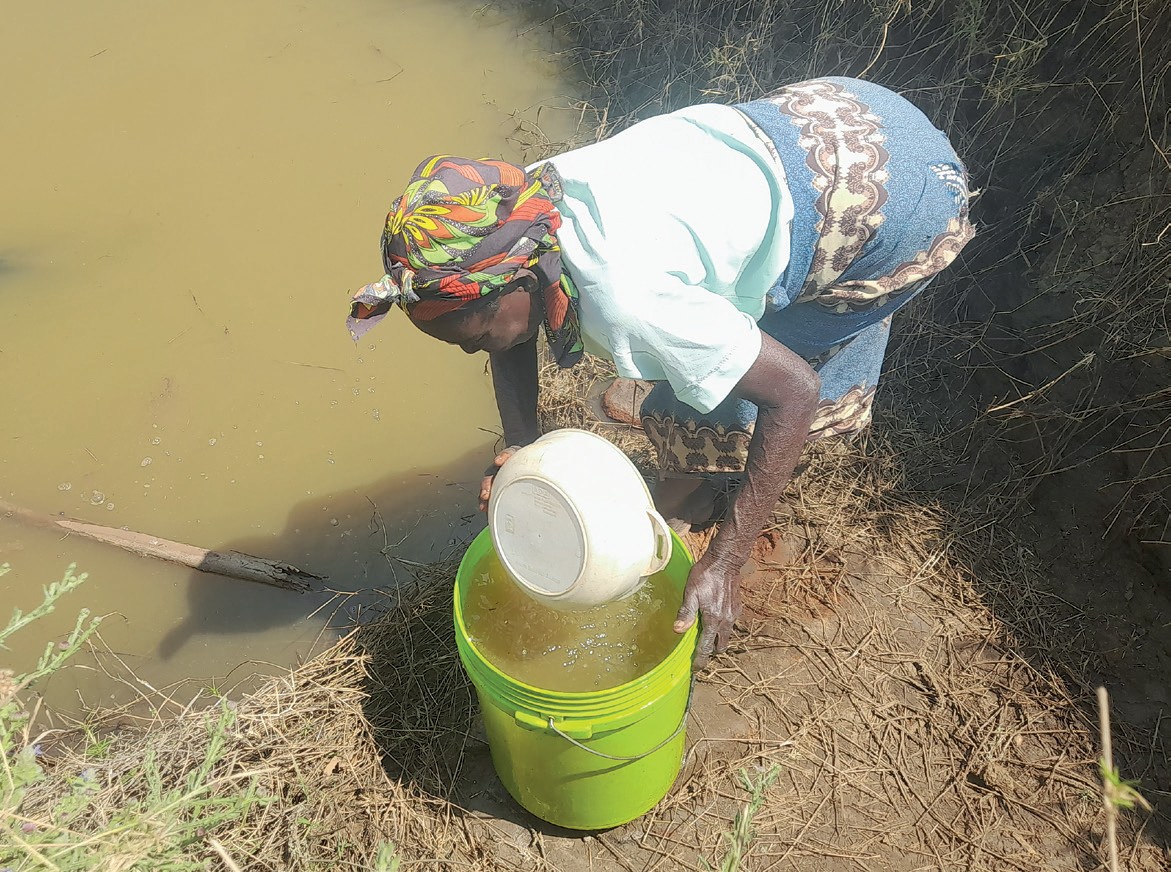
A woman fetches water from Liviri River on the receiving end of pollution from gold panning | Kondwani Nyondo
However, the murky river changes colour as it flows past Chimbiya, where both locals and migrant merchants use mercury to pan gold along its banks.
The toxic sludge flows all the way to Dwangwa River, which pours into Lake Malawi, the country’s main tourist destination and fishing ground.
By the time the flow reaches the freshwater lake in the sugar-producing district of Nkhotakota, it becomes a swirling brown mass carrying soil, waste and chemicals from gold mills of Chimbiya and surrounding villages.
The machines grind heaps of ore day and night, overwhelming the brains behind to use mercury for quick yields.
For villages along the riverbank, the contaminated stream remains the only source of drinking water.
Linda Mwale, 69, bends carefully, her knees stiff with age as she scoops muddy water into a bucket.
“I’ve been doing this every day for over five decades because water is life,” she says.
There is no tap in her village. No safe alternative.
“Whatever flows past our community quenches our thirst, cooks food and keeps our children clean,” she said, cupping the muddy water.
Mwale has learned to ignore the colour, but her body and neighbours are not immune to waterborne diseases and poisoning.
“Our stomachs hurt, but what else can we do?” she asks.
In Zungu Village upstream, three gold mills grind relentlessly, washing tonnes of soil mixed with mercury to fast-track gold panning.
From the grinding machines, a thick sludge drips directly into the river, swirling and drifting away to contaminate the water Mwale often drinks without boiling or treating.
The gold rush noiselessly poisons the very people who live closest to the unregulated mining zones.
In 2011, village head Siliuka’s was delighted when she heard that her territory was sitting on gold.
“When the gold merchants drilled a borehole, the first and only one, we thought better things were on the way. But as years passed, the population grew and the borehole broke down repeatedly, forcing people back to the contaminated river,” she laments.
Eliza Jere, a mother of two, says water from Liviri is no longer safe and clear.
“Even fish have perished. You no longer see them swimming past stones,” she says.
Since the gold-milling machines arrived in 2021, the water became too thick and life-threatening.
“If water is life, there is no life here,” Jere says. “Many people complain of stomach aches and unexplained rashes. We are dying slowly.”
Lazaro Phiri, from Zungu, spends hours pushing drifting soil away from a spot where women fetch water.
“I do this to slow the damage and the risk of mercury poisoning,” he says, shovelling the sludge away.
Apart from mercury contamination and siltation, there are no toilets in the illegal gold mines of Chimbiya. The people toiling for the most precious metal defaecate in the open.
The breakdown in water supply and sanitation exposes the miners and surrounding villages to preventable disease outbreaks, including cholera.
The grass walls of few makeshift latrines in sight barely shield anyone from prowling eyes.
The lack of privacy fuels open defaecation along the riverbank, which fuels cholera.
“When rains fall, running water washes human waste into the same water locals drink,” says Siliuka. “This leaves me asking: Did these people come to help or to kill us?”
Despite the visible damage, accountability remains elusive.
Village head Zungu said their cry for safe water, sanitation and hygiene services goes unheeded by miners, members of Parliament and Kasungu District Council.
During our visit, a site linked to former Lilongwe Mapuyu legislator Esther Kathumba was found discharging wastewater into Liviri River.
In an interview, the ex-lawmaker said she has a medium-scale mining licence, but did not respond to our questionnaire on water pollution.
The Nation asked her if her mining activity is backed by an environmental and social impacts management plan approved by the Malawi Environmental Protection Authority.
Harlod Abisalomu, who runs another gold mill nearby, admitted using mercury to bind gold particles.
“We use mercury, but it is not dangerous. We also drink the same water,” he claimed.
However, the World Health Organisation lists mercury among the top 10 chemicals of major public concern.
According to the United Nations public health agency, the natural occurring element may have toxic effects on the nervous system, digestion, body immunity, lungs, kidneys, skin and eyes.
“Mercury is toxic to human health, posing a particular threat to the development of the child in the uterus and early in life,” WHO warns.
Professor Adamson Muula, from Kamuzu University of Health Sciences, warned that mercury poses immense danger to human, animal and plant life.
“Mercury affects nearly every human organ system. People may have breathing problems, skin irritation and general body weakness. There is little awareness among miners that they expose themselves and communities to great risk. Strong regulation is critical.”
Malawi is party to the Minamata Convention of 2013, which requires governments to take decisive actions to end the release of mercury into the environment from human activity, including gold mining and food production.