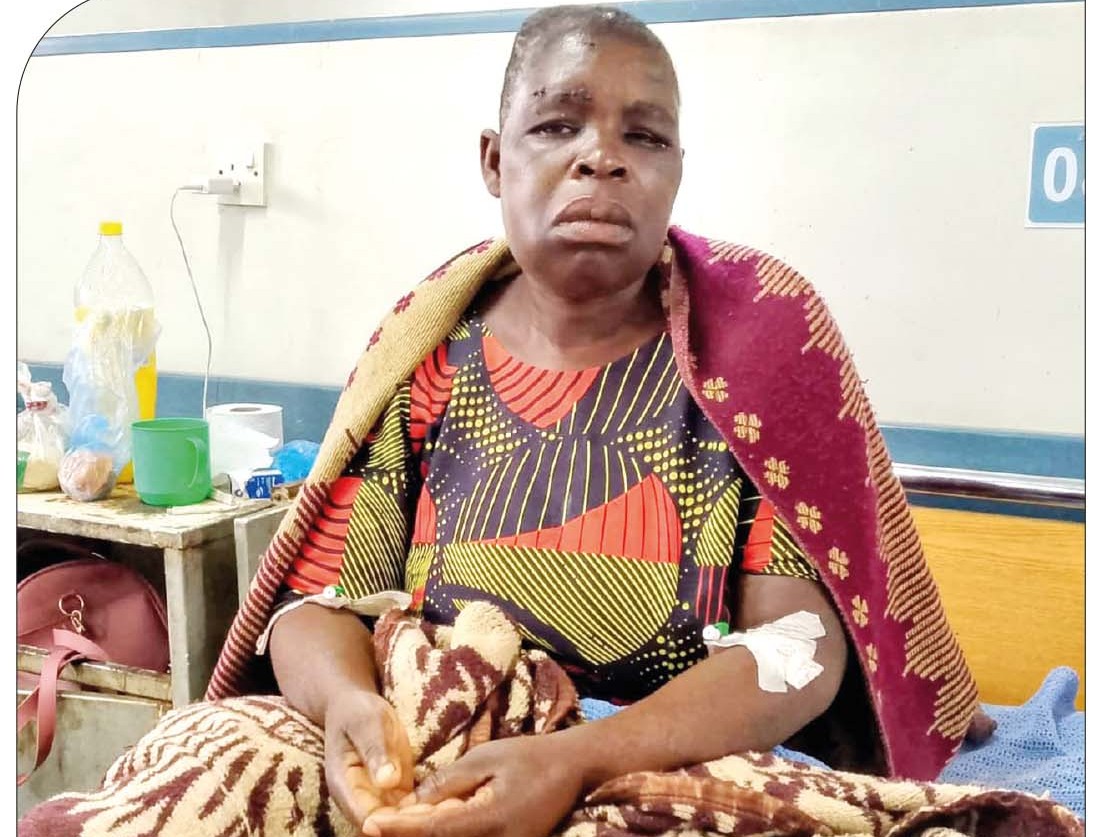
On November 25 2025, as Malawi joined the world in marking the beginning of this year’s commemoration of the16 Days of Activism against Gender-Based Violence (GBV), 41-year-old Eneless Kachere was discharged from Chiradzulu District Hospital.
A week earlier, her in-laws had nearly beaten her to death, accusing her of killing her husband.
Kachere on hospital bed
Instead of returning to her home in Jumbe Village, Chiradzulu, Kachere sought refuge at her sister’s house in Blantyre. Her home had been burned, her property seized, and her life threatened.
“For three hours they beat me with sticks and metal bars,” she said. “One even suggested cutting me into pieces. They thought I was dead.”
Her ordeal began on November 16, when her husband, 45-year-old GracianoYohane, returned home drunk and demanded money she had kept for him. When she refused, he hanged himself.
Kachere discovered his body and alerted relatives, but instead of helping, they accused her of murder. On November 18, they dragged her to the police, tearing her clothes and assaulting her along the way.
Rapozo: Culture is to blame
Kachere says her husband had been abusive throughout their marriage, especially when drunk. Despite reporting seven suspects to police, they have made no arrests.
Chiradzulu Police Station spokesperson Hubert Mwangoka said investigations are ongoing.
Her case is not unique. According to the 2024 Demographic and Health Survey showed that alcohol was a contributing factor to 32 percent of GBV cases with 14 percent ending in rape. Further, 28 percent resulted in emotional abuse.
A 2008 study by Sintef Health Research of Norway and the University of Malawi’s Centre for Social Research found that women married to heavy drinkers were more likely to suffer physical, emotional, sexual, and economic abuse.
“Men who drink often spend family income on alcohol, leaving children hungry and wives vulnerable,” the report noted.
Emma Kaliya, Malawi Human Rights Resource Centre executive director, whose organisation commissioned the survey with Norway’s Forut, says alcohol and gender-based violence are inseparable.
“They are like cousins,” she said. “When men are drunk, they go mad. In Kachere’s case, neighbours knew she was abused but did nothing. When her husband died, they blamed her and beat her mercilessly.”
Women Lawyers Association executive director Golda Rapozo adds that culture compounds the problem. She observed that much as alcohol is a contributing factor, abusive men are abusive men when they take culture to the letter.
“Men are taught that beating a wife is proof of love. Women are taught to endure abuse. Any culture contrary to the Constitution should not be tolerated,” she said.
The Southern African Alcohol Policy Alliance (Saapa) has documented similar patterns across the region. This was clear during a dialogue they organised on November 17 for researchers, advocates and media practitioners from Malawi, South Africa, Lesotho, Namibia, Botswana, Zambia and Zimbabwe.
“Alcohol does not cause GBV, but it makes violence more frequent and more dangerous,” said Odwa Makanini of South Africa’s community police forum in Khayelitsha.
In Malawi, Saapa coordinator Jefferson Milanzie warns that cheap, unregulated alcohol is fueling abuse.
“We see men and women suffering violence at the hands of intoxicated partners. Men suffer in silence, often leading to suicide. Alcohol is sold even next to schools, leaving the youth vulnerable,” he said.
He criticized the government’s failure to implement the National Alcohol Policy, calling it “just a document.”
Grassroots organisations are stepping in. Norwegian Church Aid and Danish Church Aid support survivors of alcohol-related abuse through such organisations as the Seventeen Active Youth Organisation (Sayo).
In Lirangwe, Blantyre, 31-year-old Linda Moya left her marriage in 2023 after years of violence since 2011.
She said: “I used to believe family life was about endurance. However, I quit. Now I run a small business after I got counselling and financial assistance from Sayo.”
Sayo executive director Sidney Juma says cases are overwhelming.
“It’s not only physical abuse. Some men sell plots or even dismantle roofs to buy alcohol, leaving families destitute,” he said.
As Malawi marks the 16 Days of Activism, Kachere’s story underscores a grim reality: alcohol is not the root cause of GBV, but it is a powerful accelerant.
Without stronger enforcement of laws and cultural change, women and families remain trapped in cycles of abuse.