- Wildlife photographer Steve Winter and environmental journalist Sharon Guynup have worked together for decades, and they offer a vital message in Big Cats their new book: Wildlife storytelling can deliver real, measurable environmental change, helping people and big cats find ways to coexist and benefit from each other.
- In this Q&A with the creative duo they discuss how technology, from camera traps to GPS collars, helped make intimate big cat photography in the wild possible, and how it revolutionized the ways big cats are studied, documented and conserved.
- Even with all their groundbreaking work covering big cats, “Conservation has no end point,” they say. Successes born of stunning images and moving prose can help power conservation, but there are always new challenges, making protecting wildlife a constantly evolving process.
- Despite global conservation efforts, all big cat species are still considered vulnerable to extinction. That is why Winter and Guynup have teamed up to create a book documenting their work together and its impacts. Big Cats, published by National Geographic, was released Oct. 6 and is available at book stores and online.
See All Key Ideas
For more than two decades, National Geographic photographer Steve Winter and environmental journalist Sharon Guynup have followed big cats into some of Earth’s wildest, most dangerous places. Their work has taken them from the jungles of India and Brazil to the high Himalaya, from Southeast Asia’s forests to the African savanna and the urban wilds of Los Angeles, documenting the world’s big cats and the ways humans are succeeding or failing in living alongside them.
Winter’s iconic photos of tigers, jaguars, snow leopards, cougars and lions have earned some of the field’s highest honors, including Wildlife Photographer of the Year. He is also known for his innovative use of remote camera traps, which has allowed him to capture intimate glimpses of animals that are extraordinarily difficult to observe in the wild.
A young male Bengal tiger trips a camera trap in India’s Kaziranga National Park. Image © Steve Winter/Big Cat Voices.
Guynup, an award-winning environmental journalist, and now, Mongabay’s global wildlife editor, has penned prolific reporting on numerous topics. She’s especially known for her coverage of big cat conservation, exposés on wildlife trafficking, documenting the creation of wildlife corridors, and alerting the world to the threats posed by zoonotic diseases.
The two have been partners in life and work for 37 years (they married just last year), and together have produced investigations delivering real change. Their reporting on captive tigers in the U.S., for example, (featuring Steve’s photos and Sharon’s prose), revealed abuse and wildlife trafficking, contributing to the passage of a new law, the U.S. Big Cat Public Safety Act.
In their new book Big Cats, released Oct. 6, Winter and Guynup bring together 170 photographs and the stories behind some of their most extraordinary and impactful feline encounters, both in the wild and in captivity.
This interview has been edited for length and clarity.
Sharon Guynup and Steve Winter have worked collaboratively and independently for 25 years; photographed here in Svalbard. Image by Hadleigh Measham.
Mongabay: What was it that made you want to do this book now? In many ways, this seems like a retrospective of your respective careers, a magnum opus.
Sharon Guynup: Steve has photographed big cats for 25 years and I’ve reported on them about that long. Some of the stories he did on his own, some we did together. But in doing this book we decided we wanted to work from a basic premise — impact. Which of our stories have had tangible impact?
Stories about snow leopards and jaguars, for example, saw local conservation benefits. Other stories helped bring about initiatives that made it economically viable for local people to coexist with cats, through ecotourism or the offering of compensation for livestock losses.
Then there was the Tiger Temple in Thailand, which we exposed and shut down — a tiger-petting Buddhist monastery. It was also a Blackfish moment of sorts for cub petting and hands-on animal contact. It showed the underbelly of that industry.
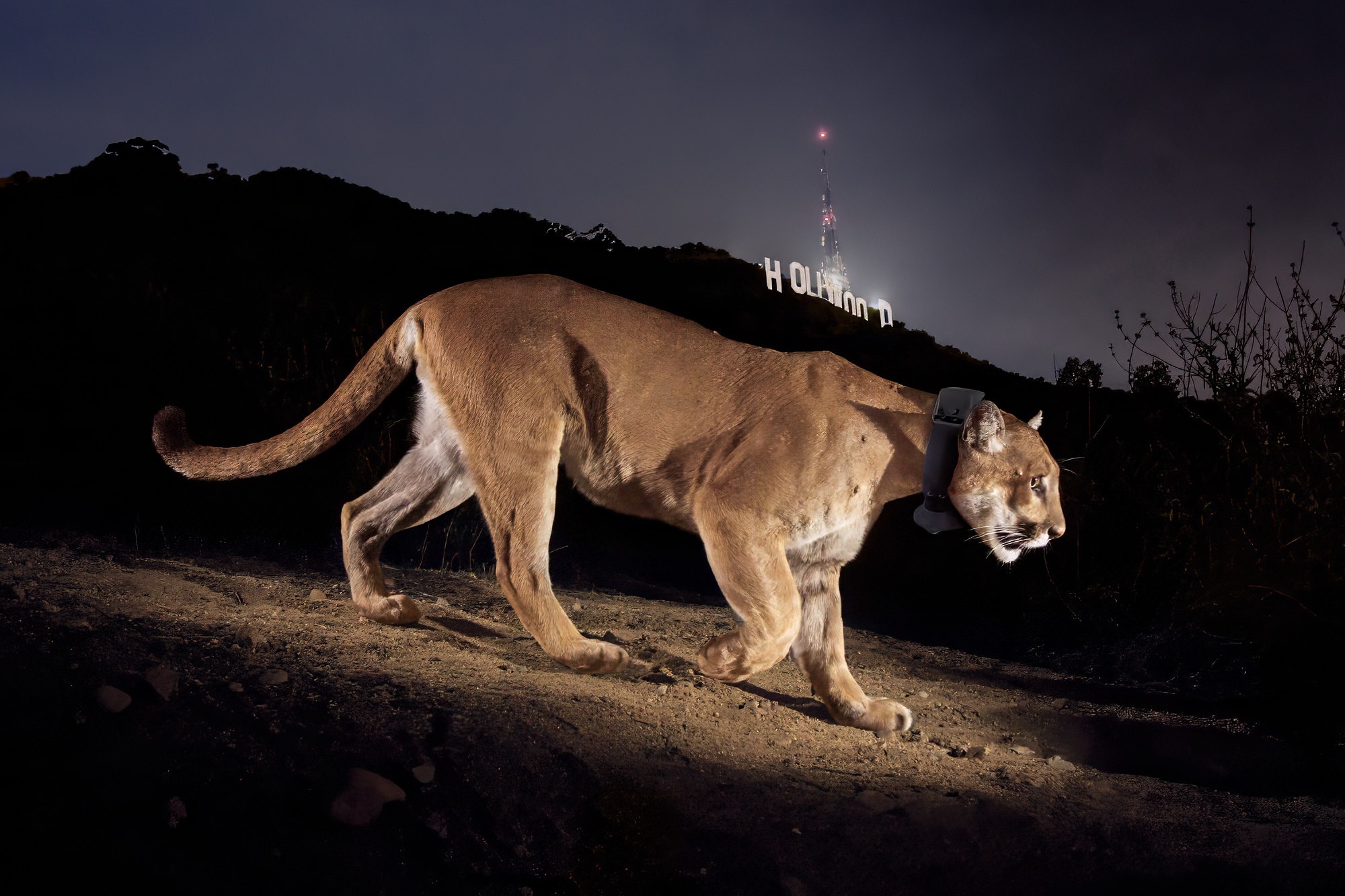
And there’s another very different example: P-22. Steve likes to say his picture of P-22 [with the Hollywood sign] made that cat a celebrity in the land of celebrities, and an international star.
That photo sparked construction of what will be the world’s largest wildlife overpass, built within a landscape hemmed in by 10-lane freeways. It connects the two best protected areas near L.A. [in the U.S,] with a wildlife corridor that goes over the 101 Freeway. The overpass opens December 2nd.
Steve Winter sets up a camera trap in South Africa with local guides and filmmaker Bertie Gregory, right, while working on a story about leopards. Image © Steve Winter/Big Cat Voices.
Part of a pride of Asiatic lions in Gujarat, India. Image © Steve Winter/Big Cat Voices.
Mongabay: You’ve spent decades looking at big cats in their habitats. What do you think has changed most dramatically during that time? And what has surprised you the most in terms of what you’ve witnessed?
Steve Winter: As a photographer, I’m often trying to get images of “ghost cats,” animals that don’t want to be seen.
One of the big things that has happened: When I started photographing some of these cats, there hadn’t been stories done before. Maybe there was some scientific work on them, but that’s about it. And then I did a feature story, whether jaguars or snow leopards, and now there’s this big [beneficial] ecotourism activity going on in the exact areas I was working.
The change with jaguars is just absolutely amazing. From [my first assignment] — when the cowboys thought the only good jaguar was a dead jaguar — to now: A cow was maybe worth $2,000 in its lifetime. But each jaguar [today] brings in $108,000 a year in ecotourism income. Each one!
A jaguar mother and cubs in the Brazilian Pantanal, the world’s largest inland wetlands. Image © Steve Winter/Big Cat Voices.
Sharon Guynup: One of the biggest differences, in addition to those examples, and the larger populations of big cats that have resulted, is in technology — both in photography and in scientific monitoring.
Steve Winter: For me, I got to see firsthand how much information you could gather from cats with GPS collars in areas where there was human-animal conflict. One example: A billionaire rancher called up a scientist. I’m standing right next to her. The rancher says, “Your cat killed one of my cows last night.”
The researcher says, “Can I come over now?” And she brings her laptop, and showed him that “her cat” was 11 kilometers away when it supposedly killed the cow. “Of course, it didn’t,” the rancher immediately said, “This is the kind of science we’ve been waiting for.”
Mongabay: I’m curious how camera traps have changed the game. Obviously some of your very famous images were taken through camera traps.
Steve Winter: I wouldn’t be who I am without them. I picked stories with the knowledge that the only way I would get images was to use camera traps. And then I waited years until I felt comfortable that I could bring back the images that would be one-of-a-kind, never seen before, because that’s what my editor expected. And so, I waited.
I did pre-visualizations in many instances. And then I tried to figure out how to get that image at that spot. Then with digital, you could look and see the behavior of the cat once it comes to the area.
A Bengal tiger in India, the cat’s stronghold, home to about three-quarters of the world’s remaining wild tigers. Image © Steve Winter/Big Cat Voices.
Mongabay: I want to talk about P-22 and the Hollywood sign. Obviously, that mountain lion photo sparked conservation action, as Sharon said, with the new wildlife overpass. Over your career, what have you learned about what makes an image capable of moving people to that extent — to actually do something?
Steve Winter: Well, to start with just basic things. Everybody loves big cats and everybody loves Hollywood, and you put them both together. I was [in Los Angeles] at a mountain lion meeting with the biologist and the idea just popped into my head. It’s not like I had thought about it before. I just blurted out: “What we really need to show urban wildlife would be a mountain lion with the Hollywood sign.”
Because, like I said, you have to visualize these things. You know there’s a trail in the park. You want the sign. You want a mountain lion to be walking by. I mean, P-22, obviously. And you put them both together and the magic happens.
Sharon Guynup: That photograph introduced Angelinos to P-22. And yes, there were people there that were worried [about big cats in the city]. But there was a lot of amazement and awe and excitement as well.
And when the Nat Geo issue came out with P-22 and the Hollywood sign (an important detail is that they actually stopped the presses to insert the photo) that single image made that cat famous. And then L.A. totally fell in love with him.
There are murals all over the city, in low-income neighborhoods, in the most elite neighborhoods. The entire city fell in love with that cat. And one thing that happened as a result is that L.A. added urban wildlife science curriculum into their schools.
The L.A. County Natural History Museum installed a permanent exhibit. In October every year, somewhere around the 22nd of the month, it’s P-22 day, and there’s a festival. But most importantly, it shined a light on how horribly fractured the L.A. habitat is. The big cat population was becoming inbred with visible signs, like kinked tails.
Steve Winter’s photographs of P-22 (cutout) helped gain support for construction of what will be one of the world’s largest wildlife overpasses across the 10-lane 101 Freeway near Los Angeles, California, U.S., providing safe passage for wildlife moving between two large protected areas. Image © Steve Winter/Big Cat Voices.
Mongabay: What was the process like of writing your Big Cat book? It’s written in Steve’s voice, first-person, but I take it, Sharon, you did the writing. How much of this did you already know? Was there anything that he told you that surprised you?
Sharon Guynup: Well, Steve and I have been together a long time. I’ve lived with him through these stories, and some of them we worked on together. Yes, there were times that I would interview him for the book, ask him how he felt about something that happened, how he would frame it, what he thought was important, and glean details from his field experiences.
But then, whether I’d worked on the story with him or not, I also contributed research on big cat conservation and natural history. It was a close collaboration.
The reason I decided to write first person in Steve’s voice resulted from an experiment. I wrote three paragraphs in third person, then went back and wrote three in first person. By writing in first person, I was better able to share Steve’s field stories, and some of those images were really challenging for him to produce.
For example, it took 15 months to get that picture of P-22 under the Hollywood sign. And Steve camped out for three months in 30 to 50 below zero weather in the Indian Himalayas to get those snow leopard pictures; all of which were camera traps. He camped at 15,000 feet, and some of the camera traps were up at 18,000 feet.
That was pretty brutal. And he’s a jungle guy! He likes hot weather.
Steve Winter: I hate mountains. If you go up a mountain, you have got to come down. And then you have to go up again.
A snow leopard captured on a camera trap in Hemis High Altitude National Park at about 4,500 meters (15,000 feet) in India’s Himalaya. Image © Steve Winter/Big Cat Voices.
Sharon Guynup: This is a book about big cats. It’s obviously a photography book. But the basic premise is that targeted conservation can make a difference, even when you’re trying to protect dangerous animals or wide-ranging animals. There are problems, and there are solutions.
Mongabay: I wonder if there is anything that you’ve photographed or have written about that might seem like it’s a conservation success at first, but the truth is much more complicated.
Sharon Guynup: Conservation is a constantly evolving process. It’s not like you ever arrive.
I remember Alan Rabinowitz [a world-renowned big cat expert] years ago asking why do cities need police? It’s the same reason we need park guards and ongoing surveillance and protection. Conservation successes bring with them the next challenge.
I think that’s really obvious in our Asiatic lion story. Those cats once lived from Africa across Mesopotamia, Persia, all the way to eastern India. They’re almost gone.
There was one population left in Gujarat, about two dozen or so. And now they’re up to about 900. But today all the protected areas are full, and the lions are moving out into the landscape. That poses new problems for people and lions.
A young male Asiatic lion gazes at a remote camera in a tree in Gir Wildlife Sanctuary in India. Concerted conservation efforts have brought this subspecies back from a few dozen in 1900 to about 900 today. Image © Steve Winter/Big Cat Voices.
Mongabay: Do you have a moment in this big cat compendium that is most memorable to you, or a favorite photo?
Steve Winter: My favorite shot is the one that makes the biggest difference. Obviously, there are ones that I may say, “I really love this picture.” But maybe it didn’t have the power to create change that some of the other ones have had.
Mongabay: What gives you hope for the future when you look back at what you’ve witnessed through your careers?
Steve Winter: Each human-big cat situation is unique, but finding ways to coexist in the landscapes where these cats live is key. What we mostly heard about early on, with lions in Africa or with jaguars in Latin America, is that it didn’t even seem like there would ever be answers.
But now things are moving forward, with livestock insurance, with ecotourism that brings money into local communities. In every one of these areas, things are working. But adjustments have to be made.
A Bengal tiger crosses a waterway in the Sundarbans wetlands in India. Tigers are good swimmers and spend substantial time in the water. Image © Steve Winter/Big Cat Voices.
Guynup, a journalist and producer, and Winter, a wildlife photojournalist and filmmaker, frequently collaborate on projects. This selfie was taken in Yala National Park, Sri Lanka. Image © Sharon Guynup/Big Cat Voices.
Sharon Guynup: Place to place, there is progress. But in general, big cat numbers are dropping. For example, every tiger species is endangered or critically endangered. Of the tigers, the Bengal is the only one that’s in pretty good shape. But tiger poaching in India is skyrocketing.
Just because you’ve made progress, it doesn’t mean the fight is over.
What gives me hope beyond efforts to reconnect wild landscapes, is that there are really amazing people that are doing phenomenal work.
And the public is maybe starting to understand the bigger picture a little better. Many people don’t realize how important predators are to an ecosystem in maintaining balance. We need to think differently about wildlife and nature. Not that animals are just there for our use. But their presence is crucial to our own existence.
Steve Winter: People are really taken by the fact that real change has come from these stories. Story after story, there was something that happened that has had a positive influence. That gives me hope.
Banner image: P-22, a cougar photographed in Los Angeles’ Griffith Park. He crossed two of the busiest freeways in the U.S., the 101 and 405, to find his own territory. Image © Steve Winter/Big Cat Voices.
FEEDBACK: Use this form to send a message to the author of this post. If you want to post a public comment, you can do that at the bottom of the page.