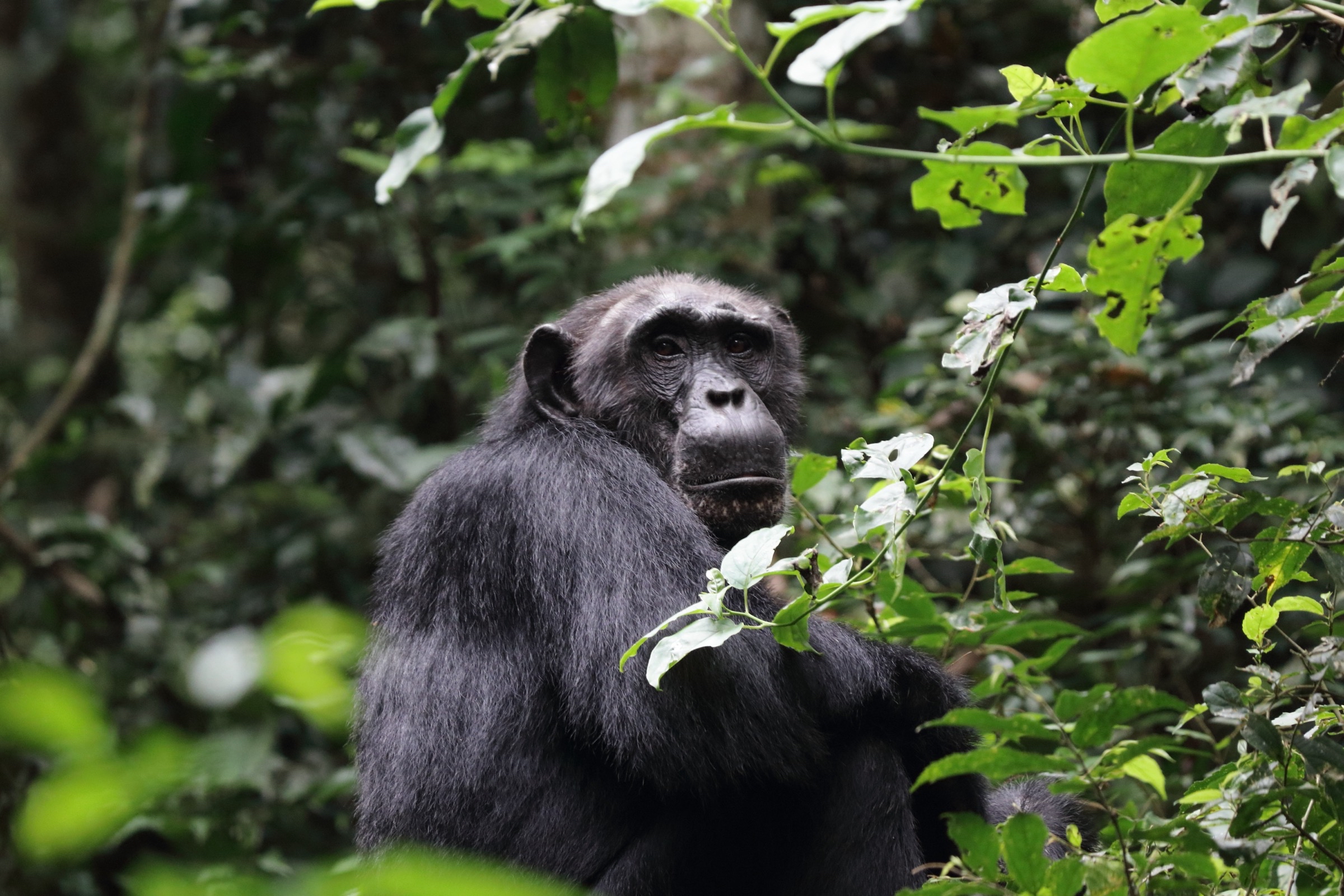
- A study found that chimpanzees tend to take more physical risks as infants and young animals rather than as adolescents, like humans.
- The researchers hypothesize that the level of care humans provide may cut down on the risks young children might otherwise take.
- The team tracked how often 119 chimps dropped or leaped through the forests without holding onto any branches at Uganda’s Ngogo Chimpanzee Project, and analyzed the results according to the animals’ ages.
- Infant and young chimpanzees were more likely to launch themselves through the trees than adolescents or adults, despite the risk of injury.
See All Key Ideas
Chimpanzees appear to be the biggest daredevils when they’re infants.
Humans tend to take more chances and put themselves in the most danger in adolescence, so the expectation has been that chimpanzees (Pan troglodytes), among our closest evolutionary cousins, follow a similar pattern. But undergraduate researcher Bryce Murray’s observations of young chimps — and especially infants — from video shot at the Ngogo Chimpanzee Project in Uganda didn’t quite jibe with that assumption, according to research published Jan. 16 in the journal iScience.
“I kept seeing these behaviors that seemed very risky,” Murray, the study’s lead author and a recent graduate from the University of Michigan in the U.S., told Mongabay. Young chimps, he noticed, frequently leaped through tree branches or dropped from them, flying freely through the air without holding onto anything.
An adult female chimpanzee leaping in the forest at Ngogo Chimpanzee Project. Image by Murray et al., 2026 (CC-BY-NC-ND).
Chimpanzees are well-adapted to life in the trees, picking up the ability to climb and swing through them as early as 2 years old. That’s an important skill, as high branches offer safety and provide the fruit that makes up the bulk of their diet. Still, it’s hard not to ascribe a bit of ebullience to their looping swings through the canopy.
But moving around 10 meters (33 feet) or more above the ground can also be dangerous, particularly in the “free flight” incidents that caught Murray’s attention. One study found that around a third of chimp skeletons found in two different sites revealed signs of fall-related injury.
Lauren Sarringhaus, a biologist and assistant professor at James Madison University in the U.S. and a co-author on this paper, said she had also noticed these risky behaviors in young chimpanzees during her research on locomotion. Teaming up with Laura MacLatchy, a paleoanthropologist and professor at the University of Michigan, the researchers collected data to understand how prevalent these behaviors are in different age groups — and whether they follow the same patterns seen in humans.
The team analyzed video recorded at Ngogo in 2020 and 2021, tabulating the movements frame by frame of 119 infant, juvenile, adolescent and adult chimps ranging in age from about 2 to 65.
The researchers found that infant chimps up to 5 years old are the most prone to these potentially dangerous aerial maneuvers. That tendency then tapers with age and on into adolescence, which happens between 10 and 15 years of age in chimpanzees.
A figure from the study shows two risky behaviors, a drop and a leap, observed most often in infant chimpanzees. Image by Murray et al., 2026 (CC-BY-NC-ND).
“We were surprised that we found such a significant difference in the young ones compared to the juveniles [and] compared to the adolescents,” Sarringhaus said in an interview.
She explained that “thrill seeking” could be advantageous, acting as a way for young chimps to develop motor skills, and the “load” on an infant’s bones could help them grow stronger.
At the same time, however, too much stress can cause fractures, with potential long-term consequences. A break along a growth plate, for example, could hamper a young chimp’s development more seriously than in an adolescent that’s mostly grown.
The study’s authors said the vigilant care humans provide may help keep infants and young children safe from similarly daring behaviors. Sarringhaus said societal infrastructure such as schools can also tamp down young children’s impulses.
“There’s this really intricate network in humans that we really don’t see in chimpanzees,” Murray said.
He noted that while little chimps are looked after by their parents and other members of the troop, they’re not always within grabbing reach. That means their caregivers might not be able to head off a potentially perilous leap or drop.
As human children get older, parental care eases, which could help explain why the risk-taking peak happens during adolescence.
The researchers found that risk-taking peaked in young chimpanzees, unlike with humans, where adolescents tend to engage in more risky behaviors than other age classes. Image by Murray et al., 2026 (CC-BY-NC-ND).
“It’s certainly a very, very interesting hypothesis,” said Lou Haux, a postdoctoral fellow at the Max Planck Institute for Human Development in Germany, who wasn’t involved in the research. “And for sure, caretaking … prevents certain behaviors.”
Haux said an interesting line of research going forward would be to explore whether an individual chimp that takes physical risks is more likely to take other types of risks. Her own research on economic decision-making in chimps involved allowing them to pick between a “safe” container, which always contained a food reward, and riskier options, which could contain larger rewards but might also have nothing inside. Haux and her colleagues found that risky economic behavior is correlated with taking chances in other domains.
But with this current study, she said, “It’s very difficult to say how predictive this very specific behavior now is for something else.”
Still, Haux added, “I’m very excited to see risk-taking studies in chimps, especially in the wild.”
The natural environment at Ngogo, located in Kibale National Park, offers the chance to study behaviors that can have dangerous consequences, like branches that break as chimps swing through the trees — conditions that are difficult to simulate in captivity, Murray said.
Ngogo also has what’s likely the world’s largest chimpanzee community, providing a surfeit of individuals of different ages to study with the aim of a better understanding of them, and ourselves, Sarringhaus said.
“There’s just so much that we can learn from the wild that it’s impossible to even start to take into consideration in captivity,” she added. “It’s priceless, not to mention the importance of [protecting] the individuals and their habitat.”
Banner image: A chimpanzee in Uganda. Image by Nigel Hoult via Flickr (CC BY 2.0).
John Cannon is a staff features writer with Mongabay. Find him on Bluesky and LinkedIn.
Study ties same-sex behavior in primates to ecological and social pressures
Citations:
Murray, B., MacLatchy, L., & Sarringhaus, L. (2026). Chimpanzee locomotor risk-taking points to the importance of parental and alloparental supervision in humans. iScience, 114452. doi:10.1016/j.isci.2025.114452
Carter, M. L., Pontzer, H., Wrangham, R. W., & Peterhans, J. K. (2008). Skeletal pathology in Pan troglodytes schweinfurthii in Kibale National Park, Uganda. American Journal of Physical Anthropology, 135(4), 389-403. doi:10.1002/ajpa.20758
Haux, L. M., Engelmann, J. M., Arslan, R. C., Hertwig, R., & Herrmann, E. (2023). Chimpanzee and human risk preferences show key similarities. Psychological Science, 34(3), 358-369. doi:10.1177/09567976221140326
FEEDBACK: Use this form to send a message to the author of this post. If you want to post a public comment, you can do that at the bottom of the page.