- The hill districts in the Chittagong region in Bangladesh have seen a large scale switch from the traditional shifting agriculture, or jhum, to more profitable cash crop cultivation in recent years.
- According to a study, a major portion of the 40,000 hectares (98,842 acres) of hills that were previously used for traditional agriculture have been transformed for cultivating different cash crops like ginger, turmeric, pineapple and banana.
- Though the transformation ensured economic gain for the farmers and investors, the ecology of the hill landscape has been affected by soil erosion, dried up streams, increased landslides and water scarcity for the locals.
See All Key Ideas
The hill people of Bangladesh have been moving to profitable cash crops for the last couple of decades, dropping traditional agricultural practices. However, the economic gain soon turned into ecological damages, including severe soil erosion and water crisis.
The Chittagong Hill Tracts (CHT) region in Bangladesh, comprising three districts — Rangamati, Khagrachhari and Bandarbans — has a unique hill forest landscape and rich biodiversity and is home to several Indigenous communities.
The agricultural people of CHT have long been accustomed to the shifting, or slash-and-burn, cultivation process, locally known as jhum. Jhum cultivation is a process where farmers use a piece of land for cropping for one to three years, then leave it fallow for five to 20 years. They later clear rain-fed trees and bushes using the slash-and-burn method to make it arable again.
A 2016 study mentioned that, lately, people of the region are farming pineapple, banana, papaya, turmeric and ginger, which are usually cultivated on the same land every year.
“Cultivating cash crops has become very common in the region now, and these crops do not need the land to be kept fallow. All the changes come through different initiatives, including government and non-government projects, and also by the social influencers and corporates,” said Ratan Kumar Dey, former project manager at Anando, a Bangladeshi nonprofit that empowers rural populations. Dey worked in CHT for 18 years till 2025.
Smoke and fire rise over land used for jhum cultivation on the hills of Bandarban, CHT. Image by Ariful Islam S’uhas via Flickr (CC BY-NC-SA 2.0).
According to a 2024 study, a major portion of the 40,000 hectares (98,842 acres) of hills that were previously used for traditional agriculture, have been transformed for cultivating various cash crops like ginger, turmeric, pineapple, banana and cassava.
The study also mentioned that the area of natural forests decreased over the years from 172,000 hectares (425,021 acres) in 1963 to 70,000 hectares (172,974 acres) in 2005, which is considered a factor in the loss of livelihoods of forest-dependent communities.
Meanwhile, media reported that currently a large share of the seasonal fruit production in Bangladesh comes from the hilly districts.
Compared to traditional farming — even though the current practices of farming cash crops ensure economic benefits to the locals — the modern practices cause severe soil erosion in the regions.
A government-run study revealed that in 2024, the CHT region experienced the highest soil loss per hectare in a year: 86.62 tons, while 40 tons of soil loss in the same area was considered normal. This was attributed to increased rainfall and changing land use, which includes deforestation and extensive ploughing of the slopy hills where cash crops are grown.
Simultaneously, the changing pattern in rainfall, especially the increased volume in a short period, caused the region to be affected by landslides.
In recent years, the region experienced several incidents of severe landslides, which killed many locals and damaged their resources, including housing and public infrastructures like roads and educational institutions.
“Since most of the cash crops — — require soft soil to grow, the farmers naturally prepare the land by cutting herbs and shrubs regularly and ploughing them in an extensive way, which increases the risk of soil erosion,” said Ahsan Uddin Ahmed, executive director of a policy research organization in Bangladesh focusing on climate change, agriculture and development issues.
“During the heavy rainfall, the soil washed away into the streams, filling-up the stream bed and destroying the habitats of aquatic species,” added Ahsan, who is also a member of the Independent Technical Advisory Panel of the Green Climate Fund.
A 2020 study also mentioned rainfall, hill cutting and deforestation as the major reasons behind the landslides in CHT.
Besides these, deforestation and landslides together have dried up springs, which are the primary sources of daily use water for hill people.
A 2023 study mentioned that the people of the hill districts are facing severe potable water shortage resulting from the drying up of the streams, as those are their primary water sources over the years.
A farmer sits in the shade of cash crops like banana and ginger in Bangladesh. Image by Pierre Prakash, EU/ECHO via Flickr (CC BY-NC-ND 2.0).
Commercial ventures made it worse
Alongside the local people growing cash crops, a few commercial ventures that started operations in recent years have drastically aggravated the situation.
One of them is the cassava plantation by PRAN food industries, one of Bangladesh’s largest food and beverage production companies.
According to a media report, they cleared 486 hectares (1,200 acres) of mixed natural forest in Khagrachhari district in CHT.
Though the numbers are few, some locals of the region are now protesting the commercial venture of cash crop production and urged the government to halt the practice, considering the damage to the hills and their ecology.
Mahfuz Ahmed Russsel, the initiator of a private conservation initiative named Pitachhara, located in Khagrachari Hill District, told Mongabay, “Besides the local people, the commercial ventures have now started large-scale cash-crop production by involving the local poor people as their growers, which turned alarming.”
Climatic threats and possible solutions
The rainfall pattern in the region has changed over the decades, which has increased the risk of landslides in the coming days.
A 2025 study shows that the CHT region has been experiencing erratic rainfall patterns in recent years, which means shorter rainy days but heavy rainfall within a short time, which increases the risk of landslides and flash floods affecting the lives and livelihood of the people.
Despite the environmental and ecological degradation, Sheikh Saleh Ahammed, vice chairman of Chittagong Hill Tracts Development Board, said he believes that the changes in the agricultural practices in CHT were necessary for the sake of economic development for the region’s poor people.
“Our primary concern is to provide food for all first. Cash crop ensured the ability of the people to purchase food for all, and spend money for their children’s education and health, which was impossible earlier,” he said.
Regarding climatic risks and ecological crisis, Ahammed told Mongabay, “We are planning a large project now to minimize the ecological hazards and manage the water scarcity in the region.”
Since the region is poverty-prone and economically disadvantaged, avoiding cash crops is not an easy option for the inhabitants.
Mahfuz Russel suggested that the government promote sustainable tourism options in the region, as CHT is one of the favorite destinations in Bangladesh for tourists.
“‘Homestay tourism’ could be an alternative option as this directly helps the locals benefit economically,” Mahfuz added.
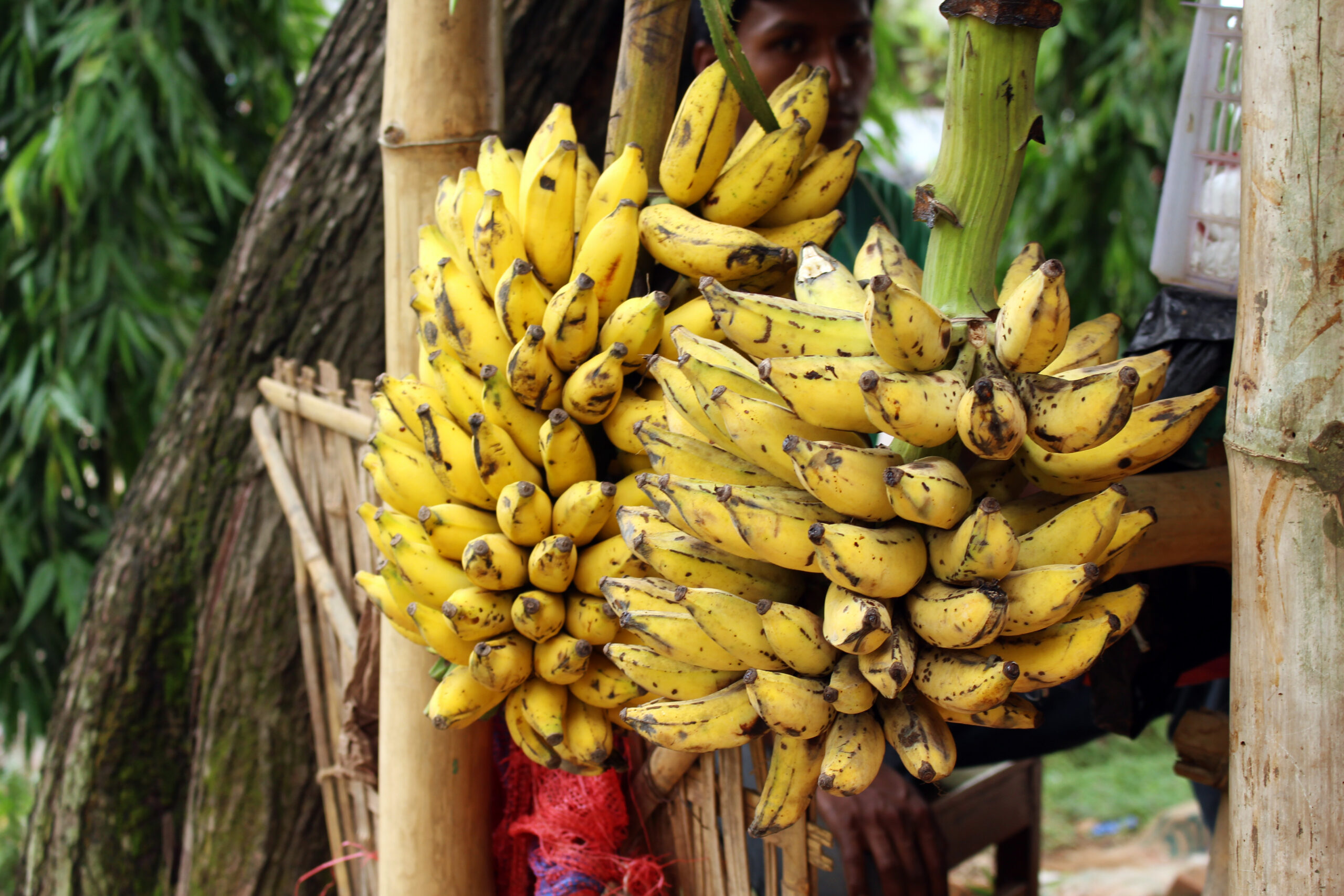
Banner image: Bananas for sale in Chittagong. Image by Moheen Reeyad via Wikimedia Commons (CC BY-SA 4.0).
Invasive whiteflies pose a new threat to Bangladesh’s cash crops
Citations:
Chakma, S. (2023). Water Crisis in the Rangamati Hill District of Bangladesh: A Case Study on Indigenous Community. International Journal of Disaster Risk Management, 5(2):29-43 doi:10.18485/ijdrm.2023.5.2.3
Chakma, P., Moniruzzaman Muzib, M., Bhowmik, D., Rahat Jui, J., Kumar Saha, S., & Mahmood Shaon, S. (2025). Transformative Harvests: Agricultural Diversification and Economic Resilience in the Chattogram Hill Tracts of Bangladesh. MBSTU Journal of Science and Technology, 11(2), 62-72. doi:10.69728/jst.v11.83
Misbahuzzaman, K. (2016). Traditional farming in the mountainous region of Bangladesh and its modifications. Journal of Mountain Science. 13, 1489–1502. doi:10.1007/s11629-015-3541-7
Nadiruzzaman, M., Shewly, H. J., Rashid, M. B., Mukul, S. A., & Dutta, O. (2025). Beyond Climate Reductionism: Environmental Risks and Ecological Entanglements in the Chittagong Hill Tracts of Bangladesh. Earth, 6(3), 63. doi:10.3390/earth6030063
Rasul, G. & Gurung, P. (2024). Unlocking the potentials of sustainable livelihoods in Chattogram Hill Tracts of Bangladesh. Nature-Based Solutions. 5, 100108. doi:10.1016/j.nbsj.2023.100108
Feedback: Use this form to send a message to the author of this post. If you want to post a public comment, you can do that at the bottom of the page.