- Scientists identified 57 new marine species and five new genera from Argentina’s Mar del Plata Canyon in just two weeks.
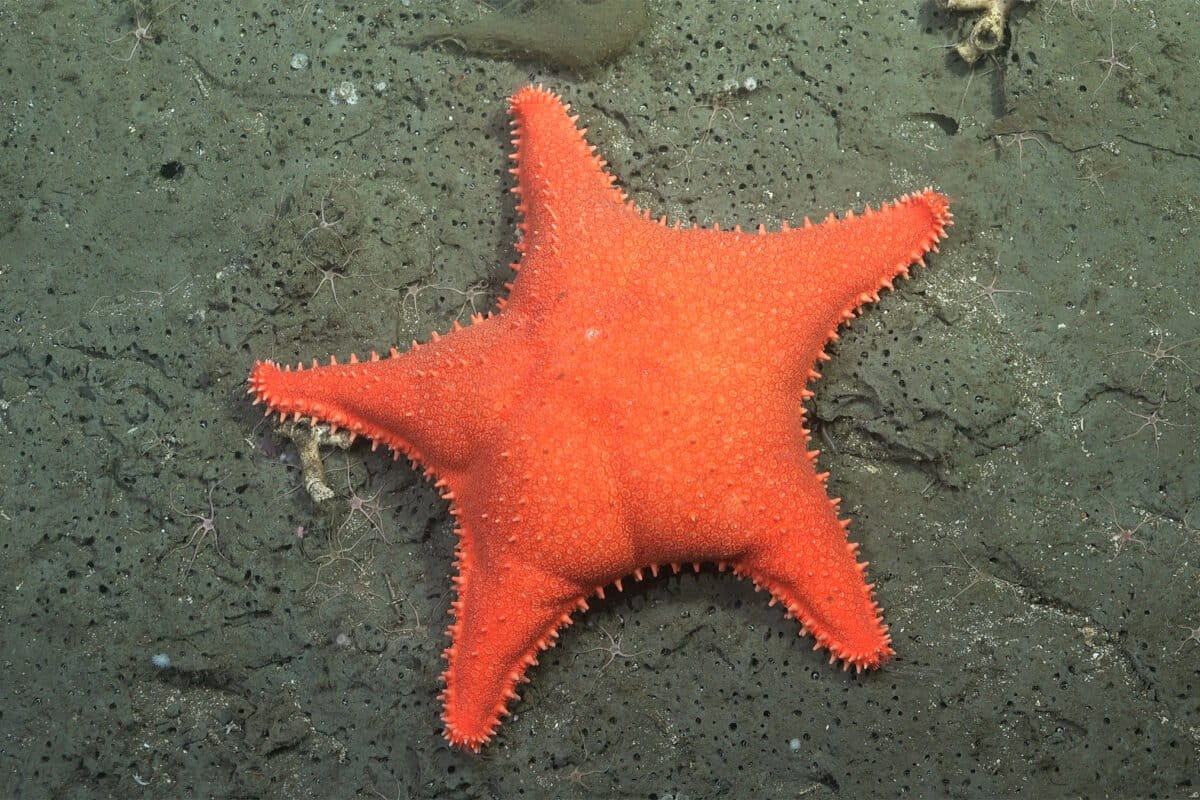
- Most specimens came from a 2025 expedition whose livestream drew more than 4 million viewers, many of whom tuned in for a sea star that looked like the cartoon character Patrick Star.
- The finds include a horned sea cucumber nicknamed Loki and 20 new copepods, with 90% of the copepod samples still unexamined.
- Researchers also found plastic and fishing litter in the canyon, a sign that even this remote deep-sea habitat faces human pressures.
See All Key Ideas
A sea cucumber with two horn-like appendages sits on the mud in the deep South Atlantic Ocean. Scientists named it Loki, after the horned Norse trickster god. Loki lives 2,577 meters (8,455 feet) below the surface, nearly eight Eiffel Towers deep.
Loki (Peniagone sp.) is one of 57 species new to science that researchers identified from Argentina’s Mar del Plata Canyon, according to the Nippon Foundation-Nekton Ocean Census. The team also found five new genera. It took them two weeks.
“The deep sea holds some of the least understood ecosystems on Earth,” Michelle Taylor, head of science at Ocean Census, said in a press release.
A standout discovery of the workshop, this striking deep-sea holothurian (sea cucumber) was named “Loki” for its prominent horned appendages, reminiscent of the god in Norse mythology. Captured in high-definition in-situ video and images on the seafloor of the Mar del Plata Submarine Canyon, it represents one of up to 10 new holothurian species uncovered during the Argentina workshop. Image courtesy of ROV SuBastian / Schmidt Ocean Institute.
Most of the specimens came from a 2025 expedition that turned the deep sea into must-watch TV. That July and August, the research vessel Falkor (too) sent a remotely operated vehicle named SuBastian into the canyon and livestreamed the dives. More than 4 million people tuned in live, according to Ocean Census. Many came for a plump orange sea star that looked like Patrick Star from the cartoon SpongeBob SquarePants.
Patrick, it turns out, is not a new species. Scientists left him where he was, unaware of his fame.
In July 2026, 20 taxonomists from Latin America and Europe gathered in Buenos Aires to sort the samples. They found 22 new echinoderms (sea cucumbers and feather stars), 20 copepods, 14 corals and sea pens, and one scaphopod, a mollusk that lives in a tusk-shaped shell.
The 14 new corals and sea pens include two potential new genera and a potential new family, which still awaits genetic analysis.
An extraordinary in-situ photograph of a bright purple holothurian (sea cucumber) resting on the seabed of the Mar del Plata Canyon. Recorded by ROV SuBastian during the August 2025 Schmidt Ocean Institute expedition, this specimen was analysed alongside dozens of other echinoderms by international experts during the species discovery workshop in Buenos Aires. Image courtesy of ROV SuBastian / Schmidt Ocean Institute.
Found between 1,909 and 2,625 meters (6,263 and 8,612 feet) deep in Argentina’s Mar del Plata Canyon and Deep Basin, this tiny copepod is part of a group of crustaceans that play a vital role in deep-sea ecosystems. During the workshop, taxonomists examined just 10% of the copepod samples collected — yet every specimen examined proved to be new to science, contributing to the discovery of 20 new species and one new genus.
These species are “discovered,” not yet “described.” Ocean Census counts a species as discovered once experts judge it new and log it in an open-access database called Ocean Census NOVA.
Formal description requires a peer-reviewed paper and a reference specimen in a museum. That process can take years. “International cooperation in taxonomy is critical, especially in groups with few active specialists,” Daniel Lauretta, the Argentina’s National Scientific and Technical Research Council (CONICET) scientist who led the 2025 expedition, said in a press release.
The copepods make this clear. The team examined only 10% of the copepod samples, and every specimen they looked at was new to science. That yielded 20 species and one new genus, with 90% of the samples still unexamined.
The canyon’s unique diversity comes from its position at a crossroads. It sits where two currents intersect. The warm Brazil current flows south, and the cold, nutrient-rich Malvinas current flows north from sub-Antarctic waters. Where they collide, nutrients fuel a burst of life.
The canyon itself plunges more than 3,500 meters (11,500 feet), nearly twice the depth of the Grand Canyon, according to Ocean Census.
But the canyon isn’t untouched. On the same expedition, researchers recorded 29 pieces of litter during 10 dives, mostly plastic and some rubber, according to a study in PLOS One. The first item they spotted was a plastic bag tangled on the seafloor. One piece of plastic tissue-paper packaging lay at 3,814 meters (12,513 feet).
Detailed in-situ imagery captures this vibrant sea pen living on the seafloor, as well as its careful collection using the robotic manipulator arm of ROV SuBastian. Gathered during the August 2025 Schmidt Ocean Institute expedition in the Mar del Plata Canyon, this colonial coral represents one of 14 new cnidarian species identified during the species discovery workshop. Image courtesy of ROV SuBastian / Schmidt Ocean Institute.
The full team of international taxonomists, regional experts, and early-career researchers assembled at Universidad Maimónides in Buenos Aires. Over two weeks, the collaborative team rapidly identified 57 new marine species and 5 new scientific genera from deep-sea samples, logging their findings directly to the open-access Ocean Census NOVA platform. Image courtesy of the Nippon Foundation-Nekton Ocean Census / Schmidt Ocean Institute
The canyon lies about 250 kilometers (155 miles) offshore, and much of the trash was fishing gear, so the researchers suspect most of it came from activity at sea. Animals had already moved in: A sea star sat on a plastic bag, and organisms colonized a fishing rope.
Pressures extend beyond the canyon. In separate Falkor (too) expeditions, scientists found what may be one of the world’s largest cold-water coral reefs along a 900-km (560-mi) stretch of Argentina’s waters, Mongabay reported in April. The reef held about 40 new species. It also showed tangled fishing lines and corals that may have been damaged by a trawler. Researchers worry the area could be targeted for oil and gas exploration.
The new specimens will stay in Argentina, housed in national collections including the Museo Argentino de Ciencias Naturales in Buenos Aires. Lauretta’s team plans to return with Schmidt Ocean Institute in February and March 2027 to a different canyon, one they expect to hold many species found nowhere else.
Banner image:Live-streamed to a global audience of nearly 4 million viewers, this vivid orange sea star became an internet sensation for its uncanny resemblance to the cartoon character Patrick Star (Patricio Estrella). Documented on the seafloor of the Mar del Plata Submarine Canyon during the 2025 expedition, the sea star was determined not to be a new species and was left undisturbed in its deep-sea habitat. Image courtesy of ROV SuBastian / Schmidt Ocean Institute.
Liz Kimbrough is a staff writer for Mongabay and holds a Ph.D. in ecology and evolutionary biology from Tulane University, where she studied the microbiomes of trees. View more of her reporting here.
One of the world’s largest deep-sea coral reefs discovered off Argentina
Citation:
Teso, V., Urteaga, D., Bozzano, G., Bigatti, G., Brogger, M. I., Brusa, F., … Lauretta, D. (2026). Out of sight, hidden into the deep: Marine litter in the Mar del Plata Submarine Canyon (southwestern Atlantic) revealed by ROV survey. PLoS One, 21(9), e0357098. doi: 10.1371/journal.pone.0357098
FEEDBACK: Use this form to send a message directly to the author of this post. If you want to post a public comment, you can do that at the bottom of the page.