A coalition of legal and environmental groups has filed money laundering complaints against JBS, the world’s largest meat processor, and 12 financial institutions, investors and advisers, including the U.K. bank Barclays. The complaints allegedly tie JBS profits to illegal deforestation in the Brazilian Amazon.
The Transnational Legal Coalition filed 14 complaints with prosecutors and financial regulators in the United Kingdom, Ireland, Germany and the Netherlands on Nov. 5. It argues that profits from cattle raised on illegally cleared land constitute “proceeds of crime” under anti-money laundering laws, potentially exposing JBS, and institutions that handle its money, to legal liability.
“Illegal deforestation of the Amazon is a crime, not a business model,” Bláithín Quigley, coordinator for the Transnational Legal Coalition, said in a statement.
The coalition of legal nonprofits includes Global Legal Action Network and the European Center for Constitutional and Human Rights, as well as advocacy groups Mighty Earth, FIND and King’s College London in the U.K.
The complaints draw on a report by environmental research nonprofit AidEnvironment that linked JBS suppliers to more than 6.5 million hectares (16 million acres) of deforestation in the Brazilian Amazon between 1988 and 2026.
Barclays is JBS’s largest financier and earned $1.7 billion from its dealings with the company between 2018 and 2023, according to a 2024 investigation by Global Witness. An analysis by the Center for Climate Crime Analysis for the same investigation found nearly 8,000 cows reared on illegally occupied Apyterewa Indigenous territory in Pará “entered JBS’s supply chain” in the same period.
AidEnvironment also found evidence of deforestation in legally protected areas on more than 80% of farms they sampled that directly or indirectly supply JBS. The affected areas included Legal Reserves, portions of rural properties that landowners must preserve under Brazilian law, and Areas of Permanent Preservation, where clearing vegetation is generally prohibited.
Barclays declined to comment.
In an email to Mongabay, a Mighty Earth spokesperson said that JBS has received a summary of the report and is “aware of the key findings.” However, JBS has disputed the allegations and said it hasn’t received the data needed to assess the claims.
“JBS regrets that the NGO’s campaign has withheld the purported data on which its allegations against JBS are based, which prevents the Company from taking action on them. We cannot comment without access to the methodology of the purported study.”
JBS added that it has monitored its suppliers in the Amazon since 2010 using a protocol set by Brazil’s Federal Prosecution Office. It also said that their systems automatically block farms with illegal deforestation or that overlap conservation units.
“Environmental crime is financial crime. Revenue linked to illegal deforestation can flow into the global financial system,” Mariana Gutiérrez, director and investigator at FIND, said in a statement. ”JBS has raised billions in the past year alone despite well-documented deforestation risk in its Brazilian supply chain.”
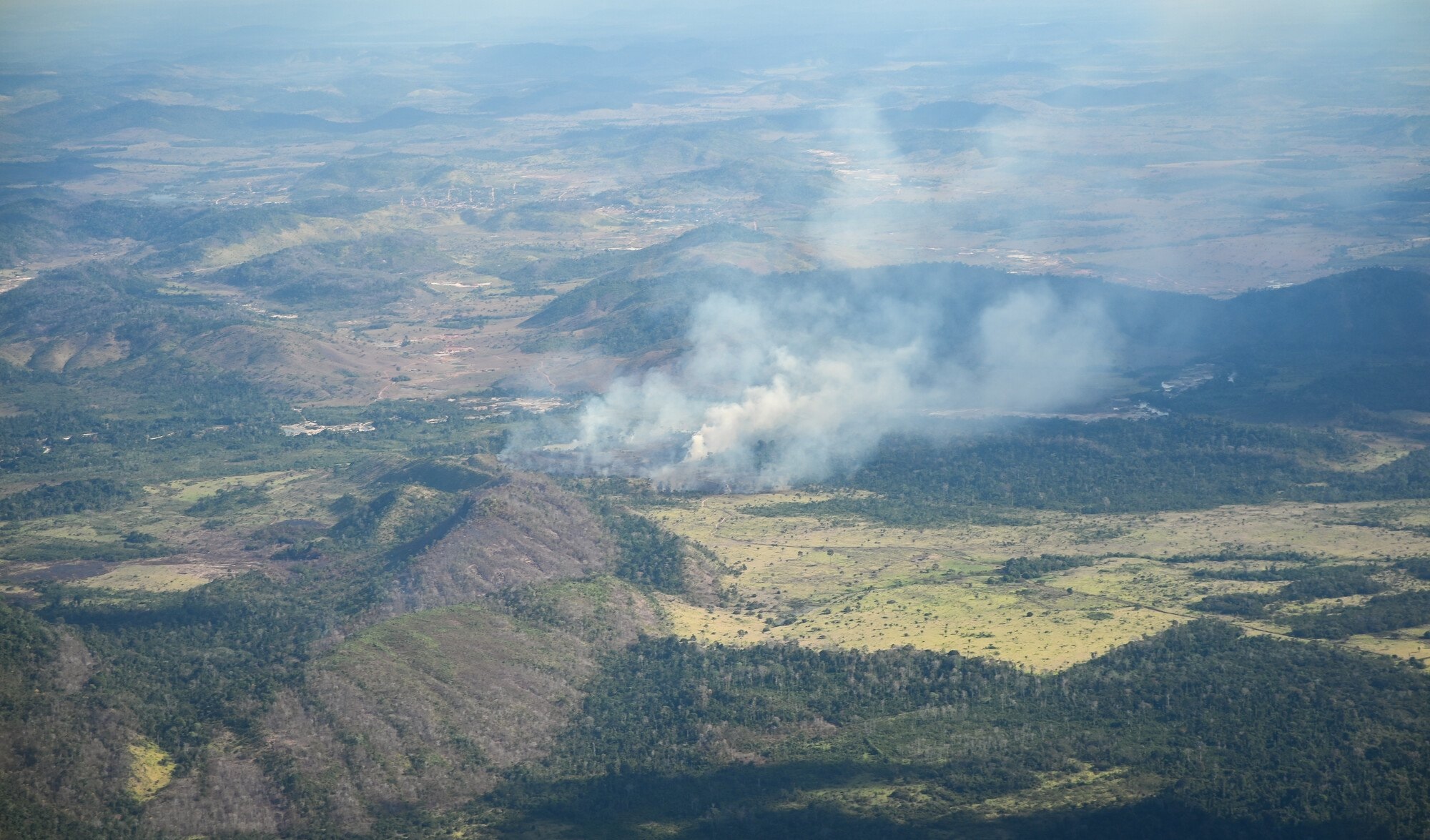
Banner image: Smoke from fires in Apyterewa Indigenous Territory in Pará state, Brazil. Image courtesy of Cícero Pedrosa Neto/Global Witness.