- Yala National Park in southern Sri Lanka attracted more than 380,000 visitors in the first half of 2025, generating an income of more than $5 million.
- Among the most popular national parks, overcrowding at Yala Block I is a recurring problem, intensified since the social media boom, conservationists say.
- Most leopards at Block I have become acclimatized to humans and safari jeeps, creating more interest among visitors.
- Despite regular training programs, speeding jeeps have become a serious challenge to animals there, and authorities now plan to limit the number of jeeps and open other blocks to reduce the pressure on Block I.
See All Key Ideas
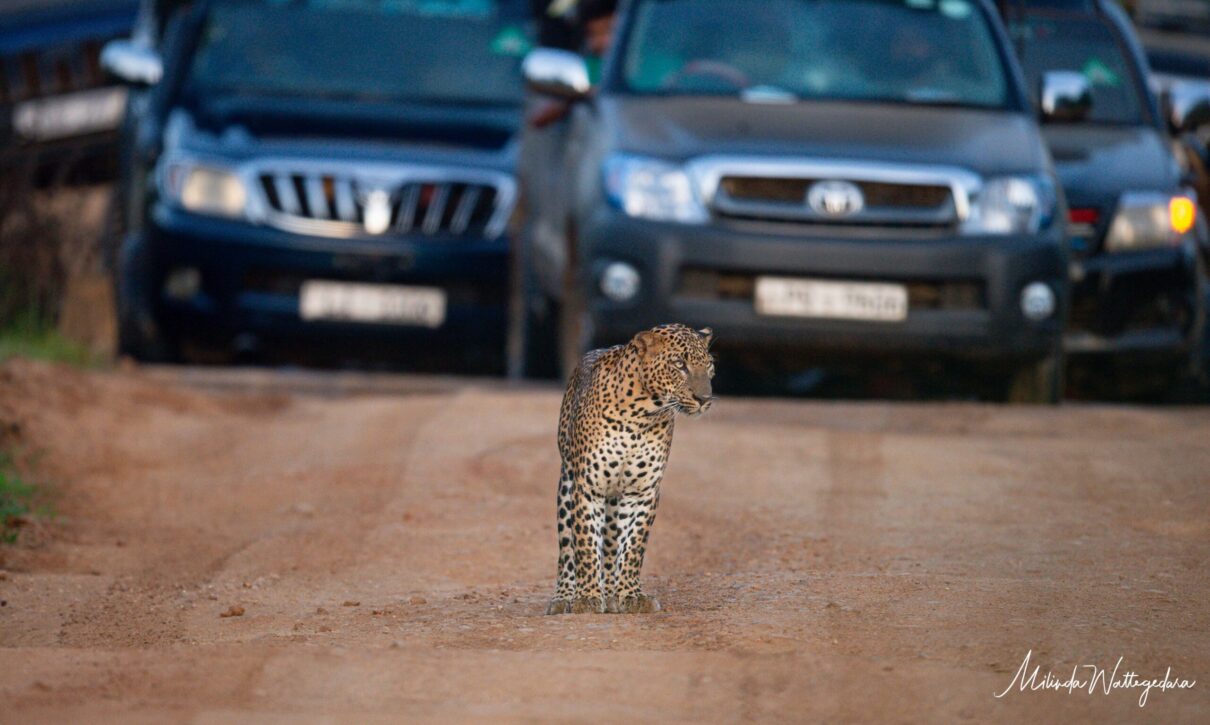
YALA, Sri Lanka — Spotting a leopard at Yala National Park, Sri Lanka’s most famous wildlife park located in the deep south, tops the list of priorities for many local and foreign wildlife enthusiasts. Block I of Yala National Park attracts the most number of visitors, as it is known to have the highest density of leopards, with at least one leopard per square kilometer (0.4 square miles). Due to this pressure, many visitors flock to Yala Block I all year round, with the hope of spotting one or more leopards, resulting in overcrowding, “leopard jams” and speeding jeeps, posing significant threats to its wildlife.
Hit-and-run cases
Past incidents indicate dangers associated with speeding jeeps for both humans and wildlife. In October 2011, a young leopard was killed in a hit-and-run safari jeep accident. Another jungle cat died in a hit-and-run incident in June 2012. Then, in September 2021, two safari jeeps carrying local and foreign visitors collided, injuring one local visitor.
Recently, Lucas, a magnificent male leopard in the Block I area, made headlines when a safari jeep had come into close contact with the animal. The incident itself was mired in controversy, as some factions claimed the animal had been “slightly bumped” from behind, while park officials denied these claims.
Ravindra Kumara, Yala National Park warden, told Mongabay the incident was not an accident as reported in the media. “Usually, when a safari jeep is close to an animal, jeep drivers have been advised to switch off the engine. But this driver had turned on the engine, and it had scared away the animal. However, Lucas was spotted the following night near Yala junction, the animal’s usual territory, and is in good health,” Kumara said.
Overcrowding at Block I
Even though Lucas barely escaped injury this time, the larger issue of overcrowding remains a challenge.
“Overcrowding at this section of the park started with the social media boom and when communication became much easier,” said Milinda Wattegedara, wildlife photographer and co-founder of the Yala Leopard Center. “People came to Yala even during early 2000s, prior to the social media boom, but their genuine intention was to see animals and photograph them. At least 80% of them were genuine wildlife lovers. Back then, there were no highways, and coming to Yala was a full day trip,” he told Mongabay.
Block I has a high population of herbivores and an attractive predator population, owing to the availability of resources.
“These resources include food, water and the ability to reproduce. At present, around 500 jeeps are allowed entry into the park during morning and afternoon sessions. There is a traffic jam whenever there is a leopard sighting. On the other hand, there’s decent mobile reception inside the park, which makes it easier for jeep drivers to communicate with one another, often increasing the line of jeeps,” Wattegedara added.
Lucas, a prominent male leopard at Yala Block I, was knocked out by an errant diver. Image courtesy of Milinda Wattegedara.
Contribution to economy
Yala is considered one of the best places in the world to view wildlife in their natural settings. Visitor arrivals from 2025 bear testament to this observation. The 2025 year in review by the Sri Lanka Tourism Development Authority recorded almost 390,000 local and foreign visitors to the park from January to June. Among the individual parks, Yala emerged as the highest income generator, bringing in more than 1.6 billion rupees ($5 million) supported by high visitor numbers and substantial vehicle fee income.
Statistics also show the national park’s contribution to the Sri Lankan economy. But over the years, the issue of overcrowding at Yala Block I has discouraged frequent visitors from visiting the park.
“Leopards are elusive animals and they usually hide, but in the case of leopards at Block I, they have become acclimatized to people and safari jeeps,” Srilal Miththapala, veteran wildlife enthusiast, tourism and sustainability professional, told Mongabay. “Leopards in Yala would sleep in the middle of the road and showcase certain behaviors, which sparks interest among visitors,” he said.
Miththapala said tour operators have developed a tourism package and that most tourists visit Yala to “tick the box” of sighting a leopard. “They may not quite be interested in seeing leopards. But if a leopard is spotted, drivers would receive tips of $50-$100 and more than 50% of foreign tourists visit at least one wildlife park. But 10 years ago, it was only about 30%. Most visitors today are going to just see a leopard but they may not be the interested lot,” he added.
Visitors at major tourist attractions during the first quarter of 2025. Image courtesy of the Sri Lanka Tourism Development Authority (SLTDA).
Driver training programs
Due to the growing number of concerns regarding speeding jeeps and unethical behavior of drivers, the Department of Wildlife Conservation (DWC) and other conservation-focused organizations such as the Wildlife and Nature Protection Society (WNPS) initiated training programs for drivers, emphasizing the need to adhere to speed limits and the importance of respecting wildlife.
In 2017, a multi-stakeholder advisory committee appointed by the then-Prime Minister Ranil Wickremesinghe developed a comprehensive framework titled “An Action Plan for Improving the Overall Wildlife Tourism Experience in Yala National Park (Block I).” The report identified several critical constraints, including insufficient number of trained wildlife guides to ensure one guide per vehicle.
Spencer Manuelpillai of WNPS told Mongabay that nearly a decade later, these challenges remain. “A growing trend within the park is the prioritization of sightings over observation — where the success of a visit is measured by proximity and quantity, rather than the quality of the experience or respect for animal behavior.
WNPS calls for the immediate and consistent enforcement of park regulations firmly, fairly and without exception. This includes strengthening driver accountability, ensuring adequate deployment of trained guides and restoring the authority of park management to act decisively in the interest of wildlife welfare,” he added.
In January 2024, DWC launched a program to issue licenses to safari jeep drivers. This allowed only guests accompanied by licensed jeep drivers to enter the park.
“So far, there are 552 registered jeeps in Yala and only these jeeps are allowed entry into the park,” Ajith Priyantha, president of the Yala Jeep Owners’ Association, told Mongabay.
“We have been trained on maintaining the distance between a jeep and an animal, and we adhere to those guidelines. We have also been issued a license. We do have to comply with these rules and guidelines, and if not, our licenses would be suspended. The DWC would also impose a fine depending on the severity of the offense,” he added.
A leopard walking toward a safari jeep. Image courtesy of Milinda Wattegedara.
Mitigation measures and solutions
A 2019 study on commercial safari jeep drivers’ perspectives on mitigating traffic congestion in Yala National Park lists 16 mitigation measures to reduce traffic. These include expanding the road network to banning the use of mobile phones inside the park to limiting the number of safari jeeps, limiting time spent at wildlife sightings, permitting only one-way driving, among others.
“Our earlier research demonstrates that visitor satisfaction is influenced not only by wildlife sightings but also by the quality of guiding offered,” Supun Lahiru Prakash, conservationist and a contributing author to the study, told Mongabay. “Tourists accompanied by skilled and knowledgeable safari guides and drivers reported high levels of satisfaction even when wildlife encounters were modest. In terms of solutions, rehabilitating and properly maintaining the internal road network is paramount. It should be guided by a structured management plan implemented on a rotational basis across the park to avoid cumulative ecological disturbance,” Prakash added.
However, with the new park warden assuming duties, certain changes have already been observed.
Wattegedara noted there is strict adherence to time limits, a positive sign. “If the vehicle is late even by one minute, chances are high that this vehicle would be banned from entering the park for a day. They have also given time frames for jeep drivers when they come out of the park. Ultimately, it is the responsibility of safari drivers to act professionally and ethically inside the park,” he said.
Hope for the future
As a solution to reduce overcrowding at Block I, Anton Jayakody, Sri Lanka’s deputy environment minister, told Mongabay the government is planning to open several less populated blocks to reduce the pressure on Block I.
“These include Galge area at Blocks III, IV and V, Lunugamvehera and Kalu Palama at Block VI and Left Bank new entrance also at Block VI. We are also trying to limit the number of jeeps entering the park to around 250-300,” he said.
Jayakody said plans are afoot to install GPS devices on jeeps, enabling to track their location and ensure they reduce speed. He said the road network has been improved in each one of the blocks, and the government is keen to implement these changes within this year.
“Our ultimate goal is to make Yala the best destination in the world to see leopards. Whenever someone wants to see a leopard, their number one destination has to be Sri Lanka and not Africa. That is the vision that all stakeholders, including researchers, safari drivers and even the government should be working towards,” Wattegedara added.
Banner Image: A leopard at Yala National Park surrounded by safari jeeps in the background. Image courtesy of Milinda Wattegedara.
Citations:
A.M. C. P. Aththanayaka, Siyasinghe, D. P., & Prakash, L. (2019). Commercial safari jeep drivers’ perspectives on mitigation of traffic congestion in the Ruhunu National Park (Yala), Sri Lanka. 7(2), 59–64. https://www.researchgate.net/publication/338395186_Commercial_safari_jeep_drivers
Egresi, I., & Prakash, T.G.S.L. (2019). What makes wildlife tourists happy and what disappoints them? Learning from reviews posted on TripAdvisor. GeoJournal of Tourism and Geosites, 24(1), 102–117. https://doi.org/10.30892/gtg.24109-346