- The Asian small-clawed otter was rediscovered in Nepal in 2024 after 185 years. Since then, however, it’s gone dark again, with no more confirmed sightings.
- Identifying the animal remains challenging due to its small size, dietary overlap with other carnivores, and resemblance to common species such as the crab-eating mongoose.
- Funding and logistical constraints impede targeted surveys, as conservation priorities in Nepal focus mainly on larger, charismatic species such as tigers and rhinos.
- Despite this, conservationists are already planning measures to reduce potential threats to the animal by including it into the national otter conservation action plan.
See All Key Ideas
KATHMANDU — A year ago, the appearance of the Asian small-clawed otter in Nepal created a buzz, given that the species hadn’t been seen in the country in 185 years. Since then, however, it’s disappeared once again, with no confirmed sightings in the past year, leaving researchers flummoxed on the question of whether it’s still found in the country.
The November 2024 discovery of a juvenile Asian small-clawed otter (Aonyx cinereus) in Dadeldhura district, on Nepal’s western border with India, left researchers hopeful of more sightings would follow. However, limited funding and difficulties in DNA analysis have left them relying on scattered clues rather than certainty, even as the species is formally incorporated into the country’s conservation plans.
“Despite multiple reports of suspected signs, such as scats recovered from different river systems, there hasn’t been a second verified sighting of the Asian small-clawed otter anywhere in the country,” Mohan Bikram Shrestha, a leading otter researcher, told Mongabay. “We firmly believe that the animal is present in the eastern river systems as well.”
The lone confirmed record from 2024 was remarkable not only for being the first recorded sighting since 1839, but also for raising the possibility that overlooked populations of the world’s smallest otter species might still roam Nepal’s rivers and wetlands.
A rescued Asian small-clawed otter with its distinct webbed feet in Dadeldhura, Nepal. Image by Rajeev Chaudhary.
Since then, however, there’s only been indirect evidence of a possible otter presence. Community members and researchers have collected suspected otter droppings from several locations, and people have reported seeing animals that resemble the small-clawed otters. However, none of the potential sightings have been verified.
“We know that the small-clawed otters are out there, but we can’t prove it conclusively,” Sanjan Thapa, one of the researchers involved in the last sighting, told Mongabay. “The main problem is we don’t have the financial resources to go look for them in potential habitats.”
Otters are known to avoid areas with human disturbance, and reports of their sightings have often proved to be a case of mixed identity. Most such sightings have been of the similar-looking crab-eating mongoose (Urva urva), whose range overlaps with that of the small-clawed otter.
“People can easily misidentify it,” Shrestha said. “Without clear photographs or genetic confirmation, it’s very hard to say what they’ve seen.”
Nepal is officially home to three otter species, which differ noticeably in size, physical features and food preferences. The smallest have partially webbed paws and short, blunt claws, hence the name “small-clawed.”
The other two are the Eurasian otter (Lutra lutra), which feeds on fish, and the smooth-coated otter (Lutrogale perspicillata), which feeds on frogs, crabs, shrimp, snakes and insects. The small-clawed otter has a similar diet of crabs, snails, mollusks and small fish, which makes identifying it through its scat more complicated.
A scat sample likely belonging to an Asian small-clawed otter. Image courtesy of Mohan Bikram Shrestha.
Studies show that more than 80% of the scat of small-clawed otters consist of crabs, with smaller proportions of fish, insects and snails. “These remains can resemble those of other small carnivores such as mongoose, making field identification difficult,” said Shuvam Sharma, a researcher in Darjeeling, just across the border in India.
Just as in Nepal, Sharma and his team rediscovered the Asian small-clawed otter in Darjeeling in 2022 after a long absence. He also echoed the sentiment that identification purely from a visual sighting remains a challenge to untrained observers.
Genetic studies from biological samples offer a much greater degree of certainty when it comes to making a positive identification, but doing so in Nepal is complicated, Shrestha said. There are strict rules governing the collection, storage and transport of biological samples, and laboratory processing can take months.
Funding is another major obstacle. Conservation resources in Nepal focus overwhelmingly on charismatic megafauna like tigers, rhinos and elephants, leaving smaller species like otters with little dedicated support, Thapa said.
The uncertainty and mystery surrounding the Asian small-clawed otter mirrors that of the Eurasian otter, for which there were also no confirmed sightings in decades. However, that changed in 2021, when researchers documented the species in rivers such as the Barekot, Roshi and Tubang in western Nepal. This followed a flurry of reported sightings elsewhere, including in the Kathmandu Valley.
Despite the elusive nature of small-clawed otters, the threats they face can’t be underestimated, conservationists say. According to the IUCN, the global wildlife conservation authority, otters in general are impacted by habitat loss as a result of infrastructure development, agriculture, aquaculture, deforestation, and wetland reclamation. Pollution from pesticides, heavy metals and siltation further degrades water quality and prey availability. In Nepal specifically, additional threats include the use of, small-mesh fishing nets that can trap otters, dam construction, waste dumping and river pollution, Thapa said.
A small mesh net used used for fishing in Nepal. Image by Abhaya Raj Joshi.
Yet despite these growing threats and the lack of confirmed sightings, conservationists continue to include the Asian small-clawed otter in national conservation planning.
“The national plan includes provisions to facilitate research on the Asian small-clawed otter,” Thapa said. “There are plans to allocate funding for surveys in potential habitat areas.”
Shrestha said he believes lessons from the rediscovery of the Eurasian otter gives reason for hope when it comes to its smaller cousin.
“Given what we’ve learned from the Eurasian otter,” he said, “we know that sooner or later we will have another confirmed presence soon.”
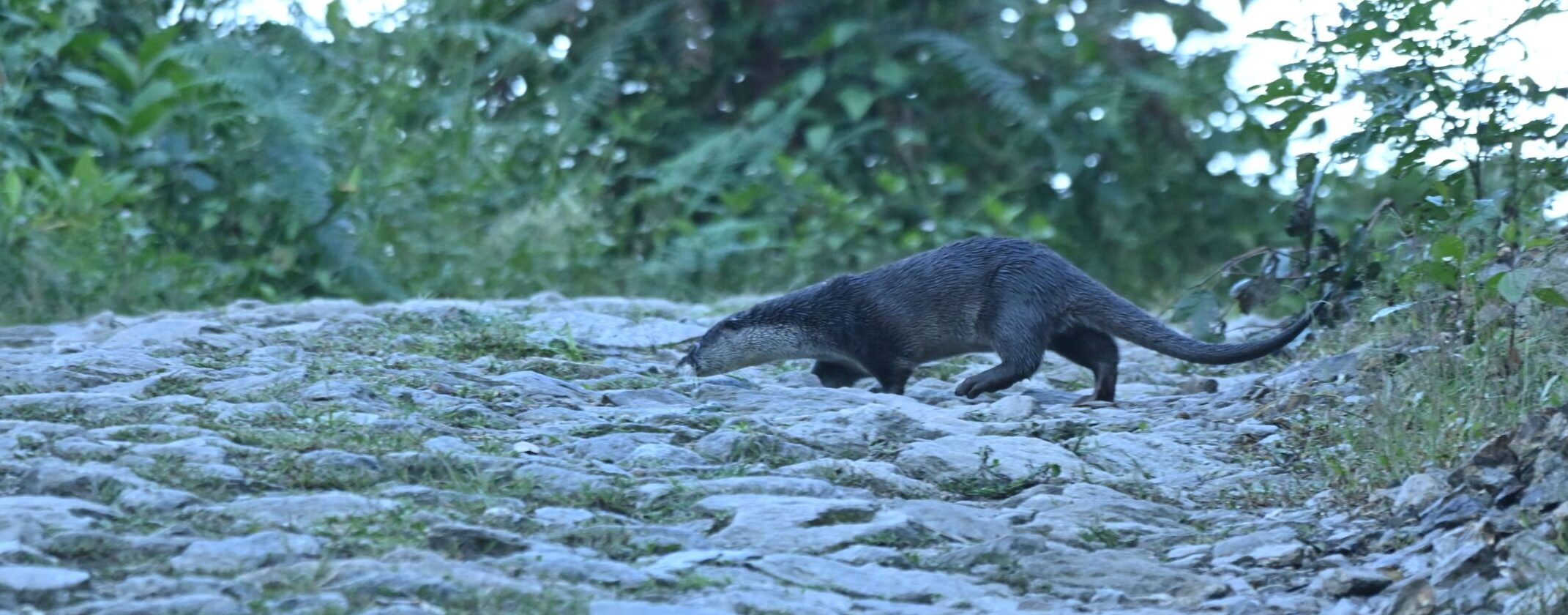
Banner image: An Asian small-clawed otter (Aonyx cinereus) photographed in Darjeeling, India. Image courtesy of Ganesh Pradhan.
Abhaya Raj Joshi is a staff writer for Nepal at Mongabay. Find him on 𝕏 @arj272.
On World Otter Day, an uphill struggle for these creatures in Nepal