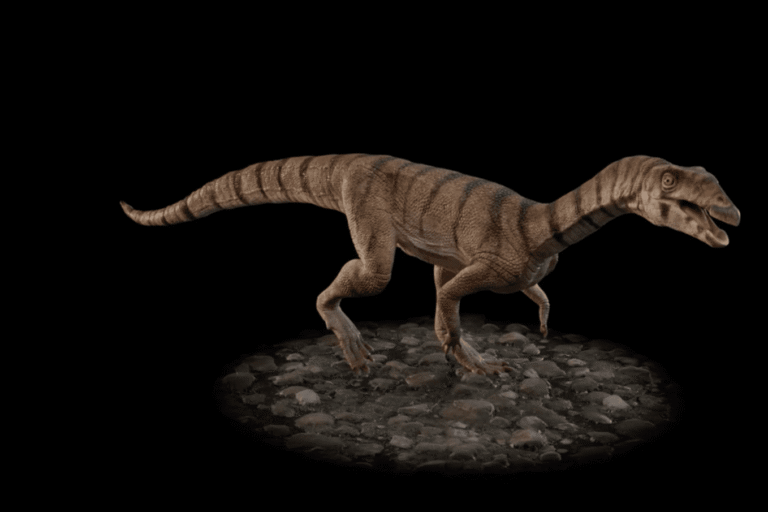
Dinosaurs like tyrannosaurs and velociraptors famously walked on two legs. But they weren’t the only bipedal prehistoric creatures to exist. In a study published in June, paleontologists shared the discovery of a new bipedal shuvosaurid, an ancient, distant relative of crocodiles, that lived 212 million years ago in what is now the U.S. state of New Mexico. Unlike modern-day crocs, the newly described Labrujasuchus expectatus was beaked, toothless, had two tiny arms, and walked on two legs. Researchers found fossilized bones of L. expectatus alongside those of bipedal dinosaurs at the Hayden Quarry at the Ghost Ranch site, famous for its well-preserved fossils. They were found in sediments dated to the Late Triassic period. The generic name of the species Labrujasuchus comes from “Ranchos de los Brujos,” or Ranch of the Witches, an old Spanish name for the Ghost Ranch area. The Greek word Σοῦχος (suchus) means crocodile. The species name expectatus references the idea that researchers expected to find a shuvosaurid fossil at the Hayden Quarry. In an email interview with Mongabay, Nathan Smith, study co-author, paleontologist and director of the Dinosaur Institute, Natural History Museum of Los Angeles County, U.S., said the first shuvosaurid described, which was originally misclassified as a dinosaur, was named Shuvosaurus inexpectatus, as a way to point out that such a bizarre-looking creature was not “expected” in Late Triassic rocks. “So, the ‘expectatus’ name is a cheeky nod to the original Shuvosaurus discovery, and the fact that we definitely expected to come across some…This article was originally published on Mongabay