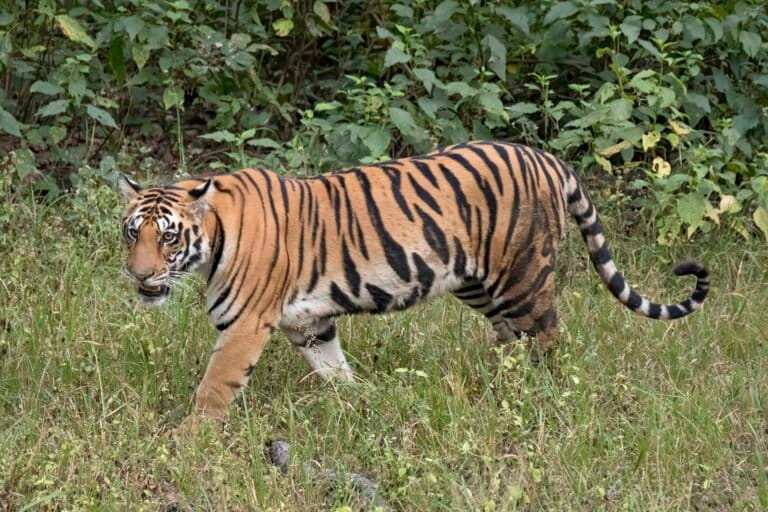
Founder’s Briefs: An occasional series where Mongabay founder Rhett Ayers Butler shares analysis, perspectives and story summaries. Cambodia is preparing to reintroduce tigers after nearly two decades without a confirmed wild population. The plan is ambitious, and many of its basic assumptions remain contested, report Mongabay India’s Arathi Menon and Mongabay contributor Andy Ball. The last confirmed tiger sighting in Cambodia came from a camera trap in 2007. By 2016, tigers had been declared extinct in the country. The animals were lost after years of poaching, snaring, habitat degradation, and trade in tiger parts. Those pressures remain. Cambodia’s Indochinese leopard (Panthera pardus delacouri) was declared functionally extinct in 2023, and snares continue to threaten large mammals. The proposed reintroduction would use Bengal tigers (Panthera tigris) from India, released into Kravanh National Park in the Cardamom Mountains. Supporters of the program see a chance to restore an apex predator to one of Cambodia’s largest remaining forest landscapes. India has rebuilt its own tiger numbers over several decades, and Cambodia has approved a tiger action plan. A soft-release enclosure has already been built. The unresolved questions are ecological and political. Tigers need abundant prey. One 2020 study found only a low probability that the proposed landscape could support 25 adult tigers, though it might support a small founder population of five tigers. However, small populations face inbreeding risk and require sustained management. Wild pigs in the landscape may form much of the prey base, but experts disagree on whether current prey data…This article was originally published on Mongabay