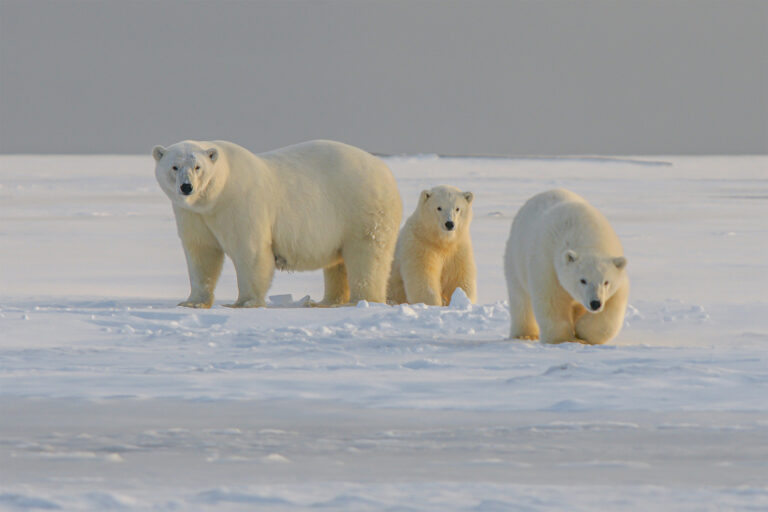
How do you spot polar bears in the vast, and often dark, wilderness of the Arctic? Enter Bear-dar. This AI-driven radar system scans the landscape to spot approaching polar bears. The technology was developed by the nonprofit Polar Bears International in collaboration with U.S.-based security firm Spotter Global in a bid to mitigate encounters between the animals and people. “We wanted to add another tool to the polar bear safety toolbox,” Alysa McCall, director of science at Polar Bears International, told Mongabay in a video interview. “With an early-warning detection system, there’s less chance of a bear getting killed because it surprised somebody.” Climate change is the biggest threat to the survival and existence of polar bears (Ursus maritimus). As sea ice melts in the Arctic, these threatened species are rapidly losing their habitats. As a result, they move on to land in search of food, where they risk coming into close contact with humans. With Bear-dar, scientists and conservationists say they hope to help manage such encounters and conflicts. The early-warning system uses radars and cameras that keep a watch on the landscape, looking out for motion in its field of vision. The radar panels, each about the size of an iPad, look at a distance ranging from a few hundred meters to 1.2 kilometers (0.75 miles). The AI algorithm in the radars was trained to detect polar bears from zoo-held animals at Assiniboine Conservancy Park in the Canadian city of Winnipeg. “There’s not a ton of polar bear…This article was originally published on Mongabay