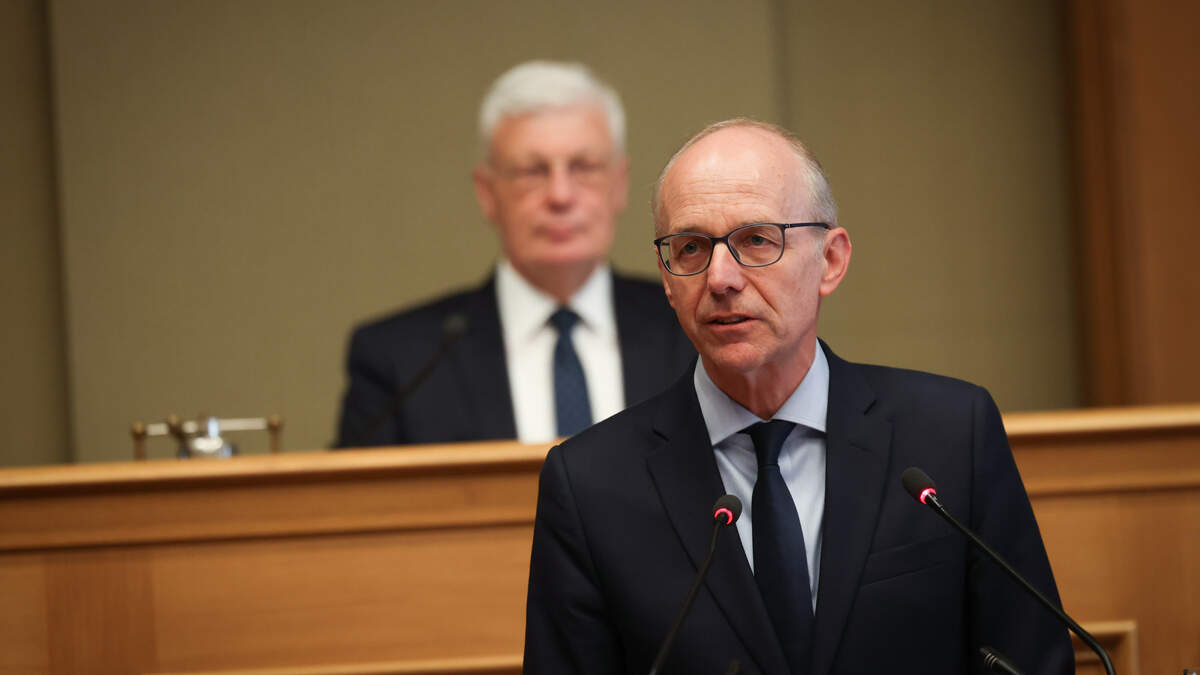
The government will convene a tripartite meeting on 12 May, followed by formal negotiations on 2 and 3 June, Prime Minister Luc Frieden announced on Tuesday during a debate in the Chamber of Deputies.
On 6 May, the government will meet social partners – unions and employer representatives – separately. A first joint tripartite session, including experts from Statec and the energy sector, is scheduled for 12 May, focusing on a shared assessment of the situation.
Formal negotiations are provisionally set for 2 and 3 June. The State of the Nation address will take place in between, on 19 May.
Presenting the roadmap, Frieden pointed to geopolitical uncertainty linked to the war in Iran and warned that “the real crisis may still be ahead”.
The prime minister did not commit to a fixed agenda for the talks, saying the government would first consult social partners. He said the framework was defined by external uncertainty, particularly developments linked to the conflict in the Middle East and its potential economic impact.
He added that Luxembourg was relatively well positioned compared with other countries, citing existing measures such as indexation, state coverage of €150 million in grid costs, comparatively low fuel taxation, and enhanced energy support for low-income households, which has recently been tripled.
Reactions from the opposition
Opposition parties criticised the timing and preparation of the process, arguing that the government was reacting under pressure and lacking consistency in its approach to social dialogue.
MP Sam Tanson from the Déi Gréng delivered a sharply critical assessment, arguing that social dialogue under the current government was not functioning.
During the parliamentary meeting she said the Luxembourg model had caught a “serious cold”, which risked developing into “pneumonia”. She also pointed to shifting government positions: from initially denying any crisis, to linking a tripartite only to multiple index tranches, to now convening one regardless.
Frieden rejected the accusation. He said the consequences of the Israeli-American strike on Iran remained unclear and that international assessments, including at a recent meeting of EU leaders in Cyprus, varied significantly.
Do not turn the social dialogue into a monologue with token participation
Georges Engel
LSAP
The potential impact on energy markets, he said, could still materialise “in a few months”. Policy responses, he added, required analysis rather than haste.
Georges Engel from LSAP welcomed the convening of the tripartite but questioned the process. He said the decision appeared driven less by conviction than by external pressure, including from the opposition and social partners.
“Do not turn the social dialogue into a monologue with token participation,” Engel said, raising concerns about limited scope for negotiation after the State of the Nation address.
Tanson also questioned the six-week timeline, suggesting the government risked prioritising political communication over crisis management.
The job of a statesman is to represent the state, not himself
Index and policy divides
Coalition MPs defended the approach. Laurent Zeimet (CSV) said the opposition’s stance risked undermining the process. He stressed that the government’s priority was stability and targeted measures, noting that the index mechanism, relatively low energy prices, and existing support schemes were already cushioning households.
The index itself, he said, was not up for debate.
Fred Keup (ADR) rejected the need for a tripartite at this stage, arguing that key socio-economic questions should be debated in parliament rather than in closed-door talks. He called instead for immediate relief measures, including temporary cuts in fuel excise duties.
Marc Baum (déi Lénk) described a “threefold crisis” affecting employment, housing, and climate and energy. He called for structural measures, including large-scale public housing investment, rent regulation, and action against vacant properties, warning of a broader social crisis if these issues were not addressed jointly.
Fedil warns Luxembourg industry needs ‘decisive reforms’ to stay competitive
(This article has first been published on the Luxemburger Wort. AI translated with editing by Lucrezia Reale.)