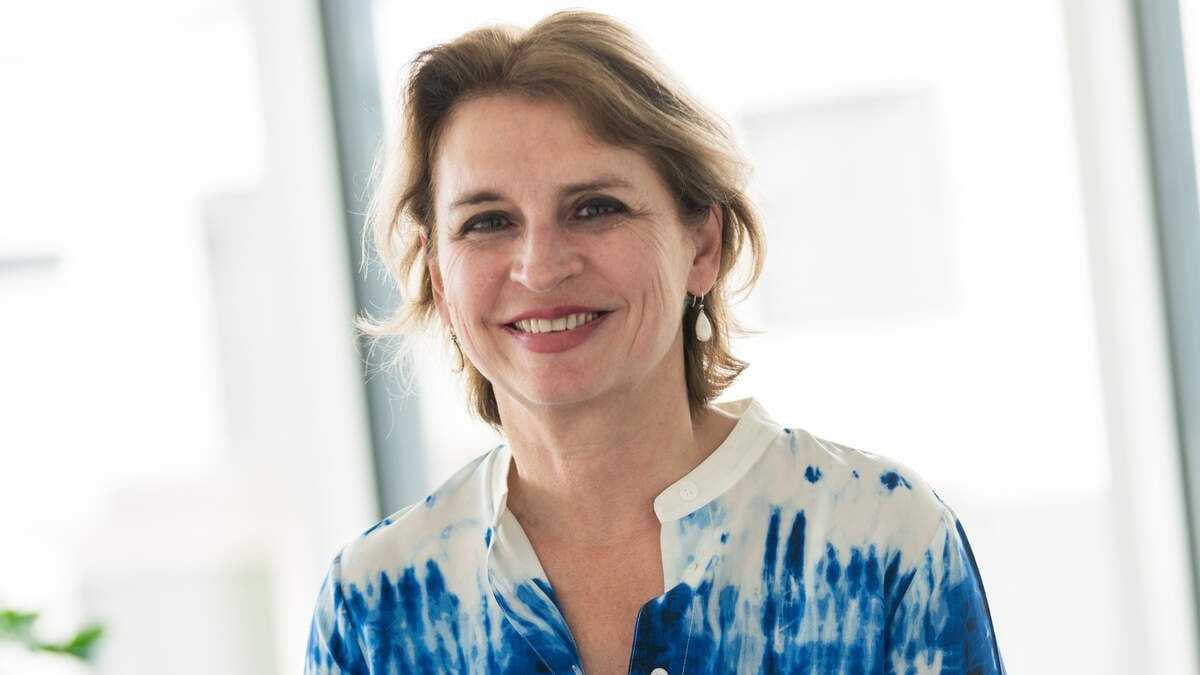
The new president of the National Parents’ Association, Carla Carvalho, has said her background as an immigrant child of Portuguese parents has helped make her fully aware of the difficulties facing foreign students in Luxembourg’s schools today.
In her first interview since taking office, Carvalho told Contacto about her priorities for the role, including tackling violence in schools, a ban on social media and enabling students to receive support with homework at the country’s maison relais.
Carla Carvalho, you are the new president of the National Parents’ Association in the Grand Duchy, but you were already one of the national representatives for primary school parents during the previous term. How do you feel about now taking on the ultimate responsibility of being the voice of parents across the country?
I must admit I was still hesitant to run for president, but I thought it over and went ahead with full commitment, to continue what we have been doing since the previous term, when the group was chaired by my colleague Alain Massen. When I was elected, through the votes of all the parents’ representatives from schools across the country, I admit I was happy and very moved.
My parents are Portuguese and were never able to help me much at school because they didn’t speak German or Luxembourgish, and that left a mark on me
Carla Carvalho
President of the National Parents’ Association
Were you moved by the election because you are of Portuguese descent and also represent the parents of students of Portuguese nationality, who make up the largest group of foreign nationals in the country?
Exactly. I was born in Luxembourg 40 years ago. My parents are Portuguese and were never able to help me much at school because they didn’t speak German or Luxembourgish, and that left a mark on me. I understand very well the difficulties Portuguese students face in Luxembourg schools, and students of other nationalities as well.
I had to do my homework alone and, as a child, I experienced first-hand the difficulty of learning to read and write in German. I didn’t feel completely integrated at school because I was learning in a foreign language without support. It was complicated.
And my parents felt it too, because they couldn’t help me. As a former student and educator in a maison relais for 20 years, I understand very well the children of Portuguese descent and other nationalities even today, who sometimes don’t have parents who can help them, who have the ability to learn the subjects but can’t develop well because of that language barrier, which makes everything much, much more difficult.
Do Portuguese and foreign parents suffer because they cannot support their children with their homework?
Yes, because they feel their children’s added difficulties and the struggle to overcome these barriers. For a child whose parents are fluent in German or Luxembourgish, who have these languages as their mother tongues, it is much simpler. Or parents who can provide other means of extra learning, such as private tuition or having someone who can help the children.
How expat children cope with several languages in Luxembourg schools
The ‘great achievement’
Will the option of teaching in French in primary education, which begins in the next academic year, facilitate pupils’ learning and integration? Was this one of the causes championed by the Parents’ Association?
Undoubtedly. I’ll go back to the example of my parents, who are fluent in French, and that alone would have made my learning much easier. The same applies to Portuguese-speaking parents who come to Luxembourg to work and learn French, one of the official languages.
Until now, the alternative was international schools, but state schools had limited places and private schools are fee-paying. It is very important for children to have the option of choosing to learn to read and write in French or German within the free state education system.
We, the Parents’ Association, strongly support this change, as it will ensure greater equality of opportunity for all pupils. And that is how it should be. Furthermore, the language of integration at school will be Luxembourgish, in which all core subjects will be taught in Luxembourgish, and children can also learn Luxembourgish, a very important language.
A child who arrives at school must be seen as equal to all others
Carla Carvalho
President of the National Parents’ Association
School must be a place of equal opportunities for all children, argues Carla Carvalho © Photo credit: Photo supplied by Carla Carvalho
During your school years, did you feel you might have been discriminated against because of your Portuguese surname, as so many Portuguese people have been complaining about for years?
I think that being of foreign origin already carried a certain label, yes. In 6th grade, the teacher told my mother that if I went into classical education, it would be very difficult because they didn’t have the means to help and support me. Today, I sometimes still think about it as a small injustice, but I made my way, went into vocational education, and then graduated as an educator, and I didn’t encounter any problems at all.
Even today, there can be discrimination from some teachers towards parents because of who they are or what they do for a living. A child who arrives at school must be seen as equal to all others, whether Portuguese, Ukrainian, Luxembourgish, or of any other nationality.
And I think there is still a lot of work to be done on this. School must be a place where all students have the same opportunities from the start, and where the potential of each child must be nurtured. Children have to feel comfortable and happy at school, that’s the most important thing, because a child who doesn’t feel comfortable won’t learn, even if they have the skills.
How can we tackle inequalities of opportunity in the education system?
One of our struggles is ensuring that all pupils can do their homework at the maison relais (after-school centres). And that all staff are aware of this and prepared to support pupils with their homework. There are already maison relais where this happens, but not in others.
It is at these centres, after school, that children should do their homework. It is not when they get home, and after a long day’s work for their parents, that they should be doing their homework.
Many parents do not know how to help, and many who earn minimum or low wages are forced to work two jobs, meaning they are away from home all day. In my case, I feel privileged, as I have time to help my children, aged eight and five, with their schoolwork, and because they have parents who are fluent in Luxembourgish and German.
Homework at the maison relais
Does this mean that homework should be done in maison relais where students can receive academic support?
The staff at the maison relais should provide this support. If they cannot do so, is it the parents who do not speak the languages who must take on this role? By making it standard practice for homework to be done at these centres, children who cannot get help at home find support at the maison relais, thereby reducing the skills gap between pupils.
It is important that the maison relais help children with their homework, but always in collaboration with parents. It is the parents’ responsibility to check their children’s work in the evening, so that they can monitor their progress and know where they stand.
Now, there needs to be a national framework for these functions of the maison relais. We have discussed this issue several times during the last term and we want to continue with this project. To this end, we advocate that parents’ representatives in schools should also be representatives of the maison relais. There must be greater cooperation and links between the school and the maison relais.
Exposure to mobile phones from a very young age, and to social media, is one of the causes of violence among pupils
Carla Carvalho
President of the National Parents’ Association
Recently, there have been a series of violent incidents in schools involving younger pupils, many of which have been filmed and posted on social media. How can we tackle this new reality?
This is also a major concern of ours. But I believe the first step towards tackling the problem has already been taken, with the ban on mobile phones in primary schools that came into force last April.
The National Parents’ Association has always supported this measure. From my experience of 20 years working with pupils, I believe that exposure to mobile phones from a very young age, and to social media, is one of the causes of violence among pupils and the adoption of aggressive behaviour.
Children are exposed too early, and this has many negative consequences. The fact that they spend time in front of a screen, rather than prioritising communication and dialogue, also leads to delays in language development.
From my experience, I see that, in the past, children used to play with one another much more and talk to one another much more. What I feel is that now younger children, aged three or four, are lagging behind in their oral development.
As they cannot express themselves well verbally, they end up resorting to violent behaviour as a form of communication, such as biting or hitting.
Often parents do not even realise the risks of access to mobile phones, nor do they know what their children are looking at. There needs to be greater awareness in society regarding the appropriate age at which to allow children to use mobile phones.
Luxembourg school expulsions breached 300 mark for second successive year
The Parents’ Association also advocates for a ban on minors accessing social media.
We have always expressed our agreement since the ministry of education first raised the idea of a ban. On this matter, and for the well-being of children and their mental health, a ban is indeed necessary. Social media and certain content they view are not suitable for minors. Not to mention cases of online bullying and violence between minors filmed and shared on social media.
Is the voice of parents heard at government level?
Yes, we are always present in the working groups set up by the ministries to discuss issues relating to pupils, where we make our position on these matters known. We are the voice of parents in education debates.
We know that there are still parents who are unaware of our existence, and here too we must continue our outreach work. Parents need to know that they can count on our support. They need to know that, in addition to school associations and local representation, there is also a national parents’ body to which they can turn.
(This article was originally published by Contacto. Translated using AI, with editing and adaptation by John Monaghan.)