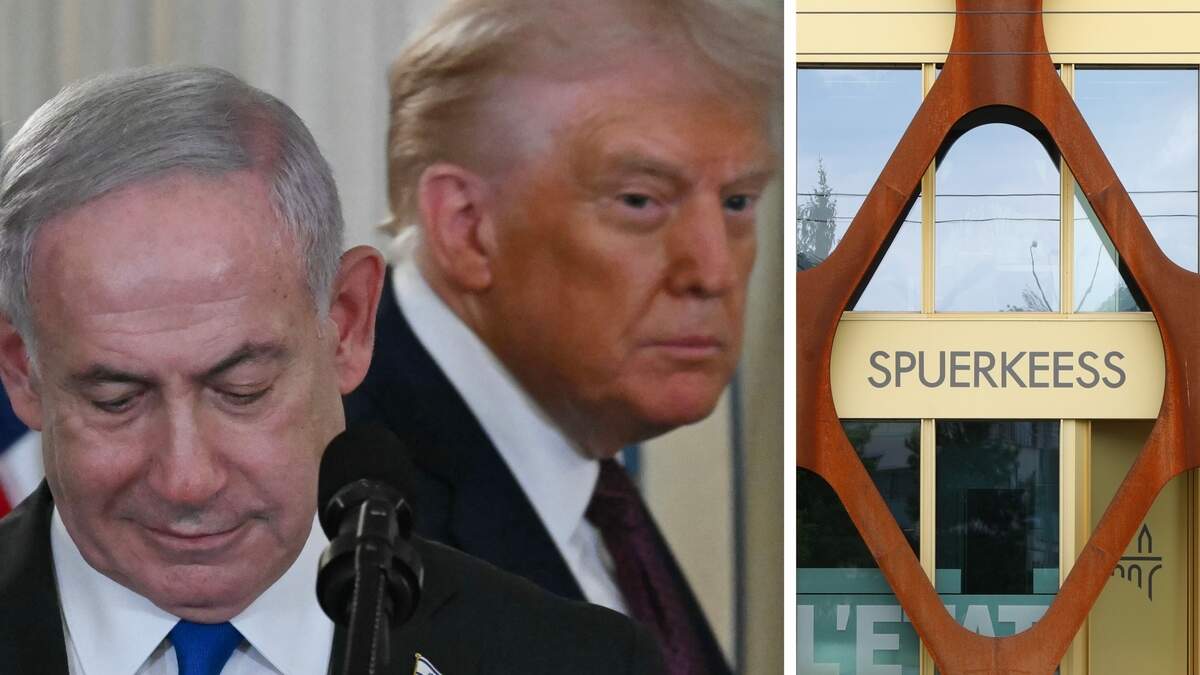
Luxembourg state bank Spuerkeess decided at the end of February 2025 to close the two accounts held in the name of the International Criminal Court (ICC), according to information received by the Luxemburger Wort.
The ICC had held around €17 million in the two accounts in Luxembourg, but the court had transferred the money to the Netherlands in early 2025 in anticipation of US sanctions imposed by president Donald Trump on the grounds that the court had “engaged in illegitimate and baseless actions targeting America and our close ally Israel.”
Even so, the ICC kept its Spuerkeess (BCEE) accounts open.
The ICC in November 2024 had issued an arrest warrant against Israel’s prime minister, Benjamin Netanyahu, and former defence minister Yoav Gallant, citing allegations of war crimes and crimes against humanity.
Concerned with jeopardising US business
It was Spuerkeess that decided to close the ICC accounts because it was apparently concerned about jeopardising its business with the United States and therefore did not want to provide a potential regulatory target.
American partner institutions that handle the Luxembourg bank’s dollar business would probably have reacted sceptically to Spuerkeess serving customers against whom US sanctions have been imposed.
Spuerkeess circles have also reported that the risks were of an operational nature. In theory, there are no sanctions against the ICC, only against its judges and employees. Spuerkeess is also considered a relatively isolated bank that is less internationally networked than other comparable players.
As a stand-alone bank without a parent company or branches in the US, with predominantly small private customers, it is fairly isolated from the US – and most of its transactions are in euros. Nevertheless, it seemed too risky for the state bank to keep the ICC accounts.
The government is avoiding any comment on the situation. Foreign Minister Xavier Bettel (DP), who only gave an evasive answer to a parliamentary question from the LSAP on the International Criminal Court a few weeks ago, shifted responsibility to the Ministry of Finance when questioned by the Wort on the effects of the sanctions in Luxembourg. Bettel cited internal demarcations of competences within the government.
However, international sanctions and relations with the ICC fall within the remit of the minister’s portfolio, as his answer to the LSAP’s parliamentary question had already indicated. But in the same response, Bettel also indicated that he had little appetite to campaign for a so-called blocking statute to prohibit the extraterritoriality of US sanctions in the EU.
It is up to the bank itself to decide how to respond to sanctions or potential sanctions after it has analysed and assessed all the facts
Ministry of Finance spokesperson
Gilles Roth’s finance ministry, meanwhile, is hiding behind banking secrecy and the nominal independence of the Spuerkeess.
“Whether or not the bank has relations with certain parties is subject to banking secrecy,” the ministry’s press office said. “It is up to the bank itself to decide how to respond to sanctions or potential sanctions after it has analysed and assessed all the facts. The government cannot interfere in such decisions.”
Prime Minister Luc Frieden, like Roth also a member of the CSV, also eschewed the subject. “The prime minister has heard about it, but it is not a file for which he is responsible or which he has supervised,” said a spokesperson.
Porous walls
The walls between Spuerkeess, the state and the government are, however, notoriously porous. Officials from the Ministry of Finance, for example, sit on the state bank’s decision-making bodies. And, as Frieden’s press office confirmed, the government had been informed of the decision to close the ICC accounts.
Opposition MPs are not going to quietly accept Roth’s evasive manoeuvres and Frieden’s shaking of the head.
“Spuerkeess is a state bank. If it closes accounts of the International Criminal Court, even though the institution itself is not sanctioned and even though BCEE is not structurally dependent on the US market, then this is not just a compliance issue, but a political one,” said déi Gréng MP and former justice minister Sam Tanson.
The government must explain whether it finds it acceptable for questionable measures taken by a third country to have a de facto effect on state institutions in Luxembourg
Sam Tanson (Déi Gréng)
“The government must explain whether it finds it acceptable that questionable measures of a third country have a de facto effect on state institutions in Luxembourg,” she added.
LSAP parliamentarian Yves Cruchten also believes that the government has shunned its responsibility. “Frieden, Bettel and Roth have turned their backs on an institution that holds those responsible for the worst crimes to account,” he said. “After many empty statements, they have tacitly allowed the ICC’s accounts in Luxembourg to be closed by our national bank – because when the going gets tough, they give in!”
Cruchten sees a fundamental problem here: Luxembourg is contributing to the destruction of the rules-based world order. “This is a capitulation to the law of the jungle and a declaration against the international legal order,” he said.
I expect Luxembourg to take its obligations under international treaties – including the Statute of the International Criminal Court – seriously and to honour them
Yves Cruchten
LSAP
“I expect Luxembourg to take its obligations under international treaties – including the Statute of the International Criminal Court – seriously and to honour them,” Cruchten explained. “Otherwise, we are actively contributing to normalising a world in which rules are replaced by power. And in such a world, a small country like Luxembourg risks having its right to security and existence called into question at some point.”
Tanson argued that the incident is also problematic for the credibility of Luxembourg’s financial sector. “As a financial centre, Luxembourg thrives on legal certainty, predictability and institutional stability. If even central international institutions cannot be sure that they can maintain a banking relationship here on a permanent basis, this sends a problematic signal far beyond this individual case,” she said.
“Would a state bank also close the accounts of Luxembourg judges or public officials if they were sanctioned abroad for political reasons?” Tanson asked. “If not, then a clear line is needed.”
“Anyone who defends multilateralism must also ensure that our financial centre does not become an instrument of external political pressure,” the déi Gréng MP continued. “This is a question of sovereignty – and of Luxembourg’s credibility, also as an international financial centre.”
As an ally of the United States, we expect Luxembourg to respect US sanctions
United States embassy in Luxembourg
The question remains to what extent the US actually exerted pressure on the Luxembourg authorities to have Spuerkeess extend the sanctions to the ICC accounts.
The response of the US embassy in Luxembourg leaves room for interpretation. “As an ally of the United States, we expect Luxembourg to respect US sanctions,” the embassy’s press office said. “We continue to call on all ICC States Parties, including Luxembourg, to address our concerns and rein in the ICC’s overreach.”
However, the embassy declined to comment on possible contacts with the government over the issue. Frieden’s press office, however, said that he has not felt any pressure from America.
Still, the effects of very narrowly defined sanctions are being felt and Europeans appear powerless when it comes to containing the consequences for those affected.
Although only a few judges and employees are subject to the sanctions – not the ICC as an institution – and the sanctions are limited to US territory and the activities of US citizens and companies, they tend to trigger chain reactions that even reach as far as Luxembourg.
‘Secondary sanctions’ and overcompliance
This chain reaction is precisely what makes the US sanctions so dangerous, said Kai Ambos, Professor of Criminal and International Law at the University of Göttingen and judge at the Kosovo Special Tribunal in The Hague. So-called “secondary sanctions” can be even more serious than the actual sanctions, he said. “They extend beyond US territory and US citizens and companies, i.e., they have an extraterritorial and global effect,” Ambos wrote in December on constitutional matters website Verfassungsblog.
“Sometimes they are also a consequence of overcompliance, which at the same time demonstrates the chilling effect of the primary sanctions. By way of example, a European bank based in the EU, which is not itself directly subject to the sanctions, terminates the account of a sanctioned person because it fears negative consequences for its US business,” Ambos wrote.
This so-called overcompliance means that the US sanctions have an effect far beyond their actual scope. And this is exactly how Donald Trump’s intimidation of international justice works. Everyone acts in anticipatory obedience. “The law of the jungle prevails,” said a high-ranking Spuerkeess employee who did not wish to be named.
Trump and the ICC sanctions
On 5 June 2025, US president Donald Trump issued an executive to extend previous sanctions against the Chief Prosecutor of the ICC to judges of the institution.
The new order banning ICC executives and their closest family members from entering the US and also froze all their US-based assets. Trump accused the court of “malicious behaviour”, saying the court had “abused its power” by issuing hwat he called unfounded arrest warrants against Israeli Prime Minister Benjamin Netanyahu and then Defence Minister Joav Gallant.
The ICC had initiated investigations against US personnel and its allies “without a legitimate basis”, the order stated.
The ICC had accused Netanyahu and Gallant of war crimes and crimes against humanity in the context of Israel’s conduct in the Gaza Strip and issued appropriate arrest warrants. The courts also issued arrest warrants for three Hamas leaders who have since been killed.
However, it is disputed whether the ICC has jurisdiction for this. The Palestinian territories have been a state party to the court since 2015. In 2021, the ICC determined that it also has jurisdiction over the territories occupied since 1967, such as the West Bank and the Gaza Strip. The US and Israel, as well as China, Syria and Russia, do not recognise the ICC.
However, the dispute goes much further than just a question of jurisdiction. At its core, it is about how easy it is for Donald Trump and the United States to force allies to do their bidding, even if this means silencing painstakingly built institutions that try to enforce international law, in order to protect an alleged war criminal like Netanyahu.
“We are being treated like terrorists, even though we are only trying to do our job as judges,” said Beti Hohler, a Slovenian judge at the ICC whose bank accounts have been blocked and who can no longer use a credit card. “What is happening to international law could soon be applied to national cases.”
(This article was first published by Luxemburger Wort. Machine translated with editing by Duncan Roberts)