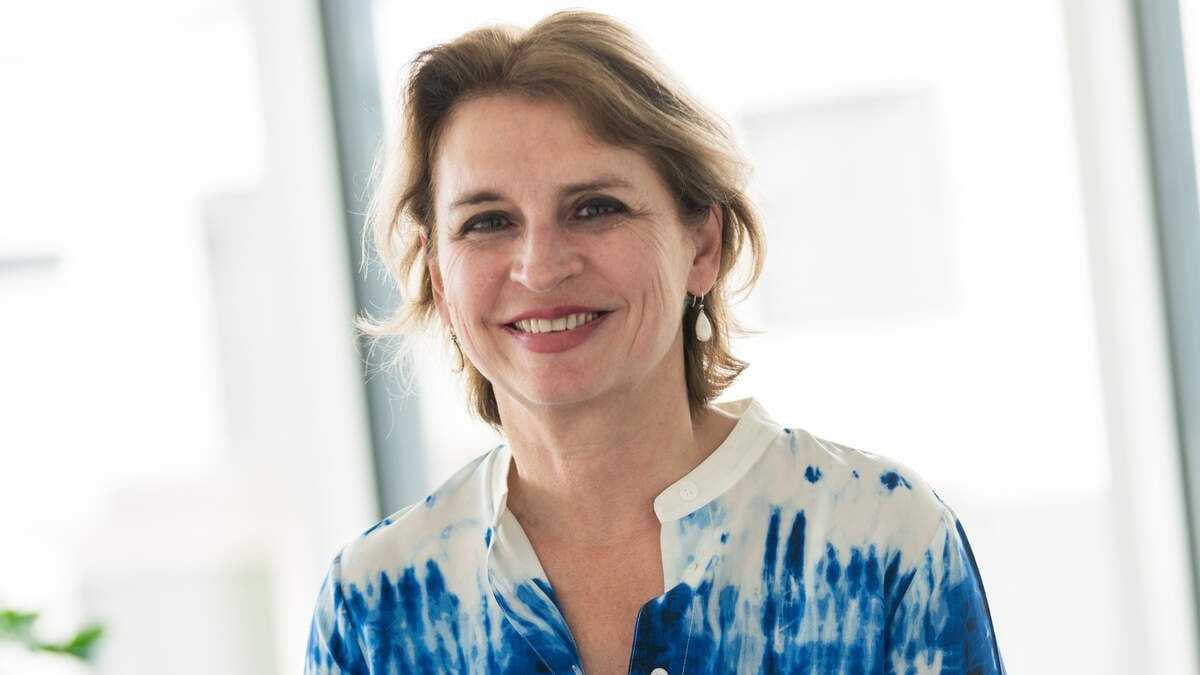
“I don’t think many people realise that we are responsible for their safety, or that our first shift starts at 03:00 and the last one ends at 02:00,” says Myriam Gouber. The 54-year-old has been working as a train attendant for Luxembourg’s national railway operator, the CFL, for eight years.
It is remarkably quiet on the platform when she meets the Luxemburger Wort at Luxembourg City’s central train station on Shrove Monday, in February. But it doesn’t take long for work to start.
Immediately after boarding the train bound for Wasserbillig, she has to ask a teenager to turn off the sound on his mobile phone, which is blaring throughout the whole compartment.
For Gouber, the working day is already half over by 08:00. She has been on the go since 04:00, ensuring her train journeys run smoothly. Most passengers are probably unaware that she and her colleagues bear a great deal of responsibility.
“I chose this job because I enjoy being on the move. It’s lovely to accompany people from A to B,” she says, relishing her daily tasks. For her, everyday life mainly means one thing: variety.
“No two days are the same. The shifts and routes change, you’re constantly seeing new faces and experiencing all sorts of situations,” says 35-year-old Carmen Welter, who is working with Gouber today.
Separate rules for each network
The CFL operates on four networks: Luxembourg, Germany, France and Belgium. Each network has its own particularities and rules. Following their training, train attendants choose a network, with their accreditation renewed every three years. Safety equipment is also located in different places depending on the train. Myriam Gouber has opted for the routes to Germany.
Before Gouber looks after passengers, however, she ensures that the train she boards is in good working order. Are the lights working? Are the carriages arranged correctly, or does the display need adjusting? Are the displays, toilets and other equipment working? Are there any other faults or defects, such as heavily soiled seats? All of this must be checked, and any potential damage must be reported via a work mobile.
“There’s quite a lot we have to report,” Gouber says. “That’s why we now have CFL stickers on our phone cases to prevent customers or colleagues from thinking we’re using our mobiles for personal reasons.”
-
Myriam Gouber has been a train attendant with Luxembourg national railway CFL for eight years © Photo credit: Jil Reale
-
Before she looks after passengers, CFL railway attendant Myriam Gouber checks that everything on the train is in working order © Photo credit: Jil Reale
-
This includes checking the toilets, which have just been refurbished on this train © Photo credit: Jil Reale
-
Any faulty or damaged equipment is reported via her CFL-issued mobile phone © Photo credit: Jil Reale
-
On the day of this press ride-along, 8 February 2026, Myriam Gouber (left) worked with her CFL colleague Carmen Welter © Photo credit: Jil Reale
In addition, train attendants and train drivers exchange information before the first departure. Gouber says: “I have to check in and discuss whether there are any special circumstances on the journey. If, for example, my documents state that a person in a wheelchair is travelling, I can let the driver know in advance that I’ll need to deploy the ramp at the stop.”
Job carries risks
Gouber particularly values her interactions with passengers – even though these very encounters carry risks, as a recent fatal incident in Rhineland-Palatinate has highlighted.
The number of aggressive incidents and assaults on public transport in Luxembourg and the Greater Region is rising. “Of course, it’s shocking,” Gouber says. “How can someone punch someone in the head? It leaves me speechless how violent people can be,” she says, expressing her dismay.
Gouber says that she always feels safe when she boards a train; she wouldn’t even consider the possibility that someone dangerous might be on board, but news like the attack on a German train makes her think.
Violence on Luxembourg’s train network: ‘People have a much shorter fuse since Covid’
Nevertheless, she remains undeterred in her mission and her passion for her job. “My experiences with people are varied. Of course, negative experiences are inevitable, but for me the positives outweigh the negatives.”
Many riders remain anonymous. Some leave a lasting impression, like a young man who set off on a long trip with a giant tobaggan. “It was exciting to find out where his journey was taking him,” she recalls of their exchange, highlighting the social aspect of her job. “If you approach people openly and friendly, fortunately in most cases you get that back.”
If everyone acted like this, we’d be in a right mess
Myriam Gouber
Train attendant for the CFL
Yet even her positive attitude does not shield her from unpleasant encounters. The worst thing that has happened to her so far is verbal aggression, which tops the statistics of reported attacks. “But that just bounces off me,” she says. “The attack is directed at my uniform, not at me; I’m actually quite good at separating the two.”
Should a situation ever take a heavier toll on her, she knows that a whole network of psychologists, coaches and social workers is there to support her. Besides, you’re never alone on the train. “If I have a problem, I can always go to the train driver,” Gouber emphasises.
‘We lack the tools to take proper action’
“In many ways, there’s a lack of respect,” she observes in her day-to-day work. Since the pandemic, the tone has become more aggressive, but above all, disruptive behaviour – such as putting feet on seats or making loud video calls – is becoming increasingly common. It’s almost as if passengers no longer distinguish between the train and their own living room.
Violence on Luxembourg’s train network: ‘People have a much shorter fuse since Covid’
“If everyone behaved like that, we’d be in a right mess,” she says. Often, a polite request to follow the rules is enough. “Exceptions are sometimes younger people travelling in groups. They egg each other on and test their limits,” she continues. For her, that means keeping her cool and politely asking them to improve their behaviour again.
-
Myriam Gouber has noticed that the tone of rail passengers has become more aggressive since the pandemic © Photo credit: Jil Reale
-
If train attendants have a problem, they can always speak with the train driver © Photo credit: Jil Reale
“At the end of the day, it’s dangerous anywhere if you come across the wrong sort of people.” One must not let fear get the better of you. During their basic training, train attendants are trained in de-escalation and self-defence. They therefore have the knowledge to help them react appropriately.
“But all that training is of no use if a passenger has malicious intentions from the outset but doesn’t let on, or is perhaps seriously mentally ill – you can’t tell that just by looking at people. And there’s only so much we can do,” says Gouber, with the agreement of our colleague on-board, Carmen Welter.
They support the call by the railway workers’ trade union Syprolux to introduce a railway police force. “Even the security staff who sometimes accompany us can only remove people who are misbehaving from the train. Then the person gets on the next train and causes trouble there. We lack the means to take proper action,” she said.
Refresher courses on voluntary basis
CFL train staff are not offered periodic self-defence courses, only lessons during their initial basic training. Recently, however, CFL staff have been given the opportunity to attend courses at the Lapunti Academy in their free time. Here, they can refresh or expand their self-defence techniques on a voluntary basis and at the employer’s expense.
Since public transport became free, there is also a sense that passengers think they can get away with more. “We used to have a different level of attention and status in the eyes of customers when everyone still had to show a ticket,” recalls Gouber.
Added to this is the fact that the majority of passengers are not even aware that the job of a train attendant involves so much more than just checking tickets. The railway says that safety is the top priority for CFL staff.
From shaky beginnings, CFL has been on track for 80 years
This is illustrated on the return journey from Trier to Luxembourg. A minor, dressed up for the Shrove Monday parade, approaches the train attendants in distress because he feels harassed by someone in another compartment. Amidst the carnival revelry and concern, there is a single troublesome passenger. While the boy feels safe again, the train attendant on duty seeks out the troublemaker.
-
Reports of violent incidents do not leave railway staff emotionally unscathed © Photo credit: Jil Reale
-
CFL train attendants ensure safety on the train and, in return, expect respectful behaviour from passengers © Photo credit: Jil Reale
Passenger wellbeing is also part of the safety remit. In addition to training in how to prevent aggression, staff undergo basic training that includes a first-aid course, which is refreshed every five years. In the event of an emergency, train attendants are obliged to administer first aid until the emergency services arrive, which in turn can lead to delays.
“I once had a case where a person was lying unconscious on the platform just as our train was pulling in,” Gouber recalls. “Another passenger had already attended to this person and dialled the emergency number, but had to leave. I stayed with the person until the emergency services arrived and covered them with the emergency blanket.”
It is also the responsibility of train attendants to look after the wellbeing of passengers who are under the influence of alcohol, or those who fall asleep during a long journey. “It happens that you approach a passenger to check their pulse and make sure everything is alright. This is an intrusion into the person’s privacy and carries risks – but it’s part of the job,” says Gouber.
Not too long ago, a colleague checked on a passenger and discovered that the traveller had died sometime during the train journey.
(This article was first published by the Luxemburger Wort on 20 February 2026. Translated with the aid of an AI tool and then reviewed and edited by Aaron Grunwald.)