Luxembourg’s hospitality industry is still facing challenges, despite recording impressive 2025 sales growth of around 8% year-on-year. The raw data masks a fragile reality.
While the number of annual tourist arrivals is heading towards the 1.2 million mark, Luxembourg’s 2,600-or-so hospitality and tourism businesses (including 1,270 restaurants) are struggling with a complex equation: operating costs, particularly for energy and food, have risen by double digits since 2022, while the shortage of skilled labour is driving wage costs ever higher.
Between efficiency and quality
With a contribution of around 1.5% of the country’s GDP and a workforce 24,000 strong (as of 2023), the sector remains a mainstay of the economy. But with falling margins and an inflation rate that is dampening households’ appetite, “the pressure on operators to reinvent themselves between efficiency and quality has rarely been as great as it is today,” said Alain Rix.
Rix was re-elected as president of Horesca – the national association of hospitality industry professionals – on Tuesday and found a few minutes on the sidelines of the organisation’s annual meeting to talk about the situation.
Alain Rix was confirmed in his position as Horesca President on Tuesday. © Photo credit: Ingo Zwank
The Horesca Board of Directors
The new Board of Directors of Horesca is made up of: Chairman: Alain Rix; Vice Chairmen: Ben Weber (catering), Carlo Cravat (hotels), Romain Weber (tourism); Treasurer: Marc Schwamberger; Members: Carole Ewert, Christian Thoma, Claude Lang, Erik de Toffol, Giuseppe Parrino, Marc Fusenig, Marie-Laure Goeres, Michel Lanners, Pascale Geraets, Steve Pfeiffer, Sven Bodry.
Focus on the guest and explain pricing
Some 389 eateries represented the fast-food segment in Luxembourg (as of 1 January 2024); 269 bars, pubs and music clubs made up Luxembourg’s nightlife and music scene; and 211 hotels, hostels and guesthouses, with a capacity of 7,742 rooms were located in the Grand Duchy of Luxembourg.
Lex Delles, minister for the economy, SMEs, energy and tourism, spoke of a “dynamic sector”, but also recognised that it “faces major challenges”. Asked about those challenges, Horesca Vice President Ben Weber said they are currently “coming faster than you can prepare for them”.
Restaurants remain busy, but their habits are changing. “Guests are drinking less, for example,” said Rix, immediately adding: “of course we don’t want to encourage them to drink”. But instead of a bottle of wine when visiting a restaurant, people might now only order a glass. This subtle change is being noticed by local restaurateurs and winemakers alike.
In response to tighter budgets, it is easier said than done for restaurants to cut their prices, Rix said.
The general meeting of Horesca took place in Mondorf with the election of a new board of directors. © Photo credit: Ingo Zwank
“We want to launch a kind of awareness-raising campaign simply to bring this price development a little closer to the guest,” Rix said. It would be helpful if members of the public were more aware of exactly why the gap in price between a piece of meat in a butcher’s shop and a restaurant is so large.
“Many people don’t realise at first glance that rent, energy, staff costs and much more also have to be included in the calculation,” he said. Horesca wants to make this more transparent. The aim is to “remain attractive to customers and not lose contact with them”, Weber said.
AI will not replace waiters
Artificial Intelligence is a mix of opportunity and threat to the wider economy and any jobs lost to AI could affect hospitality revenues. But Rix notes it is also finding its way into the catering industry more directly. Artificial intelligence optimises processes through smart forecasts for goods purchasing and staff planning, can even reduce food waste and automate guest communication via chatbots, saving valuable time, reducing costs and increasing efficiency in kitchens and front-of-house.
In keeping with the times, Horesca’s revamped website will include an AI chat bot, it was revealed at the annual meeting. Despite this, the human element is key to the restaurant experience and will forever remain so, Rix said.
Ministers Lex Delles (second from left), Léon Gloden (second from right) and Marc Spautz (right) found their way to Horesca’s annual meeting. Also pictured: Horesca Secretary General Steve Martellini (left) and President Rix. © Photo credit: Ingo Zwank
The Horesca sector in Luxembourg is also struggling with an acute shortage of qualified staff, even though it pays well, Rix said. “You simply have to pay a chef €6,000 to €7,000 today, otherwise you won’t have any,” Rix said. However, expenses such as energy costs and rent are often so high “that there is hardly anything left over”.
The industry as an attractive employer
To counteract the shortage of skilled labour, the association of restaurant, café and hotel operators is continuing its “Dreamjobs Ambassadors” campaign. This is intended to show the public the good side of the world of work in the catering industry, “because it really isn’t all bad”, Rix said.
Expogast 2026 (see box) will once again act as an important showcase for vocational training this year. The close collaboration with the École d’Hôtellerie et de Tourisme du Luxembourg, among others, is intended to inspire young talent for the profession.
World-class cuisine in Kirchberg
If you don’t pay a chef well, you don’t have one. © Photo credit: Ingo Zwank
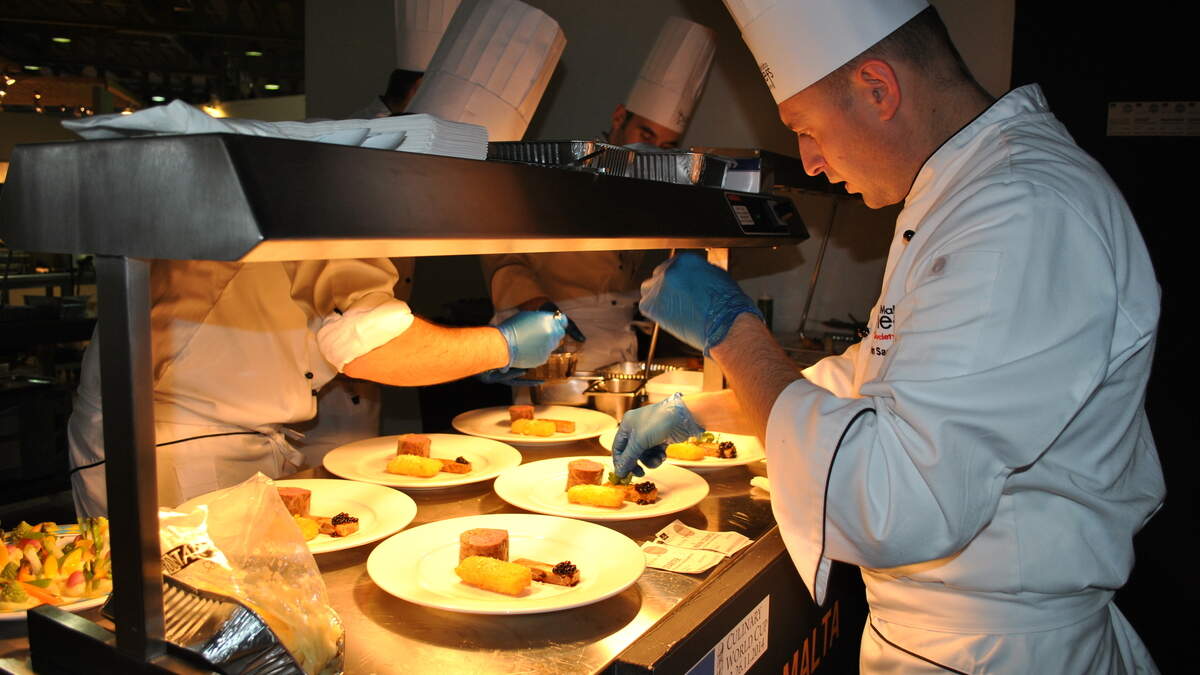
Expogast 2026 will feature the Culinary World Cup, from 21 to 25 November 2026, when Luxembourg will once again become the hub of the gastronomic world. Every four years, Luxexpo in Kirchberg is transformed into a huge showcase of flavours. More than 8,000 professionals, 2,500 chefs and around 45,000 visitors are once again expected to attend the upcoming edition of Expogast. Exhibitors will present the latest trends – from high-tech kitchen appliances to sustainable food concepts – on an area of almost 25,000 square metres.
The World Culinary Championships
The undisputed centrepiece of the trade fair is the RAK Porcelain Culinary World Cup. This year, 55 nations from five continents will compete against one another. Masterpieces will be created over five days in eight specially installed competition kitchens. Around 30 national teams – in addition to youth and community catering teams – will compete for medals. The official draw will take place on 19 March and will be livestreamed.
With challenges such as energy prices, a lack of successors in the business, an outdated liquor licence system or simply too much bureaucracy – how could the sector be supported quickly and effectively right now?
Emergency aid: revive the €50 vouchers
Rix comes up with one suggestion like a shot – including directly to tourism minister Lex Delles just moments after Rix was re-elected as Horesca president. “The €50 vouchers from the pandemic period could be revived.”
The €50 vouchers were a large-scale government economic stimulus measure that was launched in summer 2020 under the title Vakanz Doheem (holiday at home). To support the tourism industry, which had been hit hard by the coronavirus pandemic, the Luxembourg government sent out around 750,000 of these accommodation vouchers by post. Recipients were not only all residents of the Grand Duchy over the age of 16, but also all cross-border commuters working in Luxembourg (of which around 68,000 were redeemed).
Consideration could be given to organising another voucher campaign
Alain Rix
Horesca President
The vouchers were intended for overnight stays in establishments such as hotels, youth hostels or campsites within the country.
They could not be used to pay for visits to restaurants without an overnight stay. The aim was to motivate people to spend their leisure time in their own country and thus at least partially compensate for the lack of international tourists. “And you could consider organising a similar campaign again,” said Rix, adding with a smile: It “didn’t cost the government much”.
The Luxembourg government has already taken measures as part of its energy policy to provide financial relief in the energy sector, not least €150 million for a comprehensive package to cap electricity costs for households and companies (including Horesca) in 2026, Delles pointed out in a Wort interview.
Restaurateurs face mounting challenges but still love their trade
(This article was published by the Luxemburger Wort. Machine translated, with editing and adaptation by Alex Stevensson.)