As the CFL turns 80 on 17 April, the Luxembourg Times takes a short trip through Luxembourg’s railway history
The story of Luxembourg’s railways is closely linked to the nation’s own path through the 19th and 20th centuries. As the major powers to its east and west played high-stakes tugs of war, the small nation with a long and complicated history was trying to forge a new, independent identity – constantly reminded all the while that its people were poor and its economy stagnant.
A sparkling new high-tech innovation – rail – promised economic good times but was perilously expensive. Still, Luxembourg leaders were very keen on building a railway in the mid-1800s – but where to? And how?
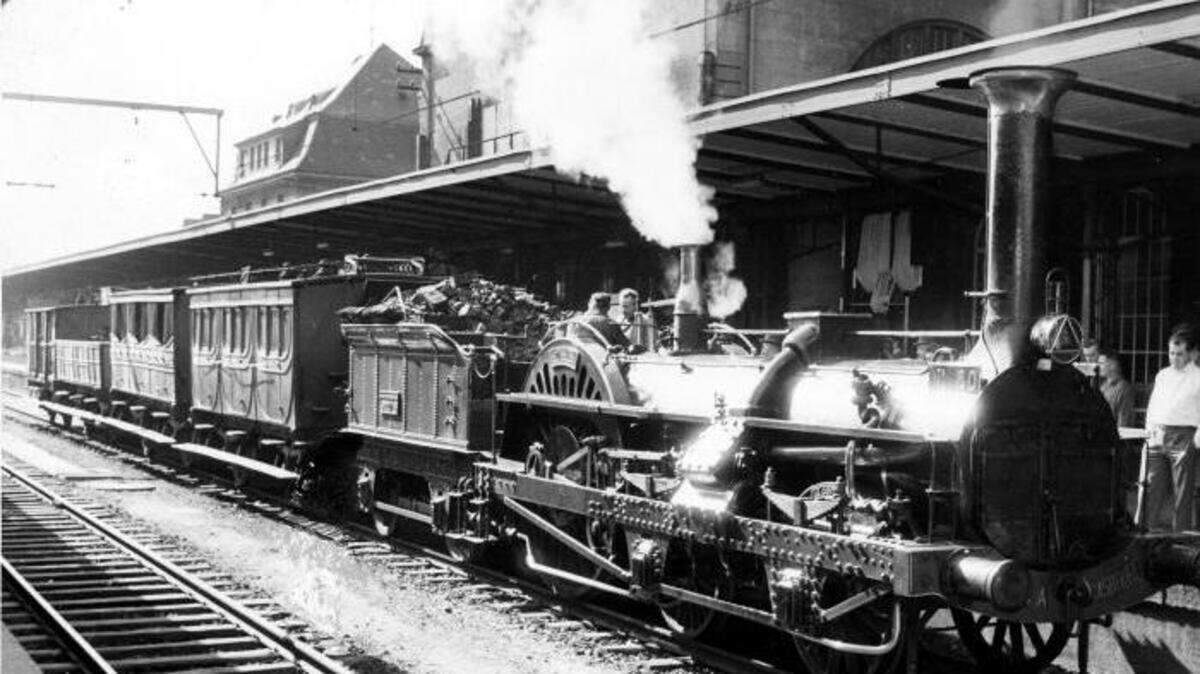
A locomotive Margarethe of the Alsace-Lorraine Railway Company, at the Bettembourg depot in 1913 © Photo credit: Luxemburger Wort archive
Getting on track
Luxembourg City was an obvious choice of start/finish point at first glance, but what about the rapidly developing steel industry to the south? Or the poorly connected rural regions to the north? Could they stand to benefit even more?
Luxembourg City was still a fortress at the heart of a new nation, which was technically sovereign but nevertheless part of the German Confederation. The Prussians were understandably reluctant to build a railway through their defensive walls. This meant building a station 1.5km away, and doing so with wood – as the military prohibited a stone railway station on security grounds.
The next question was what should be at the other end of the line: whether to prioritise a cross-border railway connection to Germany, France or Belgium (which was still a very young country and had strong British financial and political backing).
The Luxembourg City central station building from 1859 was made entirely of wood. The current one was built between 1907 and 1913 © Photo credit: ANOUK ANTONY
Eventually, the first line would open in 1859 – a whole 34 years after the world’s first commercial railway opened in the UK. It connected the City of Luxembourg to Bettembourg, on to Thionville and from there to the rest of France.
Though slow to start, railway construction was on a roll and the line west to the Belgian border, connecting to Arlon, opened just a couple of months later, and the one to Wasserbillig and onward to Trier in Germany followed in 1861.
Commissioned by the state, the railways were nevertheless all built with French, Belgian and British investment capital and the trains were then run by the operator in the French region today known as the Grand-Est. In other words, there were railways in Luxembourg, but there were no Luxembourgish railways.
The Franco-Prussian war (1870-1) saw the trains change operator – but not into Luxembourgish hands. And the Luxembourg Crisis and Treaty of London in 1867 also did nothing to change track – even as the independent Grand Duchy of Luxembourg was born, more or less in the form we know it today.
How Luxembourg became a grand duchy
The fourth major route
The disruptive power of war would eventually change all that. But to skip forward too quickly would be to miss the biggest project of all.
Luxembourg’s northern line is the country’s longest, and it was a major headache to build.
The Luxembourg to Ettelbruck section opened less than a year after the Germany line, in summer 1862. But it would be almost five more years before the line finally pushed its way north into to Troisvierges and onward, in the direction of Liège in Belgium.
-
Parts of the line were challenging to build and remain challenging to maintain (photo taken in 1980) © Photo credit: LW archiv
-
Many tunnels and hilly terrain mean stretches of the line are single track © Photo credit: Armand Wagner
The original plan was for the line to tilt further east, to Diekirch, and then curve north towards Troisvierges.
This would have been cheaper and a lot easier for two reasons, according to CFL communications head Tom Ewert. Firstly, the landscape is gentler and the line would have required few, if any, of the 22 tunnels, multiple ledges and bridges that were necessary on the route today. Secondly, the important town of Diekirch would have been on the mainline and would not have required a branch line out of Ettelbruck.
Fascinatingly, Ewert said, nobody knows for sure why the route was changed to the current one. The likeliest explanation is that there were complaints from powerful local landowners. But the nitty gritty details have been lost to history.
The outcome, however, is arguably the prettiest, most enjoyable train ride in the Greater Region – if not even further afield.
Wars
The First World War was fought to a significant extent in what is today known as the Greater Region – and Luxembourg was far from unaffected. It was invaded by Germany and its railways used to help the war effort.
At the end of the war, the allies seized the trainlines for their own purposes and the old operating companies in France had ceased to exist. Services weren’t properly restored until 1925, with teething problems persisting for eight more years, as the railways fell back under French operation.
The Great War left Luxembourg’s railways in a perilous state © Photo credit:
archiv luxemburger wort
Germany again took over the trains – and the country – in the Second World War; attempting to absorb the network wholesale into its national railways when Luxembourg was formally annexed in 1941.
By the time of Luxembourg’s liberation at the end of the war, its railways were almost beyond repair, and few trains had survived.
From punishment to partnership: Luxembourg’s occupation of Germany after WW2
CFL is born
The crucial importance of Luxembourg steel to the reconstruction of Europe meant that postwar rail resurrection was paramount.
The Nazi nationalisation of all Luxembourg railways into the unified German network gave the local government an opportunity to keep the whole Grand Duchy network under one umbrella after the war – something which the government put into practice when it established the CFL (Societé Nationale des Chemins de Fer Luxembourgeois) 80 years ago, on 17 April 1946.
Money was still tight at the time, and the need for investment was great. That is why the nationalised CFL was only 51% Luxembourg owned when it was set up. France and Belgium each owned 24.5%.
Many commuters don’t realise that both neighbouring countries are still minority owners today. CFL is 2% French and 4% Belgian. It is, however, 94% Luxembourgish.
A CFL diesel locomotive © Photo credit: Pierre Heiliger
80 years of change
After initial reconstruction with diesel trains, Luxembourg decided to electrify in the 1950s. It was a technically-unnecessary and expensive decision that however still benefits the country today. It could otherwise have become an isolated rail island that major European routes skirt around. Some complain that they do anyway, but it could have been much worse.
In the 1960s, Luxembourg fell out of love with trains and started to view cars, lorries and ‘the open road’ as the future. It was a story replicated in many countries and led to the closure of several lines, including the one to Echternach.
A train leaves Echternach en-route for the capital city, 40 km away © Photo credit: Coll. Jean-Paul Meyer
From around 500km of active track (not including sidings, maintenance yards and disused stretches) in the early days of the CFL, there are just 275km in use today – steady since the end of the ‘60s.
To accommodate line closures, the CFL started putting on bus services to replace trains, which is why the national train company remains a curiously prominent bus company to this day.
Despite fewer kilometres of track, passenger numbers were resilient. First dipping in the yuppie, car obsessed 1980s, the number of people riding CFL trains has exploded since the millennium to 31.4 million passengers in 2025 – a new record, and roughly double the number of 2007.
The introduction of free public transport in Luxembourg coincided with the pandemic, when passenger numbers plummeted. It is therefore hard to prove it increased train use, which was rising steadily before 2020 anyway.
CFL multimodal freight terminal in Bettembourg, pictured in 2025 © Photo credit: Chris Karaba
The opening of the Bettembourg freight terminal in 1979 did have a concrete impact on CFL’s cargo operation, which has always been pivotal to its growth. CFL Cargo, as a separate corporate entity, celebrates its 20th anniversary in 2026.
Future plans
Unlike with roadworks, trains cannot usually be diverted around ongoing projects. If engineers need to work, the track needs to close – frustrating as that is.
That is why the CFL carries out most of its work in the holidays, especially summer, when schools are closed and school buses are free to replace trains.
-
The 177 metre-long and 650 tonne track laying machine is a big (and heavy) help © Photo credit: CFL
-
CFL is the country’s largest employer © Photo credit: Jil Reale
This year is no exception, but Ewert stressed last summer that disruption is as much about improvement as it is about maintenance. Separating tracks around Bettembourg, for example, is a huge project that when finished will mean that delays on one line do not cause delays on the other.
Another high priority – not only for the CFL, but also for politicians – is making the journey to Brussels less excruciating. The three plus hour journey currently takes roughly as long as it did in 1939, in the months before Adolf Hitler’s invasion of Poland, old timetables show.
So, as the CFL turns 80, take a moment to appreciate its complicated history and its important role at the heart of Luxembourg society, as a connector of people, as the country’s biggest employer, a tool of national branding, enabler of the cross-border economy, and vital freight handler with influence continent-wide.
Pro-tip: The above exercise might be difficult at rush hour. Instead, try taking a moment to appreciate the CFL while cruising through the countryside of the Ardennes on a sunny Saturday afternoon. Though not between 24 August and 13 September, as buses will replace trains north of Ettelbruck.