If you’re not too keen on mulled wine, there’s another winter alcoholic drink that might tickle your fancy: Christmas beer.
The country’s three main breweries follow the tradition. At Brasserie Nationale, for example, “the two Christmas beers we produce” under the Battin and Bofferding brands “account for around 5% of the volume of our beers sold between October and December,” a spokesperson for the Bascharage-based brewery said. “It’s a relatively stable market from year to year.”
Explore Luxembourg’s craft beer scene
In Wiltz, Brasserie Simon “has been producing Christmas beer since the 1960s and the recipe has never changed, it’s always had the same success,” said its manager Betty Fontaine. “We brew it three months in advance, at the end of July and beginning of August. It matures for twelve weeks. It comes out at the end of October.”
Brasserie Nationale, one of the country’s two giants along with Brasserie du Luxembourg, and the more traditional Brasserie Simon are keeping a tight lid on production and sales figures. Fontaine simply said Simon makes “a few 70 hectolitre brews”.
Tradition, but niche market
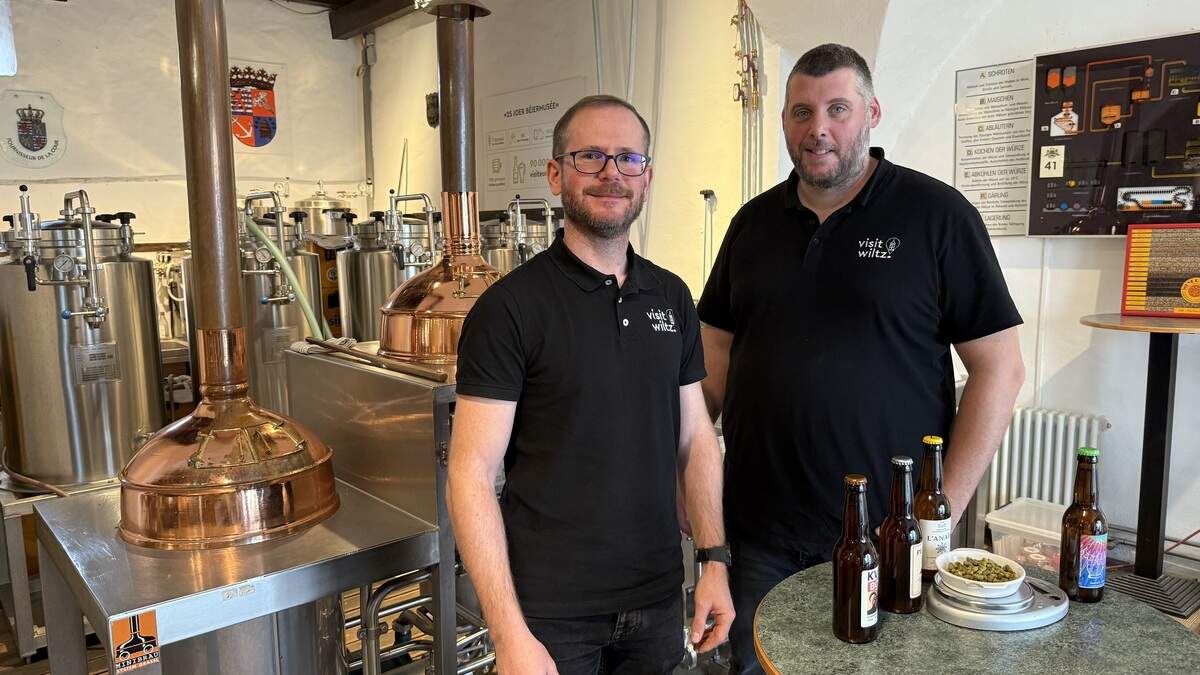
Fabien Claude, one of the two brewers at the Musée National d’Art Brassicole, the national brewery museum in Wiltz, stated: “Christmas beer is a special case among winter beers. The main difficulty lies in marketing: after 26 December, it’s harder to sell. So, for some small craft breweries, producing it is a brave move.”
His colleague Jérémy Meer, who in addition to his job at the museum founded the Brasserie de Metzert in Attert, agreed: “It’s a niche product. For a small brewer, it can be difficult to sell because it’s a beer that’s sold over a very short period, just two months. Personally, I don’t make it because if I do, I run the risk of having bottles lying around until the following winter.”
Your beer’s dirty little secret: it’s cheaper next door
But Christmas beer is still eagerly awaited and appreciated. This is mainly due to its general characteristics: *Spices, a higher alcohol content and a darker colour,” explained Claude. “In terms of taste, it’s a little rounder, not very bitter, to evoke the sweetness of Christmas in a way”.
When it comes to spices, Claude said there’s a wide choice: “cinnamon, nutmeg, star anise or star anise, cardamom, orange peel or, in Belgium, juniper berry.” But beyond these generalities, there are nevertheless regional and local specificities. “For example, in Luxembourg, Christmas beers are made without spices and with low fermentation, due to the influence of Germany.”
To illustrate the point, according to Fontaine at the Brasserie Simon: “We only use special malts with notes of caramel, in large quantities.” Simon Noël has an alcohol content of 6.7%, a rather modest figure compared with some Belgian winter beers, which happily exceed 10%.
This year’s seasonal brews
At the national brewery museum in Wiltz, you’ll find a bit of everything. Here, “our microbrewery allows us to test and seek out old traditions to bring up to date,” said Claude. “Our aim is not to produce quantity, but to spread the brewing culture and please people. We use as many local products as possible in our beers.”
The four winter beers from the microbrewery at the Musée d’art brassicole, the national brewery museum in Wiltz: L’Anaïs, Peated, Kveik-Bock and Beier © Photo credit: Pascal Mittelberger
This winter, Claude and Meer have brewed four special, atypical Christmas beers:
-
The first is a blond with a strong aniseed flavour;
-
a second, peaty and spicy with a hint of cayenne pepper;
-
a third that combines Scandinavian and German traditions for a caramelised, fruity taste;
-
the last is a tribute to the punk singer De Pascal Vu Wooltz, who tragically died last summer. It’s a re-release of the beer, for which the artist had developed the recipe.
A short history of Christmas beers
But where does this tradition of Christmas beer come from? From the North! Not northern Luxembourg, but rather the Nordic region. “Historically, the first traces of a beer produced in connection with the winter period date back to the Vikings,” according to Fabien Claude at Luxembourg’s national brewery museum. ”It was made and drunk to celebrate the winter solstice.”
The tradition then spread among Christian peoples, to celebrate Christmas, and spread to different regions. “In Belgium, it also became popular at the end of the 19th century due to the influence of thanks to the [British] and their highly caramelised Scotch Ale,” Claude said. “Originally, Christmas beer was offered to good customers, the workers of a brewery. This is the case, for example, with Bon Vœux from Brasserie Dupont, hence its name.”
(This article was originally published by Virgule. Translated with an AI tool and then edited by Aaron Grunwald.)