Your support helps us to tell the story
From reproductive rights to climate change to Big Tech, The Independent is on the ground when the story is developing. Whether it’s investigating the financials of Elon Musk’s pro-Trump PAC or producing our latest documentary, ‘The A Word’, which shines a light on the American women fighting for reproductive rights, we know how important it is to parse out the facts from the messaging.
At such a critical moment in US history, we need reporters on the ground. Your donation allows us to keep sending journalists to speak to both sides of the story.
The Independent is trusted by Americans across the entire political spectrum. And unlike many other quality news outlets, we choose not to lock Americans out of our reporting and analysis with paywalls. We believe quality journalism should be available to everyone, paid for by those who can afford it.
Your support makes all the difference.Read more
A new wargame simulating a Russian incursion into Lithuania, carried out by ex-German and Nato officials, has concluded that Moscow would “achieve most of its goals” within days.
The exercise envisaged a scenario where the Kremlin used bogus claims of a “humanitarian crisis” in the Russian exclave of Kaliningrad to seize the Lithuanian city of Marijampole to its east, a key town through which the road linking Russia and Belarus runs.
The scenario, which plays out in October 2026, suggests that an absence of US leadership and hesitancy from Nato countries could allow Moscow to gain total control over the Baltic within days, using an initial force of only 15,000 troops.
“The Russians achieved most of their goals without moving many of their own units,” Bartłomiej Kot, a Polish security analyst who acted as the Polish prime minister, told the Wall Street Journal. “What this showed to me is that once we are confronted by the escalatory narrative from the Russian side, we have it embedded in our thinking that we are the ones who should be de-escalating.”
open image in gallery
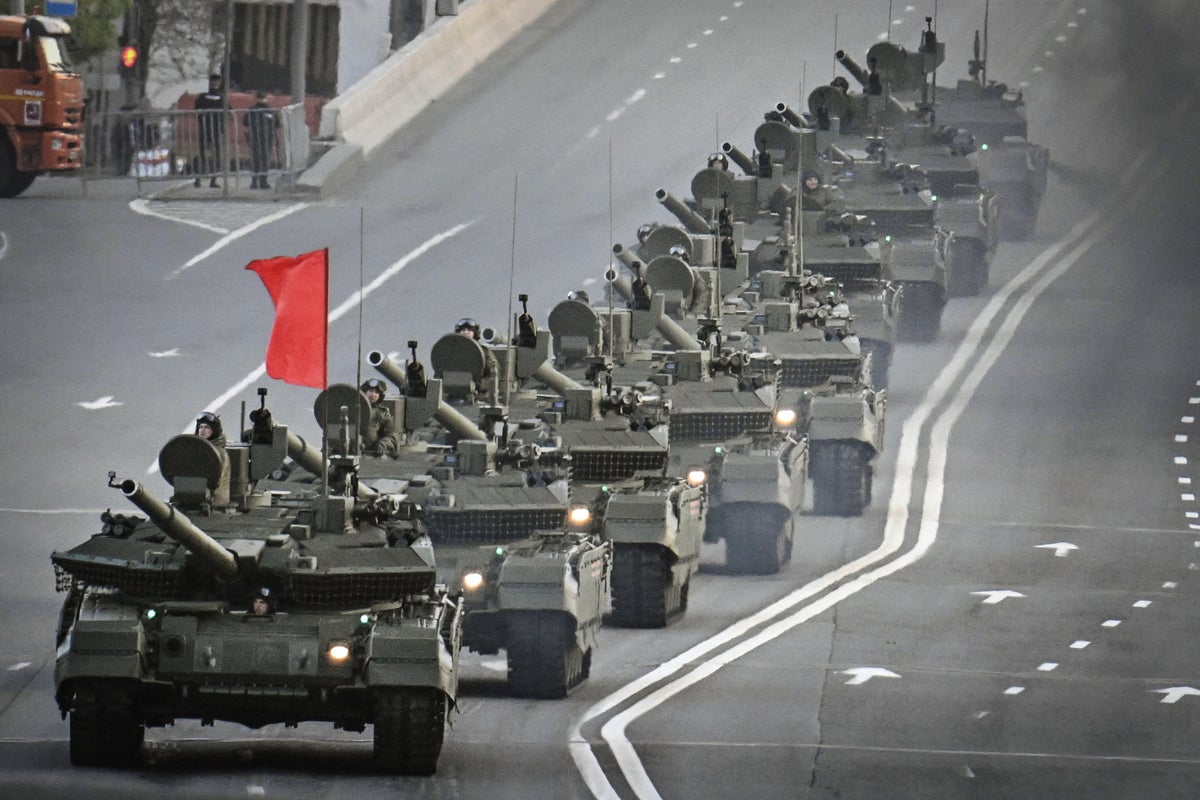
Russian T-90M tanks drive through central Moscow (AFP/Getty)
Marijampole hosts a critical road intersection in Europe. The EU and Ukraine use the Via Baltica highway to Poland, running southwest. Running east to west is a road which links Belarus and Kaliningrad, which Lithuania is obliged to keep open to Russian traffic under a treaty.
In the wargame, Russia portrayed the invasion of Marijampole as a humanitarian mission. The US declined to invoke Nato’s Article 5, which stipulates that all members must come to the defence of another member state which comes under attack.
Germany was hesitant in its response to the attack and a brigade which already deployed in Lithuania did not intervene after Russia used drones to lay mines near to a military base, the wargame forecast. Poland, meanwhile, mobilised, but ultimately did not send troops into Lithuania to help defend its territory.
Franz-Stefan Gady was a Vienna-based military analyst who acted as the Russian chief of general staff in the game. “Deterrence depends not only on capabilities, but on what the enemy believes about our will, and in the wargame my ‘Russian colleagues’ and I knew: Germany will hesitate. And this was enough to win,” he said.
open image in gallery
Moscow would use the pretext of a humanitarian crisis in Kaliningrad to justify the invasion. Picture shows Russian Chief of General Staff Gen. Valery Gerasimov, third right (AP)
The game was carried out amid growing fears in Europe of a Russian attack on Nato. Last year saw repeated incursions of Russian drones and fighter jets into Nato territory, as Moscow prodded at the alliance’s defences, a move experts and officials say was designed to expose how the countries would react.
Netherlands Defence Minister Ruben Brekelmans told the Journal that it had assessed that “Russia will be able to move large amounts of troops within one year”, adding: “We see that they are already increasing their strategic inventories, and are expanding their presence and assets along the Nato borders.”
The wargame exercise was carried out in December jointly by German newspaper Die Welt and the German Wargaming Center of the Helmut-Schmidt University of the German Armed Forces.