Your support helps us to tell the story
From reproductive rights to climate change to Big Tech, The Independent is on the ground when the story is developing. Whether it’s investigating the financials of Elon Musk’s pro-Trump PAC or producing our latest documentary, ‘The A Word’, which shines a light on the American women fighting for reproductive rights, we know how important it is to parse out the facts from the messaging.
At such a critical moment in US history, we need reporters on the ground. Your donation allows us to keep sending journalists to speak to both sides of the story.
The Independent is trusted by Americans across the entire political spectrum. And unlike many other quality news outlets, we choose not to lock Americans out of our reporting and analysis with paywalls. We believe quality journalism should be available to everyone, paid for by those who can afford it.
Your support makes all the difference.Read more
The airport in Lithuania’s capital has been shut four evenings over the past week after smuggling balloons were detected floating over the border from Belarus.
Thousands of passengers have been affected as dozens of flights were either redirected or cancelled at the airport, which is 30 kilometres (19 miles) from Belarus.
Lithuania, a NATO and European Union member state, has shut its land border with Belarus until the end of November in response, and threatened to call for NATO Article 4 consultations if these incidents continue. Authorities have branded it a “hybrid attack” by the Kremlin ally.
Here is what is known about these balloons:
What are they?
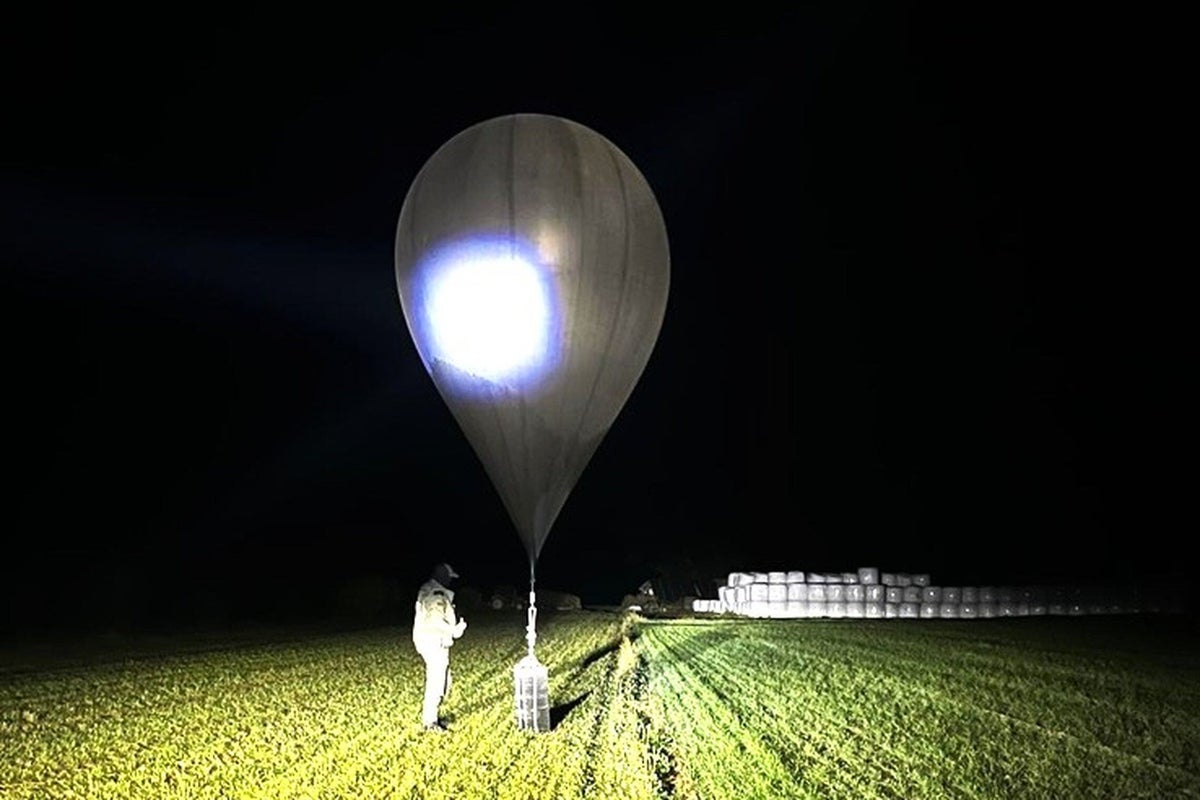
The high-altitude balloons, filled with helium or hydrogen, fly where the wind takes them, but their altitude can be controlled remotely from the ground.
They are typically used by meteorologists to sound out weather conditions in the stratosphere, which starts 15 kilometres (9.3 miles) above ground.
However, they have been repurposed by smugglers to carry cheaper cigarettes from Belarus into Lithuania, the Vilnius government says, since a crisis over a wave of migrant crossings in 2021 led to tighter curbs on movement over the land border.
open image in gallery
Belarussian smugglers often use balloons to ferry contraband into the European Union (State Border Guard Service via AP)
First spotted in 2023, the smuggling balloons became ubiquitous in 2024 when several hundred were recorded.
They pass over the border at an altitude of about 3-4 kilometres. The smugglers in Lithuania can then communicate with the balloon to track its location and direct it to land.
A balloon typically carries 500 to 1,500 packs of Belarus-produced cigarettes, with a pack costing less than a euro, versus €4.5 per similar brand in Lithuania.
Why are the balloons a problem?
Air navigation authorities say the balloons fly at a similar height to airliners approaching an airport, raising the risk of collisions.
Local rules for what constitutes a mid-air risk have recently been upgraded, and the balloons now frequently qualify.
In recent days, Lithuanian authorities have fine-tuned their detection systems and have been able to better identify whether the flight paths of any identified balloons pose a threat to civil aviation.
What happens with the cigarettes?
Lithuania says smuggled cigarettes are typically manufactured in Belarus, and many are consumed in Lithuania.
The Lithuanian Border Guard confiscated 1.4 million packs of illicit cigarettes in 2024, of which 1.2 million packs were marked for sale in Belarus.
Why did Lithuania close its border with Belarus?
The Lithuanian government says authorities in Belarus are contributing to the problem by not cracking down on smugglers on their soil, and has deemed the situation a “hybrid attack”.
What is Belarus’ position?
“If some air balloons with cigarettes or something else are flying there (Lithuania), they need to solve that question there,” President Alexander Lukashenko said.
“They are not flying into nothing; someone is receiving them there.”
open image in gallery
Belarus President Alexander Lukashenko (AFP/Getty)
He said Lithuania’s closure of the border was a “crazy scam” and, in turn, accused the West of waging a hybrid war against Belarus and Russia that was ushering in a new era of barbed-wire division.
Foreign Minister Maxim Ryzhenkov called Lithuania’s move “a provocation” that he said aimed to justify anti-Belarus sanctions.
Why aren’t the balloons shot down?
The Lithuanian government initially said they were not being shot down because of the danger to lives or property posed by their payloads, which can be as heavy as 50 kilograms (110 pounds), if they fell uncontrollably.
On Monday, however, Prime Minister Inga Ruginiene told the army to use “kinetic measures” to destroy the balloons. She did not elaborate on the measures, citing security sensitivities.