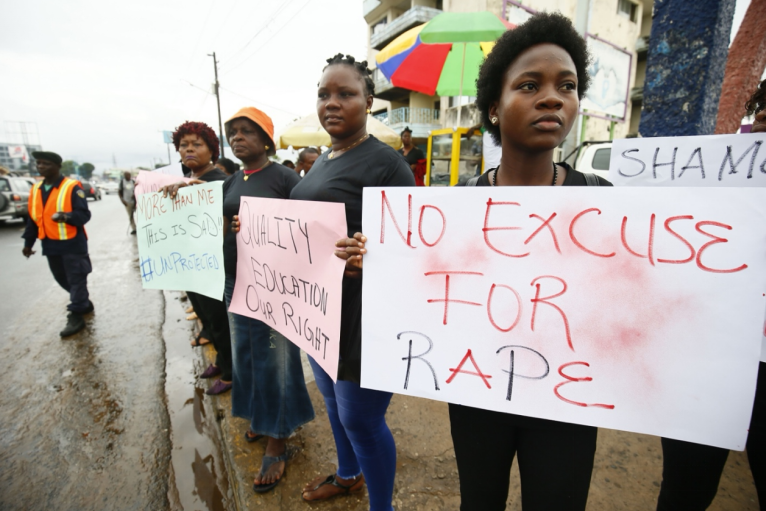
Protests in Monrovia against rape in 2018. Ahmed Jallanzo/European Pressphoto Agency for ProPublica
Summary :
• A mother says she paid to have the boy accused of raping her 8-year-old daughter jailed then found him back in the community.
• Liberia has no functioning juvenile rehabilitation centers, forcing judges to release minors accused of serious crimes.
• Lawyers warn the gap is creating a system where justice in sexual violence cases can collapse when the accused is a child.
By Tetee Gebro, gender correspondent with New Narratives
After struggling to get justice for her 8-year-old daughter, the mother in the case that gained national prominence in January, says she was shocked when, just hours after she was told the 15-year-old boy had been sent to jail, he turned up on a football pitch in her community.
The woman, who New Narratives is calling by her first initial N. to protect her from stigma, had gone from the police station to court. She had paid money she did not have to court officers and to a lawyer because she believed that was what it would take to see justice done.
“They said they were carrying the boy to jail,” N said. “But when I got close to my house, I met him right there playing football.”
N. said she is devastated.
“I was expecting them to put him in jail because the Liberian law told me that rape is a crime,” she said. “But from what happened to me, I am saying rape is not a crime in Liberia. Anybody can rape anybody and go free.”
A 15-year-old girl seeking medical treatment waits at the Médecins sans Frontières clinic in Monrovia in 2013 after being raped. Photograph: Glenna Gordon/AFP/Getty Images.
Her case reveals, what experts say, is a deep failure inside Liberia’s justice system — one that officials acknowledge but have yet to fix. The Children’s Law requires minors – those under XX years of age – accused of crimes be placed in juvenile rehabilitation programs. But the government has failed to build or fund a single functioning juvenile facility. As a result, judges are routinely forced to release children accused of serious offenses, including rape, back into their communities. Legal experts and justice officials say the gap is allowing cases to collapse and leaving victims unprotected.
For N. and her daughter the result has been more trauma. N’s daughter had already endured hospital visits and medical examinations after the alleged assault. Then the threats began. N. said the accused boy threatened to kill her daughter and burn her house. After those threats, the government relocated her and her family to another community for safety.
The case was not heard in this term of court that ends on April 12. N. has not been told yet whether it will go ahead in the next term. In the meantime they are in hiding with no end date in sight. Yet the boy is free to live in their old community.
“I want her to go back to school,” N said. “But now nobody knows where we are. I don’t trust people anymore.”
Under Liberia’s Children’s Law, children accused of crimes are meant to be diverted from the formal justice system and placed in rehabilitation programs focused on reintegration. But Liberia with no functioning juvenile rehabilitation centers, judges are left with two choices: hold children in overcrowded, unsuitable prison spaces or release them back to their families and communities — often without supervision.
There is little public data on how many of those accused of sexual violence are children. Government and human rights reports track victims, not perpetrators. National reports show gender-based violence remains widespread in Liberia, with rape and sexual assault making up a large share of reported cases each year. But those reports do not break down the age of offenders.
The Independent National Commission on Human Rights says sexual violence remains a constant threat, especially for minors, while also warning of serious gaps in the justice system that affect how cases are handled. The result, according to justice officials, corrections authorities and legal experts interviewed by FrontPage Africa/New Narratives, is a system where even serious cases like sexual violence can stall or collapse when the accused is a minor.
“The law provides that juveniles do not commit crimes — they commit acts,” said Isaac George, head of the Sexual and Gender-Based Violence unit at the Ministry of Justice. “The law also says juveniles should not be kept behind bars, especially with adult criminals.”
But, he added, the system the law depends on does not exist.
“They are supposed to be placed in rehabilitation centers, but those do not exist,” he said. “What we have at the central prison is just a room.”
That, he said, is not rehabilitation.
“Children need structured programs. They need trained professionals who can help them understand that what they did was wrong and ensure they do not repeat it,” he said. “Unfortunately, that is not happening.”
With no proper facilities, judges often rely on discretion — especially as more minors are brought into the system. “If every child brought before the court were detained, we would have overcrowded prisons,” he said.
Liberia’s prisons are already overcrowded.
With so many financial priorities a juvenile detention center has not made it to the national budget.
Gabriel Ndupellar, assistant minister for Corrections and Rehabilitation
The government has set aside hundreds of thousands of dollars in recent budgets for prison renovation, but none specifically for juvenile facilities, according to Gabriel Ndupellar, assistant minister for corrections and rehabilitation. “I think anywhere around $1 million would mean a lot in doing that,” he said.
Liberia’s correctional system was never designed for this kind of work. Some prison facilities were converted from old buildings, while Monrovia Central Prison itself began as a World War II detention site. The civil war further weakened the system.
Tiawan Gongloe, a human rights lawyer, said those explanations no longer justify the current situation.
“The government has a responsibility to make sure that everyone is secure in society,” Gongloe said. “If women and young girls are unsafe because of the conduct of young boys, then government must act.”
He described the absence of juvenile rehabilitation centers as a failure of state responsibility.
“In the past, we had places like Boys Town,” he said. “Young people who committed offenses were taken there, trained, counseled and rehabilitated. But leaving them in the same state without transformation undermines the safety of women and girls.”
He rejected the idea that lack of funding is the main issue.
“That excuse is not justifiable,” he said. “If there are zero rehabilitation centers, then government has not shown the willingness to act.”
For now, victims are paying the price. The corrections system does not monitor juveniles once a court orders their release. A child accused of a serious sexual offense can return to the same community while the case slowly moves through the courts — or disappears altogether.
“All we do is adhere to the court’s order,” said Ndupellar. “If the court says keep the person, we keep them. If the court says release, we release.”
For N, that reality has already reshaped her life.
“I am living in fear,” she said. “I have to protect my daughter.”
She does not know how long she can continue fighting. She says the price for justice in Liberia may too high for people like them.
The story was a collaboration with New Narratives as part of the “Investigating Liberia” project. Funding was provided by a private donor and the Swedish International Development Cooperation Agency. The donor had no say in the story’s content.