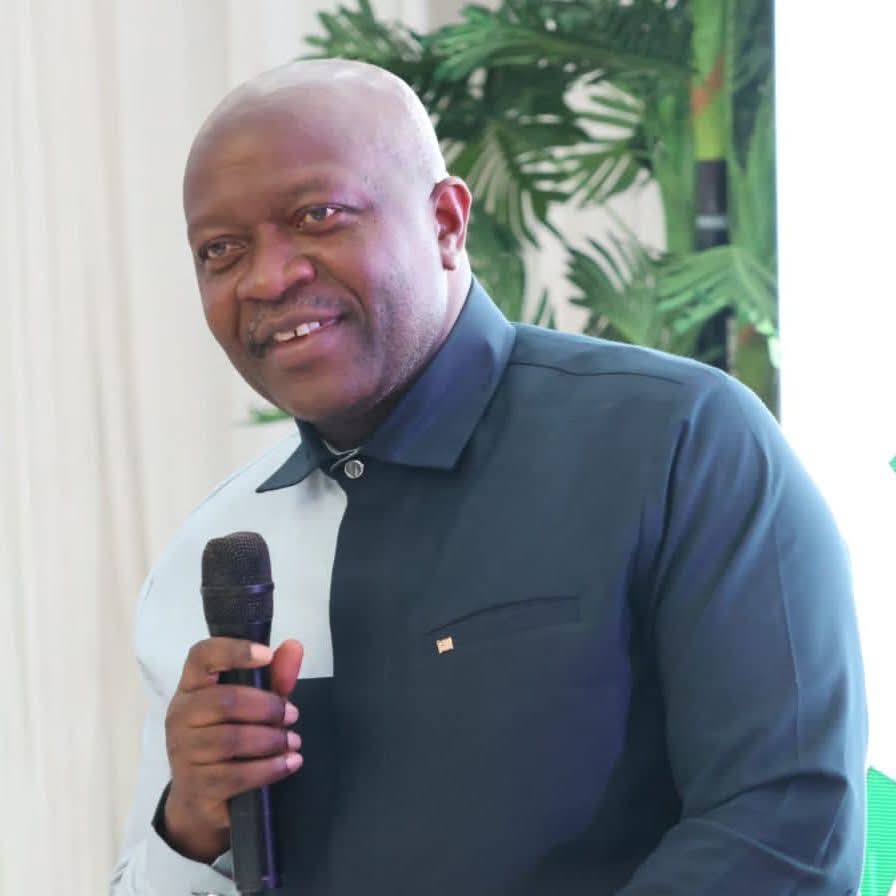
MONROVIA – Senator Amara M. Konneh has called on the Liberian Senate to urgently protect the country’s informal economy and fully enforce laws reserving key economic sectors and public procurement opportunities for Liberians, warning that citizens are steadily losing control of businesses meant by law to remain in their hands.
Delivering his opening statement to the Senate, Konneh said the most pressing challenge facing Liberia is not abstract policy debates but the daily survival of ordinary citizens whose livelihoods depend on the informal economy. He described market women, petty traders, motorcyclists, block makers, tailors, mechanics, and other informal workers as the true backbone of the national economy.
“I rise to speak to the daily struggle of market women, petty traders, motorcyclists, block makers, tailors, mechanics, and thousands of Liberians who wake up every morning hustling for survival in an economy that depends on them, yet too often fails to protect them,” Konneh told his colleagues.
According to the senator, nearly 68 percent of Liberia’s labor force operates within the informal economy, yet these workers remain largely unprotected, unstructured, and excluded from economic opportunities that existing laws already guarantee them.
Konneh said Liberians are steadily losing control of sectors that the Liberianization Act explicitly reserves for citizens, including petty trading, used clothing, small retail businesses, transportation, auto repair, block making, and bakeries.
“These are everyday businesses that feed families and sustain communities,” he said. “Yet in many parts of our country, foreign nationals now dominate these spaces, not because Liberians are unwilling or lazy, but because the State has failed to enforce its own laws.”
He pointed to fragmented enforcement, weak market governance, frequent harassment, and poor coordination among state institutions as factors pushing Liberians out of their own economic space. “Our people are being pushed out of their own economy,” Konneh warned.
To address the situation, Konneh announced plans to introduce a new legislative framework titled the Informal Economy Development and Protection Act, aimed at modernizing and enforcing rights already guaranteed to Liberians under existing law.
“This Act will recognize the informal economy as a legitimate sector of national importance,” he said, adding that it will also enforce the 26 business activities reserved exclusively for Liberians under the Liberianization Act.
Konneh explained that the proposed law would establish a unified registration and citizenship verification system, create designated trading zones with proper sanitation and security, and protect Liberians from harassment, extortion, and arbitrary confiscation of goods.
He further noted that the framework would organize sector associations, set operational standards, provide a pathway to formalization, and coordinate enforcement among the Ministries of Commerce, Immigration, Local Government, and the Liberia National Police.
Beyond regulation, Konneh emphasized that the Act would also unlock access to microfinance, skills training, and business development support for informal operators who have long been excluded from the formal economy.
Turning to public procurement, Konneh said the Senate must also confront the long-standing failure to implement the Small Business Act, which mandates that 25 percent of public procurement be awarded to Liberian-owned small and medium enterprises.
“For years, this provision has existed on paper but failed in practice,” he said, noting that the FY2026 National Budget offers a real opportunity to change that pattern.
Konneh disclosed that the budget contains approximately US$467.3 million in procurement-eligible spending, meaning that about US$116.8 million should, by law, go directly to Liberian-owned small businesses.
“By law, one hundred sixteen point eight million United States dollars should go to Liberian-owned small businesses,” he stressed.
He argued that formalizing even a fraction of informal operators would allow tens of millions of dollars to flow directly to Liberian market women, block makers, tailors, mechanics, and micro-contractors.
“This is how we turn policy into prosperity,” Konneh said. “This is how we turn legislation into livelihoods. This is how we move from speeches to impact.”
He painted vivid examples of what enforcement would mean in practice, including market women supplying school feeding programs, block makers winning community infrastructure contracts, mechanics servicing government vehicles, and petty traders becoming registered government suppliers.
“This is economic justice,” Konneh declared. “This is national security. This is the future of Liberian enterprise.”
He concluded by urging the Legislature to take the lead in reclaiming economic space for citizens, insisting that peace, growth, and private-sector development all depend on protecting and empowering Liberians already working within the informal economy.
“The informal economy is not a problem to be tolerated,” Konneh said. “It is a sector to be organized, protected, and empowered. Let us pass a law that truly puts Liberians first in their own economy.”