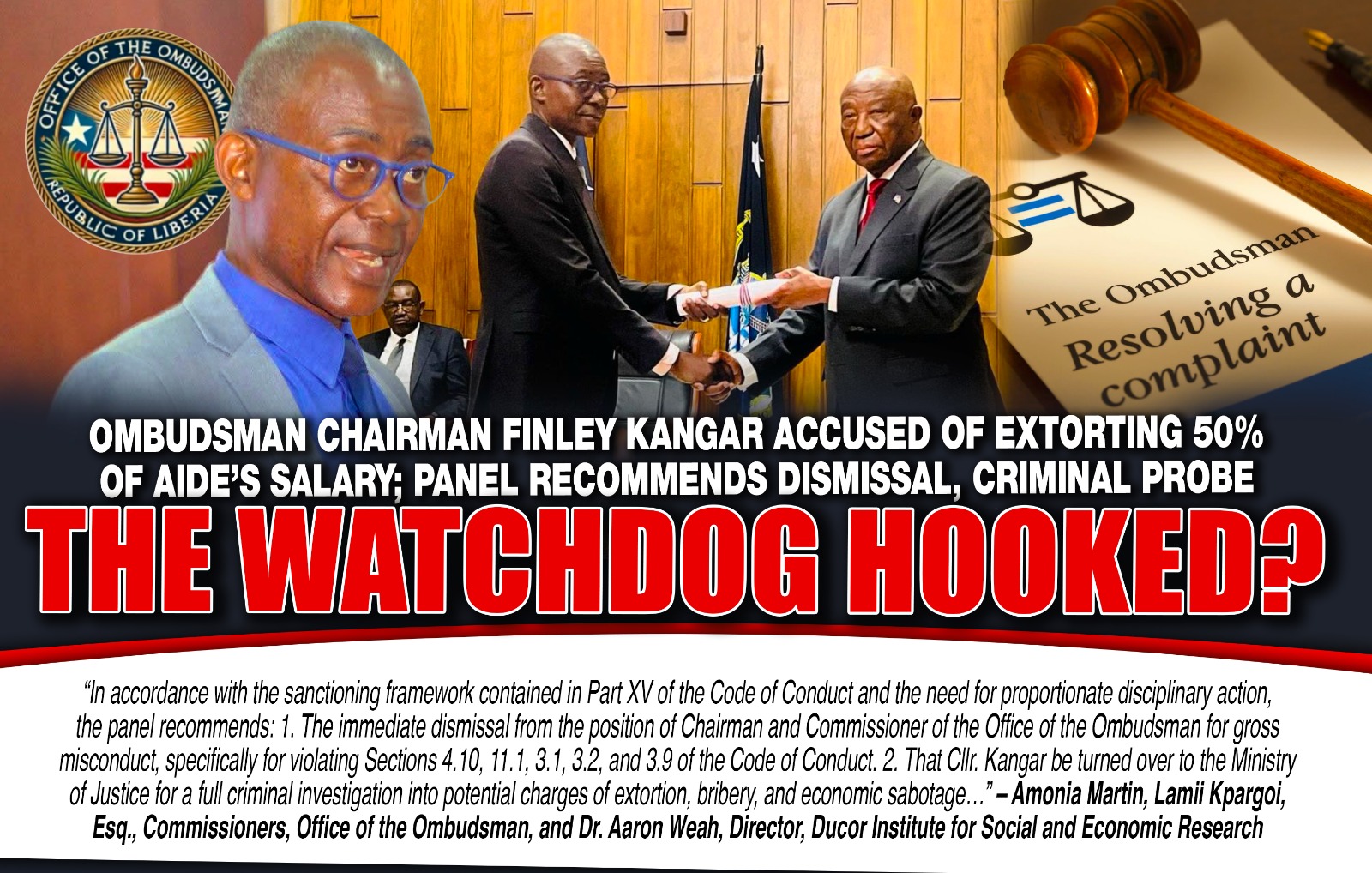
Monrovia – An independent investigative panel has recommended the immediate dismissal and criminal prosecution of Cllr. Finley Y. Karngar, Chairman of the Office of the Ombudsman, following findings that he extorted more than US$2,000 from his Special Assistant over four months.
By Gerald C. Koinyeneh, [email protected]
In a formal transmittal dated February 12, 2026, addressed to President Joseph Nyuma Boakai, the panel concluded that Karngar “clandestinely extorted” funds from Mr. Francis K. D. Cooper, his Special Assistant, in what investigators described as a “gross violation” of Liberia’s National Code of Conduct.
The report, signed by Commissioners Amonia Martin and Lamii Kpargoi, along with Dr. C. Aaron Weah of the Ducor Institute for Social and Economic Research, details allegations that the Chairman demanded 50 percent of Cooper’s monthly salary—US$500—between April and July 2025. Additional payments of US$30–35 monthly for phone scratch cards were also allegedly required.
Secret Recordings and Mobile Money Trail
According to the leaked report, a copy shared with FrontPage Africa, the allegations were substantiated by secret audio recordings, text messages, mobile money transaction records, and sworn testimony from six staff members of the Ombudsman Office.
The panel found that over four months, Cooper paid approximately US$2,130 to Karngar, either directly or through an intermediary. Investigators concluded that the payments imposed financial hardship on Cooper and were made under pressure tied to his continued employment.
The panel further determined that Cooper’s October 31, 2025 dismissal—officially attributed to poor performance and dishonesty—was “pretextual” and directly linked to his refusal to continue making the alleged illicit payments.
Chairman Refused to Participate
The report states that Karngar declined to appear before the panel on four separate occasions and instead challenged the panel’s authority, arguing that subordinates could not investigate him. He reportedly attempted to redirect the matter to other institutions, including the Civil Service Agency.
His Administrative Assistant, Ms. Angeline Y. McGill—alleged to have acted as an intermediary in some of the transactions—also declined to testify and filed a Petition for Declaratory Judgment at the Civil Law Court for Montserrado County against the majority of the Ombudsman Commission.
Despite these objections, the panel proceeded with hearings in January 2026 after expanding its membership to include representatives from civil society to enhance impartiality.
HR Director Defied Dismissal Order
One of the most significant testimonies came from the Office’s Human Resource Director, who refused to execute Cooper’s dismissal, citing violations of Civil Service Standing Orders. According to the report, Cooper had passed probation and had no negative performance appraisal on record.
The HR Director also testified that she had advised Cooper to discontinue the alleged payments and warned that retaliation could follow if the allegations were true.
Six staff members testified under oath, stating they had contemporaneous knowledge of the alleged financial arrangement. Colleagues recounted noticing Cooper’s sudden financial strain, including his avoidance of routine lunch outings, which later prompted him to disclose the alleged scheme.
Violations of Code of Conduct
The panel concluded that Karngar’s actions violated multiple provisions of Liberia’s Code of Conduct for Public Officials, including exploitation of office for personal gain, abuse of power and authority, undermining public confidence in governance institutions, and failure to cooperate with a lawful investigation.
The report described the conduct as “akin to modern-day exploitation” and warned that such behavior at the helm of the country’s premier ethics oversight body severely damages public trust.
Recommendations to the President
The panel’s primary recommendations to President Boakai include an immediate dismissal of Karngar as Chairman and Commissioner of the Ombudsman Office, criminal referral to the Ministry of Justice and the Liberia Anti-Corruption Commission for investigation into possible extortion, bribery, and misuse of public office; an order compelling repayment of the full amount received from Cooper, with interest at prevailing Central Bank of Liberia rates, and a formal probe into the alleged role of Ms. McGill.
A Test for Institutional Integrity
The Office of the Ombudsman, established as Liberia’s chief ethical oversight body, is mandated under Section 12.3(a) of the Code of Conduct to investigate violations by public officials.
In its concluding remarks, the panel warned that failure to act decisively would represent “a catastrophic failure of the ethical framework of the Liberian state.”
“The evidence in the case is overwhelming,” the report states, citing corroborated recordings and financial records. “To ignore or minimize these findings would undermine the very purpose of the Ombudsman.”
As of press time, Chairman Karngar had not publicly responded to the panel’s findings. The Executive Mansion has yet to announce whether President Boakai will act on the recommendations.
Analysts say the case now places Liberia’s anti-corruption architecture under intense scrutiny, as the nation awaits executive action on allegations involving the head of its own ethics watchdog.
Core Functions of the Ombudsman
The Office of the Ombudsman of Liberia is an independent integrity institution established to enforce the country’s Code of Conduct for Public Officials and Employees of Government. It serves as one of the principal anti-corruption and ethics oversight bodies within Liberia’s governance framework.
The Office was created following the passage of the National Code of Conduct in 2014 during the administration of former President Ellen Johnson Sirleaf. The Code was enacted to regulate the behavior of public officials, prevent conflicts of interest, and strengthen transparency and accountability across government institutions.
Under Part XII, Section 12.3(a) of the Code of Conduct, the Ombudsman is empowered to investigate violations of the Code by public officials and civil servants; conduct hearings and issue determinations, recommend administrative sanctions, including suspension or dismissal, and refer criminal matters to the Ministry of Justice or the Liberia Anti-Corruption Commission when necessary.
The Office is headed by a Chairperson and supported by Commissioners. Members are appointed by the President of Liberia and confirmed by the Senate. Though appointed by the Executive, the Ombudsman is intended to operate independently in the discharge of its mandate.
Core Responsibilities
The Ombudsman’s functions include enforcing asset declaration requirements for public officials, investigating abuse of office, conflict of interest, and unethical conduct, ensuring compliance with rules governing political participation by civil servants, and promoting ethical standards in public service.
Unlike the Liberia Anti-Corruption Commission, which primarily investigates and prosecutes corruption-related crimes, the Ombudsman focuses on ethical breaches and administrative misconduct under the Code of Conduct.
Role in Liberia’s Governance Framework
The establishment of the Ombudsman was widely viewed as a major step in strengthening Liberia’s post-war governance architecture. Alongside institutions such as the General Auditing Commission and the LACC, the Office plays a preventive and corrective role in promoting integrity within the public sector.
Its credibility, however, depends heavily on its impartiality and willingness to apply the Code uniformly—especially when allegations involve senior officials.