Monrovia – A growing chorus of political leaders and legal experts in Liberia is raising alarm over what they describe as a breakdown in due process following the expulsion of former Montserrado County District 10 Representative Yekeh Y. Kolubah, with Senator Abraham Darius Dillon of Montserrado County emerging as one of the most prominent voices questioning the legality of the House of Representatives’ decision.
By Selma Lomax, selma.lomax@ frontpageafricaonline.com and Emmanuel Weedee-Conway, [email protected]
Kolubah was expelled last Friday after the House of Representatives secured 49 signatures, the exact two-thirds majority required under the 1986 Constitution, to remove a sitting lawmaker.
His expulsion followed controversial remarks in which he claimed, based on his own research, that a disputed piece of land between Liberia and Guinea belongs to Guinea. The statement triggered outrage among his colleagues and prompted swift legislative action.
The initial complaint against Kolubah was filed by Montserrado County District 3 lawmaker Sumo Mulbah, who described Kolubah’s statement as “treasonous” and called for a full-scale investigation by the House of Representatives.
Mulbah argued in his complaint that Kolubah’s remarks undermined national sovereignty and posed a threat to state stability, urging his colleagues to treat the matter with urgency. His complaint, alongside concerns raised by other officials, formed the basis for the House’s subsequent actions against Kolubah.
The process leading to his removal, however, has been heavily criticized. The controversy deepened after reports emerged that a court had issued a prohibition on Thursday, urging the House to halt any investigation involving Kolubah.
Despite this, lawmakers proceeded with deliberations and ultimately voted to expel him. Adding to the confusion, the Deputy Chief Clerk of the House stated that she had not received any official notice of the court’s prohibition, raising serious questions about whether the legislative body was properly served before taking action.
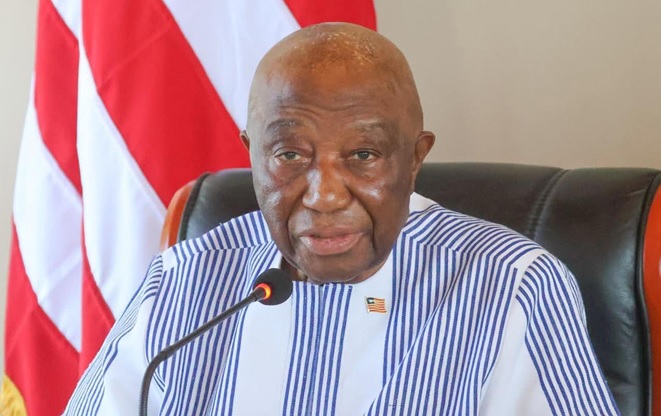
Amid the unfolding controversy, Senator Dillon has criticized the process, emphasizing that constitutional due process must take precedence over political considerations.
Senator Dillon, a member of the Liberty Party, one of the key parties that collaborated to bring the ruling Unity Party to power in 2023, warned that the Legislature risks undermining its own legitimacy if it fails to adhere strictly to constitutional provisions.
Senator Dillon stressed that while the Legislature has the authority under Article 38 of the Constitution to discipline its members, such actions must be carried out within the bounds of due process.
He noted that the Constitution clearly mandates that all rules adopted by the Legislature must conform to constitutional requirements, particularly when fundamental rights and liberties are at stake.
“Yekeh Kolubah was not accorded due process in his removal; we cannot continue this way,” Senator Dillon said. “Article 38 gives the Legislature authority, yes, but it also places a clear limitation. It says that all rules adopted must conform to the requirements of due process laid down in the Constitution. That due process is not something each house can define arbitrarily. It is defined by the Constitution itself, and it must be respected in every instance.”
Senator Dillon further argued that the issue goes beyond Kolubah as an individual, warning that failure to follow due process sets a dangerous precedence for all lawmakers. He maintained that disciplinary actions affecting a lawmaker’s liberty, rights, or status must be handled with strict adherence to constitutional safeguards, including fair hearing and respect for judicial authority.
“I did not come here to defend Kolubah as a person,” Dillon added. “I came to speak to the principle involved. Any administrative body that begins to ignore the courts when they act within their constitutional authority creates a troubling situation for the rule of law. Whether you agree with Kolubah or not is irrelevant. What matters is whether the process used to remove him meets constitutional standards. If we abandon that, then none of us is protected.”
Senator Dillon also pointed to concerns over the apparent disregard for the court’s prohibition, describing it as a dangerous signal. He emphasized that respect for the judiciary is a cornerstone of democratic governance and warned that any attempt by the Legislature to sidestep judicial authority could erode public trust in state institutions.
The controversy has also drawn strong reactions from opposition figures and political commentators. Mulbah Morlu, Chairman of the Solidarity for Trust for a New Day (STAND), delivered a scathing critique of the House’s decision, describing it as a direct assault on Liberia’s democratic foundations.
Morlu argued that the expulsion reflects a growing intolerance for dissent and a willingness to weaponize legislative power against political opponents.
Morlu warned that such actions could have far-reaching consequences for Liberia’s democracy, particularly if lawmakers begin to equate unpopular opinions with punishable offenses. He emphasized that freedom of expression is a cornerstone of democratic governance and must be protected, even when statements are controversial or widely condemned.
“This is not just about Yekeh Kolubah; this is about the future of democracy in Liberia,” Morlu said. “When a lawmaker is expelled for expressing an opinion, no matter how controversial, it sends a chilling message to every citizen and every public official. It tells them that dissent is no longer tolerated. That is how democracies begin to erode. Today it is Kolubah; tomorrow it could be anyone who dares to speak differently.”
Gbarpolu County Senator Amara Konneh also weighed in, criticizing the process as deeply flawed and inconsistent with constitutional principles. Konneh expressed concern that the House acted hastily and without ensuring that all procedural requirements were met, including respect for the court’s intervention.
According to Senator Konneh, the situation highlights a problem within Liberia’s governance system, where political expediency often takes precedence over legal integrity. He called for a careful review of the process and urged lawmakers to prioritize the rule of law in their decision-making.
“The process that led to Kolubah’s expulsion raises serious legal and constitutional questions,” Konneh stated. “We cannot claim to uphold democracy while disregarding the very principles that sustain it. Due process is not optional; it is a fundamental requirement. If we allow political emotions to override legal procedures, we risk weakening the institutions we are supposed to protect.”
Legal expert and human rights lawyer Tiawan Saye Gongloe has also entered the debate, describing Kolubah’s expulsion as a “profound constitutional error.” In a detailed legal analysis,
Gongloe argued that the House’s action was not based on any violation of law but rather on political considerations. He emphasized that freedom of expression, as guaranteed under Articles 14 and 15 of the Constitution, protects individuals from punishment for expressing opinions, even if those opinions are unpopular.
Gongloe further noted that Kolubah’s statement did not constitute treason or any other criminal offense under Liberian law. He argued that the appropriate response to such a statement should have been counter-speech, not expulsion, and warned that the decision sets a dangerous precedent for suppressing dissent.
Meanwhile, the controversy took another dramatic turn with Bomi County District 3 Representative Sam P. Jallah challenging the legitimacy of the expulsion process.
Representative Jallah denied signing the resolution used to remove Kolubah, raising serious concerns about the validity of the two-thirds majority claimed by the House.
Representative Jallah maintained that he never appended his signature to any document supporting Kolubah’s removal. He disclosed that he has already raised the issue with House leadership but is prepared to pursue legal action if the matter is not resolved promptly.
Representative Jallah emphasized that the alleged use of his signature without his consent not only undermines his personal credibility but also calls into question the integrity of the entire legislative process. He warned that if the required number of signatures was not legitimately obtained, the expulsion itself could be deemed unconstitutional.
The lawmaker further pointed to inconsistencies in the document circulating publicly, including errors in its title and the absence of standard procedural elements, such as a formal recommendation from the Committee on Rules, Order, and Administration. He stressed that he could not have signed a document he neither saw nor reviewed.
Representative Jallah also highlighted that while he participated in earlier hearings related to the case, no final resolution recommending expulsion was presented to him before he departed for his constituency. He insisted that due process must be followed, regardless of the allegations against Kolubah.
“If a proper resolution had come through the right channel, based on investigation and recommendation, I could consider signing,” Jallah said. “But that is not what happened here.”
The implications of Representative Jallah’s claims are significant. If his signature was indeed included without authorization, the number of lawmakers supporting the expulsion could fall below the constitutional threshold, potentially invalidating the entire process.