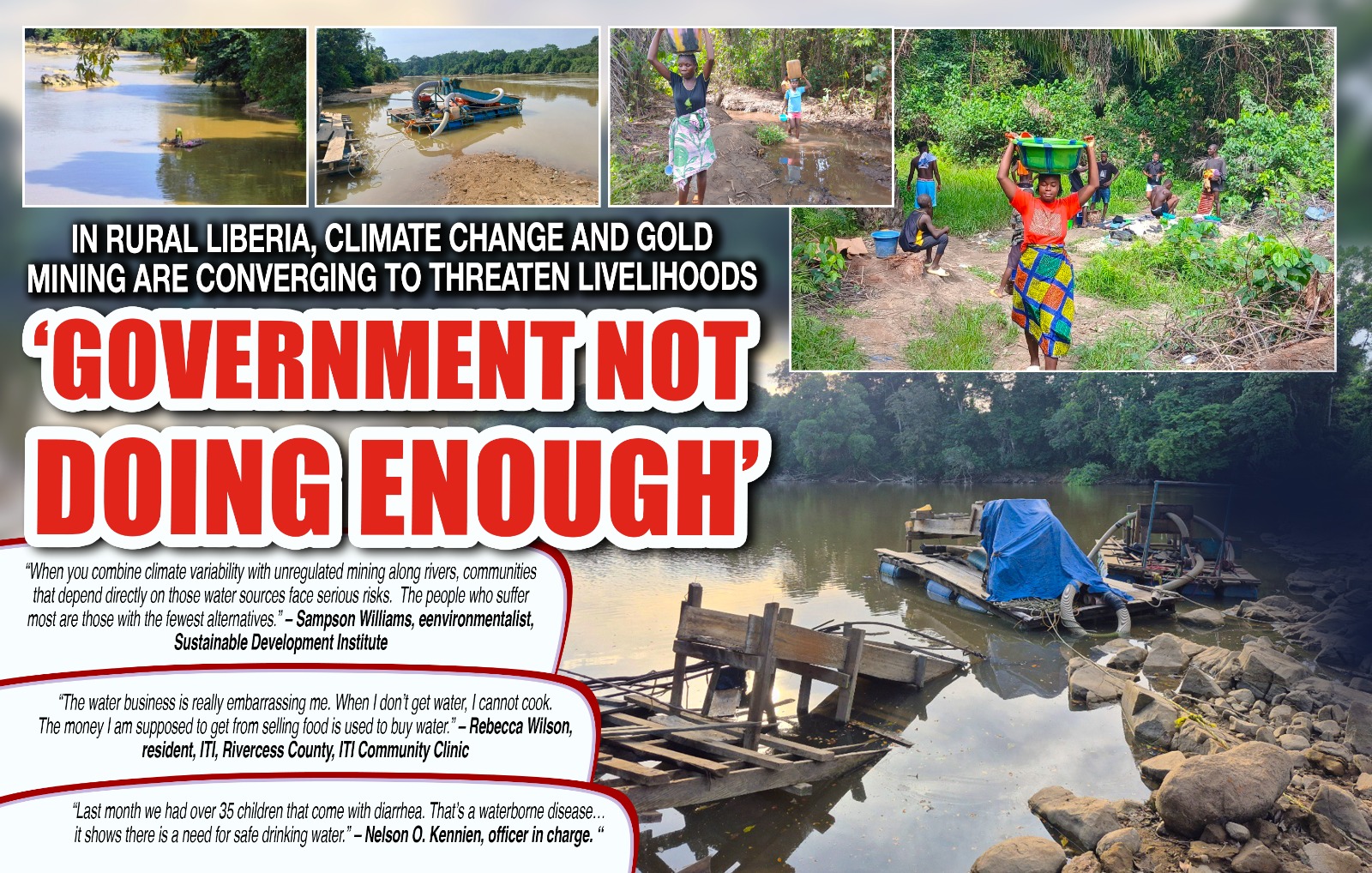
- Rural communities in River Cess County are facing growing water insecurity as climate change and expanding gold mining degrade rivers and creeks that residents depend on.
- Environmental and health risks are rising, with experts warning of pollution from unregulated mining, while local clinics report increasing cases of waterborne diseases like diarrhea.
- Experts say weak government oversight and limited resources at the Environmental Protection Agency are leaving communities exposed, as enforcement struggles to keep pace with mining activities and climate pressures.
By Eric Opa Doue with New Narratives
ITI, River Cess County — By the time Rebecca Wilson opens her food stall each morning, she has already made one decision that shapes her entire day: how much water she can afford to buy.
Wilson, the town chief here in this remote community near the border with Sinoe County, once relied on a nearby creek for cooking. Today, she no longer trusts the water. Instead, she buys treated water by the jerrycan for $L50 (about 27 cents)—an added cost that eats into her already thin profit margin.
“The water business is really embarrassing me,” Wilson said in Liberian English. “When I don’t get water, I cannot cook. The money I am supposed to get from selling food is used to buy water.”
Her struggle reflects a wider reality across River Cess County, where three in every five households relies on rivers, streams, lakes, ponds, or wetlands, the highest proportion of all the counties in the country.
Experts say that dependence makes the county especially vulnerable as climate change and expanding gold mining place increasing pressure on water systems.
“When you combine climate variability with unregulated mining along rivers, communities that depend directly on those water sources face serious risks,” said Sampson Williams, an environmentalist at the Sustainable Development Institute. “The people who suffer most are those with the fewest alternatives.”
Water Under Pressure
Along the Cestos River—the county’s main waterway—residents say creeks that once ran clear year-round now remain muddy for long periods. Many believe the changes are linked to gold mining taking place directly in the river and nearby streams.
Across Liberia, artisanal and small-scale mining has expanded as economic pressures push rural residents toward alternative livelihoods. In counties like River Cess, that expansion is colliding with long-standing infrastructure gaps and the growing impact of climate change.
A dredge operating on Cestos River: Photo by Eric Opa Doue
The Environmental Protection Agency has documented mining’s toll on Liberia’s waterways — including contamination of the Nyarfor River in Margibi County — even as national gold production jumped roughly 16 percent in 2023 – the last year data is available – much of it driven by small-scale miners working directly in riverbeds.
The damage runs deeper than what’s visible on the surface. “Heavier rains and flooding increase surface runoff, washing sediment and mining pollutants into rivers and shallow groundwater,” Williams said. The World Bank warns that worsening storms and shifting rainfall could compound that contamination, and projects runoff in the St. Paul River Basin could fall by as much as 25 percent by 2080.
Rita Koyou and other residents of ITI walk more than 30 minutes each day to get water: Photo by Eric Opa Doue
A 2021 study found mercury contamination linked to artisanal mining in Bong and Grand Cape Mount counties, with some water samples exceeding World Health Organization safety limits by up to 150 times. Though similar testing has not yet been conducted along the Cestos, experts say the pattern is clear.
“Wherever artisanal mining expands along rivers, the potential for contamination increases,” said Lawrence Yealue of the National Civil Society Council of Liberia.
A Changing Livelihood
Climate pressures are also reshaping how people survive. Erratic rainfall has disrupted farming, pushing some residents toward mining to support themselves. Along the Cestos, dredging machines scoop sand and gravel from the riverbed in search of gold—releasing large amounts of sediment into the water.
Experts say this sediment clouds the water, blocks sunlight needed by aquatic plants, clogs fish gills, and carries pollutants downstream. Residents say the changes are visible. Fish catches have declined. Riverbanks have eroded. Water that once cleared quickly now remains cloudy.
Two of the many dredges mining on the Cestos River near ITI: Photo by Eric Opa Doue
A Longer Walk for Water
For residents like Rita Koryou, accessing water now requires endurance. Each day, she walks more than 30 minutes to reach a creek that still flows during the dry season. When she returns, she lets the water sit for hours to allow sediment to settle.
“Only one pump we are depending on here,” she says. “If you want clean water, you can wake up at 5:30 to go to the creek.”
Across ITI, that routine is common. The impact is borne mostly by women. Women and children wake early, walk farther, and wait longer. The town’s six hand pumps and wells—serving more than 6,000 people—are mostly broken. Hand-dug wells that once sustained communities during dry months have dried up.
Waterborne Illnesses Are Increasing
At the ITI Community Clinic, health workers say the impact is becoming visible. Diarrhea cases, which typically stayed below 10 per month, recently tripled.
“Last month we had over 35 children that come with diarrhea,” said Nelson O. Kennien, the officer in charge. “That’s a waterborne disease… it shows there is a need for safe drinking water.”
Health experts warn that contaminated surface water, combined with flooding, increases the risk of disease outbreaks.
Weak Oversight
Liberia has national frameworks for environmental protection and water governance, including the 2018 WASH Commission Act, which establishes the National Water, Sanitation and Hygiene Commission as the lead body responsible for regulating and coordinating water, sanitation and hygiene services nationwide.
But enforcement is limited. The Environmental Protection Agency operates with far less funding than it says is needed to effectively monitor environmental compliance.
The Agency will receive $2.9 million in the approved 2026 budget — far below the nearly $20 million annually that EPA leadership has publicly said is needed. It says staffing and logistical constraints limit inspections of mining sites in remote counties. In River Cess, oversight is minimal, with only a county coordinator on the ground.
Local health officials say the County Health Team also lacks consistent capacity to conduct water quality testing. Despite national environmental frameworks and regulatory mandates, enforcement capacity remains a concern, civil society observers say.
“I don’t think our government is doing enough to punish the companies for this level of degradation,” Yealue said. “The EPA needs to step up.”
The Environmental Protection Agency did not respond to multiple requests for comment. The agency initially agreed to an interview after being contacted by email through its communications office but failed to respond before deadline.
Women and children rise early, walk farther, and adapt quietly. Photo by Eric Opa Doue
A System Under Strain
As the afternoon heat settles over ITI, Wilson pours water sparingly. Each cup represents money spent, profit lost, and a system under strain. For generations, the Cestos River sustained life in south-central Liberia. Today, residents say it reflects a convergence of pressures: expanding mining, weak oversight, and a changing climate.
Across rural Liberia, where millions still depend on untreated surface water, experts warn that what is unfolding in River Cess is not isolated—it is a warning.
In ITI, the question is no longer whether water exists. It flows past the town, stirred by dredges and darkened by sediment.
The question residents now ask is simpler—and harder to answer: Who will make it safe again?
This story was a collaboration with New Narratives Funding was provided by the Swedish International Development Cooperation Agency. The funder had no say in the story’s content.