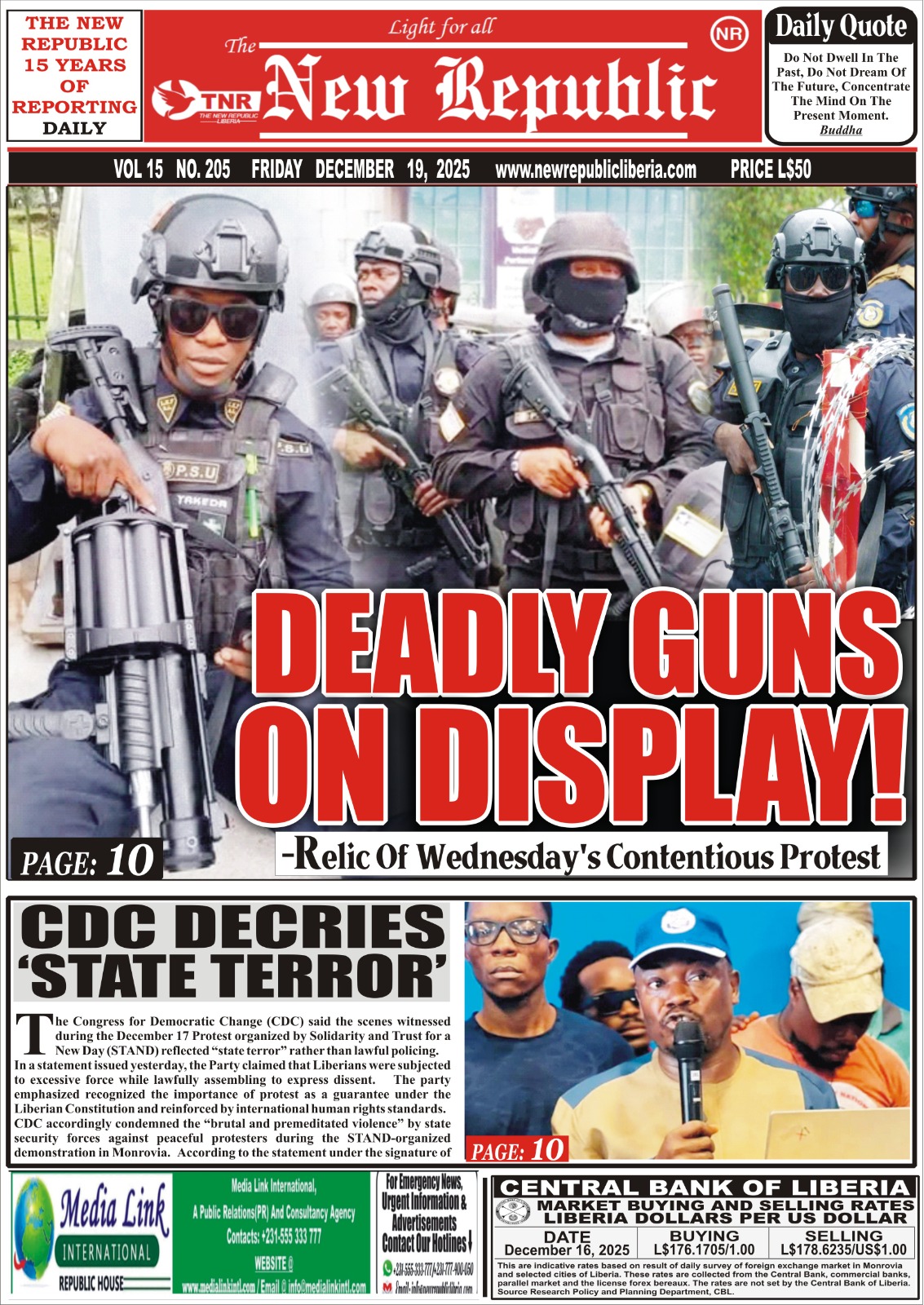
MONROVIA–Liberians on Wednesday witnessed the horrifying display of deadly weapons or guns in a manner said to be unseen in years during the ‘Leave or Lead Protest” staged under the auspices of the Solidarity @ Trust for a New Day (STAND).
Those who followed the Protest from start to end said it was not short of drama, including what they termed “uncharacteristically shocking display of guns” critics claimed are part of new cache of weapons purchased by the Liberian government.
It was one of the relics of the protest that Liberians are arguing about, whether it was called-for or not.
Besides the sporadic stand-ups between the officers of the Liberia National Police (LNP) on assignment and the protesters, the raw ‘display of deadly guns’ by Police Support Unit (PSU) in a manner unseen in years has become topical, and also drawing both condemnation and defense.
Those familiar with country’s war history argued that some of the guns seen with PSU officers during the protest are incomparable to the famous AK-47, a Russian-made rifle, that was predominantly used during the civil war.
“Those are brand new guns brought into the country by the government to deter people from protesting, from exercising their constitutional rights,” remarked an angry protester, according to our reporter who followed developments from the protest grounds on Capitol Hill.
He is quoted as saying that the display of such guns only reignited bad of memories of the civil war when guns became the order of the day, as rebels indiscriminately gunned down both enemies and ordinary citizens unjustifiably.
“I am reminded of the days of RPG or rapid prepared grenade, bereta, AK-47, and many other weapons used by opposing fighters during the war,” he growled.
The use of weapons said to be modern US-made rifles by PSU officers, most often accused of being ruthless in the discharge of their duties, has drawn and continues to draw the attention of Liberians.
Critics of the government argued that such ‘guns show’ was a complete replay of the terrible moments of the civil war when rebels used guns uncontrolled to silence their critics or anyone for that matter- not necessary their enemies.
Seeing huge number of sophisticated weapons in the hands of PSU officers for Liberians said to be exercising their constitutional rights did not pass the attention of former Representative Acarous M. Gray, a stalwart of the opposition Congress for Democratic Change (CDC).
In social media post, Gray accused the government of spending whooping USD$15m behind weapons, although this paper could not verify his claims independently.
He claimed that the weapons could not have been displayed “had it not been for the protest today these weapons would not have been displayed this early.” Gray, who is described by his critics has having fathomless hate for the administration, also remarked “This shows that this government is only interested in protecting itself against the masses.”
Those familiar with guns told this paper that most of the guns seen with PSU officers are US-made rifles, and are among some of the country’s modern rifles. One of the guns in question is the popular American portal Minutemanreview, which is said to be one of the seven best assault rifles of 2019. another is the AR-15 Tactical rifle
AR-15 variant from Springfield Armory – Saint Semiautomatic Tactical Rifle, according to authors of the portal, is an excellent choice, regardless of what type of shooting its owner practices.it is said to have good accuracy of about 16-inch chrome-nickel barrel with a melonite coating.
Statistics obtained from wikipedia say Melonite coating (the so-called dry lubricant) doubles the survivability of the barrel channel compared to the uncoated version. Details of the trigger mechanism have a nickel-boron coating and are micropolished. “All this makes pulling the trigger very smooth and allows you to fine-tune the trigger,” it said.
The debate about why the government had to arm the police with such guns during the protest is not lessening. Most critics believed the plan was to shoot at protesters had they dared to break through security barricades.
“This shows the government is callous and can do anything to protect power, not matter how many citizens affected their actions,” a protester was heard saying, according to our reporter. “This government is intolerant and undemocratic in its dealings.”
Another protester said it was the height of nonchalance displayed by the government by arming police officers with deadly automatic rifles against its own people who are disenchanted about the governance process under President Joseph Boakai.
From guns to the crowd debate
Apart from the unwarranted display of guns by the LNP to apparently intimidate protesters, the argument centered around the outcome of the protest with both proponents and opponents sharing different opinions
Sharing his thoughts about the protest vis-a-vis they claims of failure, Wantoe Teah Wantoe, a support of the opposition disagreed.
In a write-up titled “Crowd or Cause: Wantoe Calls for Deeper Reflection on STAND’s Protest: Urges Liberians to Look Beyond STAND’s Protest Crowd,” he argued that much of the public conversation around the STAND protest has focused on crowd size, with questions such as “How many people came out. How many stayed home.”
In his analysis, Wantoe said such obsession misses the point because “Protest is not a census. It is a signal. It emerges when citizens believe policy promises and lived reality have drifted too far apart.”
Ahead of the December 17 protest, STAND framed “Lead or Leave,” he said whether one agrees with STAND or not is secondary, the overriding question is whether the issues raised are grounded in fact. On that front, the government’s own documents offer the clearest evidence.
Wantoe said: “Liberia is operating under a draft national budget of roughly US$1.2 billion annually. Over three fiscal years, this administration will have managed close to US$3.6 billion in public resources. At the same time, the ARREST Agenda for Inclusive Development commits the country to an ambitious transformation plan costing US$8.38 billion between 2025 and 2029.”
He added that “Human Capital Development alone is projected to cost US$2.37 billion, making it one of the most expensive pillars in the plan.”
Despite, he propounded that the FY2026 budget, education and health combined receive roughly US$225 million, is less than one fifth of total spending, while education remains stuck at around 13 to 14 percent of public expenditure, below regional benchmarks and far below the plan’s own targets.
For the health, he said the outcomes remain catastrophic, with maternal mortality at 742 deaths per 100,000 live births, under five mortality at 93 per 1,000, and universal health coverage still out of reach.
“The contrast between promise and allocation is stark. While the ARREST Agenda speaks of empowering youth, strengthening civil servants, and restoring dignity to markets and communities, the budget structure tells a different story. The Office of the President, the Vice President, the Speaker, and central administrative institutions continue to absorb significant allocations for operations, security, travel, and centralized authority, while ordinary civil servants remain trapped in stagnant wages, delayed benefits, and poor working conditions. Market women face rising costs without protection. Teachers remain underpaid. Health workers operate in fragile systems with limited supplies,” Wantoe, a scholar said.
According to him, the contradiction becomes sharper when viewed through the government’s own reform agenda. “Strategic Policy 16 on Public Administration explicitly calls for reducing the size of central government, decentralizing power, correcting wage disparities, and strengthening local governance,” he recalled. “The plan acknowledges overlapping mandates, bloated ministries, politicized employment, and arbitrary salary structures. Yet two budget cycles in, the structure of spending remains heavily centralized in Monrovia, with limited evidence of meaningful fiscal devolution.”
Youth unemployment lies at the heart of the protest and again, the government has already diagnosed the problem. Strategic Policy 23 on Youth Development notes that 42 percent of Liberia’s population is between 15 and 35. Youth not in education, employment, or training stands at over 40 percent. Dropout rates are rising. Motorcycle and tricycle riding has become a survival economy for young people with few alternatives. The plan declares youth unemployment a national emergency. Yet funding for TVET, youth entrepreneurship, and large scale job creation remains thin and fragmented.
He also argued that Human Capital Development, the most expensive pillar on paper, is where the moral weight of this contradiction sits. Liberia ranks 177 out of 193 on the Human Development Index. Multidimensional poverty stands at 45 percent nationally and exceeds 70 percent in some counties. Rural households are deprived of electricity, clean water, sanitation, and access to health facilities. Schools lack trained teachers, basic infrastructure, and inclusive facilities for children with disabilities. Universities struggle with decay and underinvestment.
According to Wantoe, protest emerges in this space not because people misunderstand policy, but because they understand it too well. “The anger is not abstract. It is rooted in documents the government itself authored. The ARREST Agenda promises dignity through education, health, decentralization, and youth employment. The budget has not yet caught up with that promise.”
He said this is why counting bodies on the street misses the truth, stressing “Protest is not noise. It is feedback. And right now, the numbers that matter most are not protest attendance figures, but budget lines that continue to fall short of the country’s own declared ambitions.”
Alphonso Toweh
Has been in the profession for over twenty years. He has worked for many international media outlets including: West Africa Magazine, Africa Week Magazine, African Observer and did occasional reporting for CNN, BBC World Service, Sunday Times, NPR, Radio Deutchewells, Radio Netherlands. He is the current correspondent for Reuters
He holds first MA with honors in International Relations and a candidate for second master in International Peace studies and Conflict Resolution from the University of Liberia.