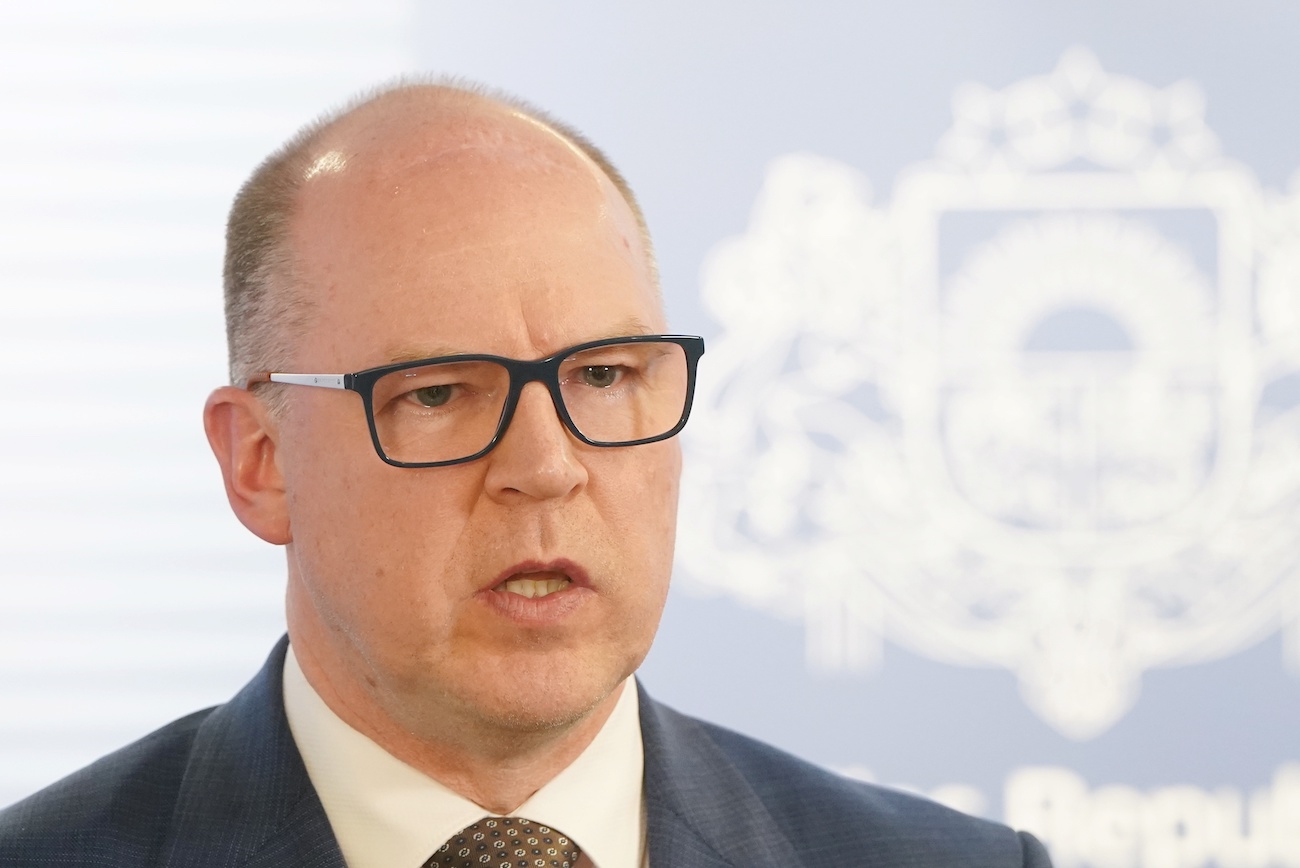
Latvia is struggling to uncover complex corruption schemes, and investigative authorities face a critical shortage of undercover operational officers, Prosecutor General Armīns Meisters said in an interview with LETA.
In his view, Latvia’s fight against corruption has remained largely unchanged in recent years, with little sign of meaningful improvement. He said this is one of the reasons why the Prosecutor’s Office has fundamentally changed its approach—from merely overseeing investigations to taking a leading role in initiating them. As an example, Meisters pointed to the ongoing investigation involving the timber industry, which originated from a review conducted by prosecutors.
At the same time, he stressed that the Prosecutor’s Office is not an operational investigative authority and cannot carry out covert investigative measures itself. Instead, it works together with the Corruption Prevention and Combating Bureau (KNAB) or, where necessary, other security agencies to gather evidence and conduct active investigative operations.
The Prosecutor General said it is unrealistic to expect personnel shortages and training challenges to be solved overnight. He noted that the problem affects not only KNAB but also the State Police, the State Security Service, and other investigative bodies. According to Meisters, all of them face the same challenge—there are simply not enough investigators, while the shortage of undercover operational officers is particularly severe.
“I’m not revealing anything new. This has been the case for several years, and there has been no noticeable progress,” Meisters said.
He expressed cautious optimism about the Internal Security Academy and other educational initiatives that could help train qualified investigators and operational officers.
According to Meisters, Latvia experienced a period of stronger anti-corruption enforcement in the past, but today investigations often focus on identifying minor weaknesses—such as careless disclosure of information or administrative violations—rather than dismantling complex corruption networks. Such cases may lead to officials losing their security clearance or facing liability for offences that are not directly related to corruption. In his view, this amounts to taking the “easy route” in fighting corruption.
“But we are simply unable to uncover the corruption schemes, the ‘spiders’, and everything else that undoubtedly exists in this country. We have to admit that, and the state must then decide which institution is capable of tackling this, how we recruit personnel, what resources we invest, and what we actually expect from these institutions,” the Prosecutor General said.
Although both the previous and the current governments have declared internal and external security to be national priorities, Meisters questioned whether politicians are truly willing to allocate the resources needed for anti-corruption work and operational investigations.
“It’s all there in public statements, policy documents and, to some extent, funding decisions,” he said.
However, when it comes to addressing practical problems, Meisters believes there is no clear action plan and no one willing to take responsibility.
He cited recent drone-related security incidents as an example.
“Everyone is doing something in a rather chaotic way, but there is no real solution, no readiness to take responsibility. People are waiting for a political signal, or simply waiting for someone else to act,” Meisters said.
According to the Prosecutor General, political declarations alone are not enough. They must be backed by concrete action, adequate resources, and a unified strategic approach that encourages cooperation between the country’s security and law enforcement agencies.
Read also: airBaltic cannot operate without state funding, Latvian PM demands business plan
Follow us on Facebook and X!