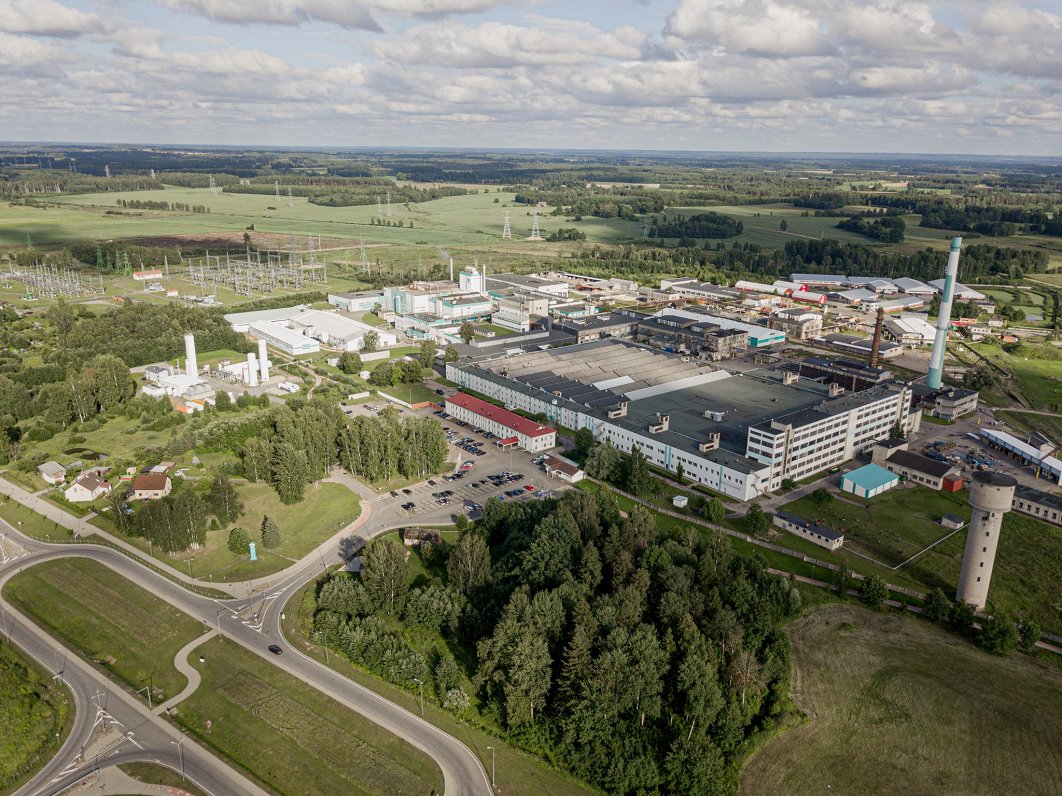
The instability of global markets, increasing competition and the slowdown in the pace of European industrial development are forcing exporting companies to reconsider their development directions.
One of the leading glass fibre producers in Europe, AS “Valmieras stikla šķiedra” (Valmiera glass fibre), is actively working on developing new export markets, as well as increasingly reorienting itself towards products with higher added value and niche products.
In an interview with LSM.lv, Ilmārs Lipskis, a member of the company’s board, outlined both the challenges and possible growth directions – from market redistribution to product portfolio restructuring.
“When it comes to the export situation in general, we are in the same boat as global events,” Lipskis said.
“Europe is our nominal home market, but if customer orders decline, we are directly affected.”
It is particularly significant that the company’s main customer segments – automotive and construction – are simultaneously experiencing a decline in Europe.
“Last year, we were affected by the stagnation of the European market. According to rough estimates, the European economy is based on automotive by 16-17%, and the construction segment is also significant. Last year, European automotive production experienced a strong decline, and even giants such as Audi were forced to close one of their production plants for the first time in their long history. Similarly, in construction, according to our customers’ estimates, we are talking about a ten percent decrease in Central Europe. Since the European segment is very large for us, this affects us directly, because the overall market demand is slowing down.”
The company is working to compensate for the loss of European exports. “That’s the task – to look in other countries, in other markets, for how we can compensate for market changes in Europe. The recent aggressive changes are forcing us to take action ourselves in the area of diversifying export markets,” explained Lipskis.
Global forces, local impact
In addition to Europe’s internal problems, global processes are having a significant impact. The US tariff policy against China has caused a chain reaction that directly affects the European market.
“America imposed aggressive tariffs on Chinese manufacturers, which gave them an additional incentive to seek new markets in Europe. As a result, we found ourselves in even more intensified competition with Chinese and Asian manufacturers in general,” said Lipskis.
This means that Asian manufacturers, losing competitiveness in the US market, are more actively moving their production to Europe. As a result, supply is increasing and price pressure is intensifying, especially in standardized product categories.
“If we look at the global map, we are a small player. We are the second largest in Europe, next to a Czech manufacturer, but on the global map we are still a small company. And with our cost structure, we cannot participate in the mass product market, where there are huge volumes.”
The pressure on prices has already led to decisions affecting the company’s product portfolio. One of them is a significant reduction in sales of standard glass fibre yarn (136 Tex), which is a widely used. A few years ago, the company sold thousands of tonnes of this yarn, but now the volumes have shrunk to a minimum, diverting the volume of fused glass to other products.
“We are unable to compete with the low prices from China. The price of standard threads for customers in Europe is often lower than our cost price, so we are trying to refocus on other products with higher added value,” admitted Lipskis.
Developing new directions a necessity
Given the volatility of the European market, the company is actively working on geographical diversification. “The long-term plan is to develop new markets to reduce risks,” Lipskis said.
The company has several regions in its sights: South America, where cooperation between the European Union and Mercosur countries can provide potential; North America, where it is possible to expand its presence in certain product groups; and North Africa, where the first deliveries have already taken place.
Uzņēmuma valdes loceklis Ilmārs Lipskis
Photo: Valmieras stikla šķiedra
Diversification is already yielding practical results, Lipsky said. Although the construction segment in Europe is experiencing a decline, the company has been able to not only offset losses but even increase sales of construction mesh in other markets.
“The market and demand are closely related to the end product application segment and industry. There are sectors that are developing, for example, aerospace, composite fabrics. We see that the market is strong there. The thermal insulation market is growing, due to increasing environmental impact and energy efficiency requirements. In these segments, glass fibre is one of the materials that is widely used.
“Meanwhile, we see a decline in construction and automotive construction. Depending on the country, the decline in demand for construction mesh in Europe reached as much as 20%, we compensated for it in other markets, overall with a plus sign. We have been able to sell five million square meters more construction mesh than a year ago. Thanks to the fact that we were able to attract new customers in Eastern Europe,” explained Lipskis.
Innovation and specialization aid competitiveness
The company’s development strategy is based on the production of higher value-added products. One of the most important directions is HR (high resistance) glass – a unique glass recipe with special physical and chemical properties.
“This year we are also launching the production of 96% and 98% silica glass, which is a military standard, and we are currently the only manufacturer in Europe that can offer this,” emphasized Lipskis.
The company is developing the production of high-silica glass, which is becoming increasingly in demand in several rapidly growing industries: electric vehicle construction for battery insulation; fire protection for flame suppression and fire containment; and the military industry as a component for various products due to the properties of fiberglass.
“We are developing various applications for these glasses – higher thermal resistance, resistance to acids, improved electrical conductivity,” he added.
Energy and geopolitics the main sources of uncertainty
The company’s operations are significantly affected by a number of external factors that cannot be predicted or controlled.
“Current events – the US-Iran war, tensions related to the Strait of Hormuz, the resulting fluctuations in oil prices, changing tariff policies, et cetera – have both a direct and indirect impact on the company. We can already observe the first signs – announcements of price increases by suppliers, as well as the nervousness of individual customers regarding the availability of materials,” Lipskis described. Customers who have actively cooperated with Asia are currently increasingly interested in the capabilities of “Valmieras stikla šķiedra”.
A particularly important factor, according to Lipskis, is energy prices. Glass production is an energy-intensive process, where gas and electricity make up a significant part of the costs. Even small price fluctuations can significantly affect profitability. In addition, there is an increase in transportation costs, which is associated with both fuel prices and global supply chains.
“Although we have secured long-term contracts, gas and electricity are an influencing factor. In glass melting, gas and electricity are two very large resources that we consume. Due to the impact of oil prices, delivery costs will certainly increase – both in land and container deliveries.”
This, in turn, may create the need to make price adjustments for customers, added the businessman.
Sustainability becoming a market standard
Sustainability requirements in exports are becoming increasingly stringent. “More and more customers are demanding it as a matter of course,” Lipskis pointed out. The company develops the principles of a circular economy: reuses production residues, reduces waste, and improves its resource efficiency. Such things are no longer just a matter of reputation – they are becoming a prerequisite for cooperation with large international clients.
“Although there are always production residues left over, we try to grind the fibers and reuse them in production. We have defined a number of further goals and projects to reduce production residues and environmental impact. This is the future, and these issues are becoming more and more relevant every year,” said Lipskis.
In the coming years, the company does not plan to significantly expand production capacity, but will focus on efficiency and productivity, as well as geographical diversification. The largest investments are related to the construction of glass melting furnaces, with an investment of approximately 11 million euros over two years. Last year, 4.2 million were invested, and the remaining amount is planned for this year.
At the same time, an internal reorientation is taking place: reducing the proportion of mass production, increasing the production of specialized products, optimizing costs and processes, and exploring new markets.
Workforce and financial outlook
Despite being one of the largest employers in the region, the company is facing a labour shortage. “Labour is an acute problem,” Lipskis admitted, pointing to the low unemployment rate in Vidzeme. Financially, 2025 was a difficult year – the company operated at a loss due to market fluctuations and rising costs. However, 2026 has started positively, and the company aims to return to profit while increasing turnover by approximately 5%.
“This year we want to work with a profit – we are looking at how to work more efficiently, how to reduce costs. At the same time, we are developing a portfolio of value-added products, increasing profit for each kilogramme sold. So more value-added products, moving away from the mass product market, exploring new markets and attracting new customers.”
Despite the political and economic instability in the world, the company’s results in the first months of this year have been successful, Lipskis said. The company plans to close 2026 with a turnover of 127 million euros, which is 5% more than last year. “We expect that the optimization of the product portfolio, business processes and expenses will allow us to significantly improve profitability indicators and close the year with a positive result,” Lipskis predicts.
The company has recovered from the legal protection process that was initiated in 2019 and for a while placed question marks over its future. The company initiated a legal protection process to restructure liabilities following financial losses incurred by its US manufacturing facility and avoid insolvency.
“We were able to meet the requirements of the legal protection process thanks to thoughtful business and financial planning and the best possible operating results in Valmiera under the current circumstances,” said Lipskis.
However, the most significant factor that ensured the possibility of terminating the legal protection process before the deadline set by law was the change of the controlling shareholder at the beginning of 2021. In February 2021, the Luxembourg fund “Duke” acquired a controlling stake in “Valmieras stikla šķiedra”. According to the company’s published information, “Duke” owns 97.18% of the company’s shares.
Attracting a new investor provided the opportunity to restructure the company’s debt and additional financing for investments and accelerated fulfillment of deferred liabilities before the deadline set in the legal protection plan. Unprofitable US assets were sold and liquidated, and a strategic investor was attracted. At the same time, production in Latvia and the UK continued without interruption.