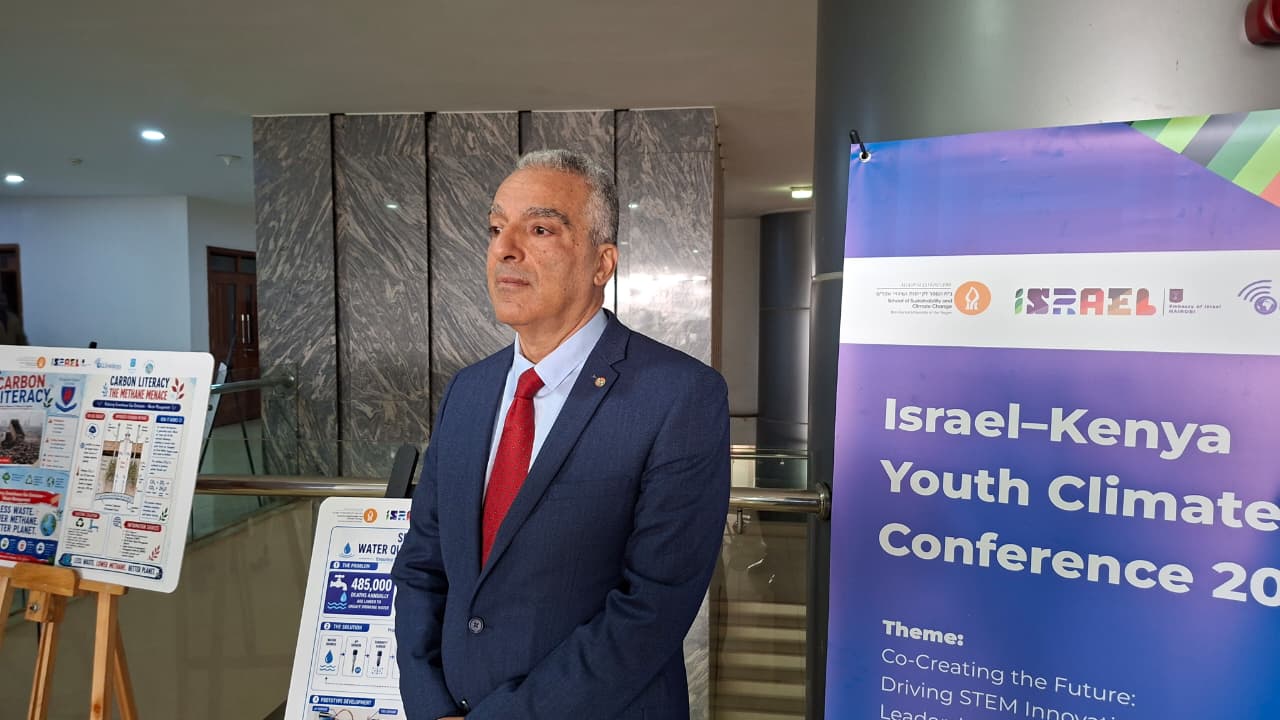
NAIROBI, Kenya, Jun 11 — The inaugural Kenya-Israel Youth Climate Conference has challenged young innovators to move beyond climate activism and develop practical, scalable solutions to some of the world’s most pressing environmental challenges.
Top officials have urged governments, investors, and institutions to support youth-led innovation to achive the new shift.
Held at the University of Nairobi, the conference brought together students from Kenya and Israel, climate experts, diplomats, and development partners in what organizers described as the beginning of a long-term movement aimed at transforming youth ideas into real-world climate solutions.
The event’s central message was clear: the climate crisis will not be solved through speeches and declarations alone, but through innovation that can be implemented, scaled, and adopted widely.
Israeli Ambassador to Kenya Gideon Behar, who officially opened the conference, challenged participants to focus on tangible outcomes rather than endless discussions.
“We need solutions, solutions, solutions,” Behar said. “I’ve been to many climate conferences and negotiations. People talk and talk, but the only way forward is to solve the problem.”
The ambassador described the conference as the start of a broader movement linking Kenyan and Israeli students to jointly develop climate solutions, with plans to eventually expand the initiative into a continental youth climate platform.
“We want this to become an African youth climate conference centred on solutions,” he said. “What we are doing here should be the launching pad for something much bigger.”
The event showcased projects developed by students from institutions including Starehe Boys Centre, Starehe Girls Centre, Maryhill Girls High School, Moi Forces Academy, and schools from Nakuru, Limuru, and Marsabit.
Notably, organizers revealed that a majority of the submitted projects were developed by female students pursuing science, technology, engineering, and mathematics (STEM) disciplines, highlighting the growing role of young women in climate innovation.
Representing the United Nations Environment Programme (UNEP), Rajiv Garg delivered a stark warning about the urgency of the climate crisis, citing increasing droughts, floods, biodiversity loss, and threats to food security across Africa.
However, Garg argued that young people are uniquely positioned to drive meaningful solutions.
“Climate innovation must move from inspiration to implementation, from prototypes to scale, and from individual ideas to collective impact,” he said.
He urged students to think beyond pilot projects and focus on innovations capable of reaching millions of people.
“If you are working on clean energy, think about how your ideas can reach communities that need reliable and affordable power. If you are working on agriculture, think about how farmers can adapt to drought and changing rainfall patterns.”
Garg also highlighted the immense untapped potential among young innovators, noting that a recent UNEP innovation challenge in Kenya attracted more than 3,000 applications.
According to UNEP, the world remains on a pathway toward a temperature increase of between 2.6°C and 3.1°C despite current climate commitments, underscoring the need for accelerated action and investment.
The conference also highlighted growing educational ties between Kenya and Israel.
Addressing participants virtually, Rafaela Babish, Israel’s National Coordinator for Climate Change Education and climate education coordinator at the Israeli Ministry of Education, said the partnership demonstrates how young people from different countries can collaborate despite geographical and cultural differences.
“Climate change is a global challenge, but it is also an opportunity for young people to lead, innovate, and inspire,” she said.
Beyond the conference itself, organizers unveiled ambitions to transform the initiative into a continental platform for climate innovation.
Ambassador Behar proposed digitizing the student exhibitions and sharing them across Kenya, Israel, and eventually the wider African continent.
He also floated the idea of establishing an Africa-wide youth climate conference and annual competition focused on climate solutions rather than climate rhetoric.
“We want this conference to develop into something bigger, into a youth movement that tackles climate change,” Behar said.
“We need to move beyond slogans to real solutions that farmers, businesses, and governments can adopt.”
Behar said some of the ideas presented during the conference were already worthy of further investment and expansion.
“As an expert in climate change, I can tell you some of the solutions presented here deserve to be scaled up and given more attention,” he said.
Responding to concerns about financing, the ambassador argued that viable ideas naturally attract investment.
“When you have practical solutions, people invest in them. There is enough money in this world. It has to be channelled to the right places.”
The conference concluded with calls for stronger collaboration among governments, universities, the private sector, and development partners to support youth-led climate innovation and accelerate the deployment of climate solutions.