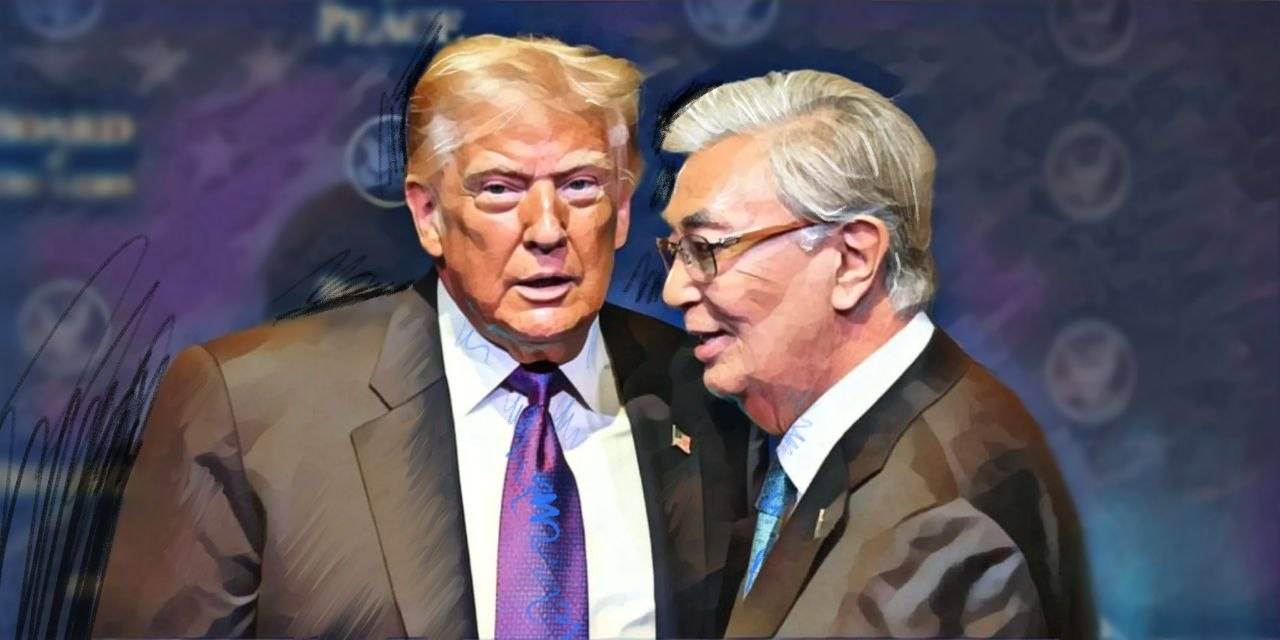
Investment, nuclear security and a possible visit to Kazakhstan featured in a July 10 telephone call between Kazakh President Kassym-Jomart Tokayev and U.S. President Donald Trump.
Tokayev began by congratulating Trump on the 250th anniversary of U.S. independence. He noted that the United States had become a global superpower within three generations and expressed support for what Akorda described as the Trump administration’s “common-sense policies”.
The Kazakh president also said those policies aligned with his own vision of building a Just Kazakhstan based on law and order. The language reflected the increasingly warm tone of the relationship and Tokayev’s effort to engage Trump through themes of national strength, order and economic achievement.
The discussion soon turned to results. Tokayev reported progress in implementing agreements reached during his November 2025 visit to Washington. During that visit, Kazakh and U.S. partners announced 29 deals and cooperation initiatives worth nearly $17 billion, according to Kazakh officials. They included a planned $1.1 billion tungsten project involving U.S.-based Cove Capital.
Kazakhstan’s scale gives the relationship wider strategic weight. By far Central Asia’s largest economy, it accounted for 56.4% of the combined GDP of the region’s five states in 2025, based on World Bank data. Kazakhstan also held 66.4% of Central Asia’s inward foreign direct investment stock at the end of 2025, according to UNCTAD.
Its importance to the United States and its allies is equally concrete. Kazakhstan-origin material accounted for 24% of foreign-origin uranium deliveries to U.S. civilian nuclear-power operators in 2024, second only to Canada, according to the U.S. Energy Information Administration. Kazakhstan also accounted for 12.7% of the value of the European Union’s crude petroleum-oil imports from outside the bloc in 2025, behind only the United States and Norway, according to Eurostat.
That economic and strategic weight helps align the priorities of the two governments. Washington wants dependable sources of critical minerals and more resilient supply chains. Kazakhstan wants American capital and technology to expand processing, manufacturing and higher-value production. The November package provided a framework for moving the relationship from political interest toward concrete commercial projects.
Senator Steve Daines has helped sustain that momentum. Akorda specifically mentioned Tokayev’s recent meeting with Daines, alongside his contacts with U.S. Special Envoy for South and Central Asia Sergio Gor, other White House officials and American business leaders.
Daines has become one of Washington’s leading advocates for closer engagement with Kazakhstan and the wider Caspian region. In a June speech on U.S. relations with the region, he called for new mines, upgraded infrastructure and artificial-intelligence investment. He also pressed Congress to repeal the Jackson–Vanik restrictions still affecting Central Asia. For Kazakhstan, the lingering Cold War-era measure leaves normal trade relations subject to annual review rather than permanent status. Its removal would provide greater political certainty for long-term American investment.
The most strategically significant language in the Akorda readout concerned nuclear non-proliferation. Tokayev reaffirmed Kazakhstan’s commitment to “non-proliferation of nuclear weapons and enriched uranium” and stressed close collaboration with the International Atomic Energy Agency to ensure effective international oversight.
Iran was not named, so any connection remains an inference. The surrounding diplomacy nevertheless gives Tokayev’s wording immediate relevance to the Iranian nuclear issue. IAEA Director General Rafael Grossi has said that Kazakhstan indicated a willingness to receive Iran’s stockpile of uranium enriched to 60% if Washington and Tehran reach a political agreement governing the material.
Kazakhstan has strong non-proliferation credentials. It renounced its Soviet-era nuclear arsenal, transferred the warheads to Russia and dismantled associated infrastructure with U.S. assistance under the Nunn–Lugar program. It later hosted two rounds of P5+1 talks with Iran in Almaty in 2013 and supplied Iran with 60 metric tons of natural uranium as part of the internationally coordinated implementation of the 2015 nuclear agreement. Kazakhstan also hosts the IAEA Low Enriched Uranium Bank at the Ulba Metallurgical Plant. The Times of Central Asia examined that record and its possible application to Iran.
The existing bank could not simply accept Iran’s 60%-enriched uranium. Its mandate applies to low-enriched material held as an assurance-of-supply reserve for peaceful nuclear power. Any arrangement involving the Iranian stockpile would therefore require a separate legal and technical framework.
Even so, Kazakhstan could offer a politically workable location and help the IAEA implement an agreement. Tokayev’s reference to enriched uranium signaled Astana’s readiness to play that role if Washington and Tehran reach a deal.
At the conclusion of the call, Tokayev renewed his invitation for Trump to visit Kazakhstan. He had extended the same invitation during their December 2025 conversation, when he said such a visit would carry historic significance.
No sitting American president has visited any of the five Central Asian states. Trump would become the first, establishing a new benchmark for American engagement with the region. He has already said that he does not rule out visiting Kazakhstan and praised the country’s natural resources and its president. The Times of Central Asia reported his remarks following the November summit.
A visit would allow both presidents to demonstrate the progress made in investment, critical minerals, energy security and diplomacy. It could also follow Tokayev’s expected attendance at the U.S.-hosted G20 summit in Miami. Trump has invited Tokayev to attend the summit, further raising Kazakhstan’s profile in Washington.
The July 10 call reflected a relationship increasingly defined by practical cooperation. Tokayev presented Kazakhstan as a partner capable of delivering commercial projects, strengthening mineral and energy supply chains and contributing to nuclear security. Trump has elevated Central Asia’s place in American diplomacy and focused the relationship on trade, investment and peace.
A visit to Kazakhstan would give that progress its clearest public expression.